

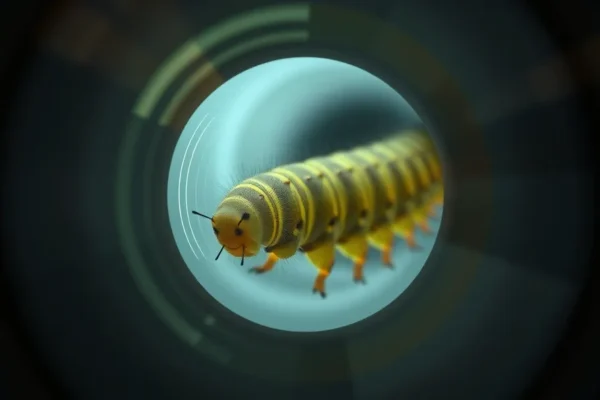
Nature’s Tiny Listeners How Caterpillars Hear Without Ears Could Revolutionize Microphones
Imagine a world where even the faintest whisper can be detected, not by bulky equipment, but by incredibly sensitive, almost invisible sensors. This isn’t science fiction; it’s the emerging reality inspired by one of nature’s most unlikely sound detectors: the caterpillar. Recent scientific research has unveiled the astonishing ability of these larvae to perceive sound, not through specialized ears, but via a sophisticated sensory system distributed across their bodies. This groundbreaking discovery in insect hearing is paving the way for entirely new approaches to microphone technology, promising a future of highly sensitive, exceptionally quiet sound perception.
Unlocking the Secrets of Caterpillar Hearing
The ability of caterpillars to detect sound without conventional ears is a testament to the diverse strategies life employs for survival. For these small creatures, sound can signal danger, like the approach of a predator, or identify potential food sources. The scientific research, notably conducted by a team at the University of Bristol led by Dr. Ben Ronacher and his colleagues, focused on understanding this unusual sensory biology. Their findings, published in journals such as Current Biology, revealed that caterpillars possess a network of tiny, hair-like structures and specialized cells that respond to airborne vibrations. This is significant because it challenges our traditional understanding of how animals perceive auditory information. Instead of a centralized ear structure, caterpillars utilize a distributed system, effectively turning their entire bodies into a sound-sensing organ.
The Ingenious Mechanism of Sound Perception
So, how exactly do these creatures “hear” without ears? The core mechanism lies in their delicate body hairs and associated nerve endings. Think of it like this: imagine a field of tiny microphones spread across a surface. When sound waves, which are essentially vibrations in the air, hit the caterpillar’s body, they cause these microscopic hairs to move. Each movement is then translated into an electrical signal by specialized sensory cells located at the base of these hairs. These signals are then transmitted to the caterpillar’s nervous system, allowing it to perceive the presence and direction of sound. This is a form of bioacoustics, the study of sound production and reception in animals. Researchers used ultraquiet chambers to meticulously isolate and test the caterpillars’ responses to various frequencies and intensities of sound, confirming that these structures are indeed responsible for sound perception.
Early Glimmers of Application in Microphone Technology
While caterpillars are not yet being deployed as miniature listening devices, the scientific research into their hearing mechanisms is already sparking innovation in microphone technology. The primary problem this natural phenomenon addresses is the limitation of current microphones, which often struggle with detecting very faint sounds or are susceptible to background noise. The distributed and sensitive nature of a caterpillar’s sensory system offers a blueprint for developing new types of acoustic sensors. Imagine microphones that are incredibly sensitive, capable of picking up the subtlest sounds, or sensors that can filter out unwanted noise by processing vibrations from multiple points simultaneously. This could have a profound impact on fields requiring high-fidelity sound capture, such as advanced surveillance, medical diagnostics (e.g., listening to heartbeats or lung sounds), and even enhanced robotics, allowing machines to “hear” their environment with unprecedented detail.
Who Else is Listening: The Competitive Landscape
The quest for more sensitive and sophisticated microphones is a broad and active area of technological development, and it’s not solely inspired by insects. Researchers worldwide are exploring various bio-inspired approaches to sensor technology. For instance, companies are developing microphones based on graphene, a single layer of carbon atoms known for its extreme sensitivity to vibrations. Other research delves into mimicking the auditory systems of bats or birds, known for their exceptional hearing capabilities. However, the caterpillar’s approach offers a unique advantage: its simplicity and distributed nature could lead to more robust and cost-effective designs compared to some of the more complex bio-mimetic systems. While other technologies might focus on mimicking specific ear structures, the caterpillar’s distributed sensory network provides a fundamentally different model for sound perception that could be easier to replicate in artificial systems.
Reshaping Our Sonic World Implications and Impact
The implications of mimicking caterpillar hearing are far-reaching. In the short term, we can expect to see advancements in specialized acoustic monitoring equipment. For example, environmental scientists could deploy highly sensitive sensors to study subtle animal communication or monitor delicate ecosystems without disturbing them. In the longer term, this could lead to consumer electronics with vastly improved audio capture capabilities. Picture smartphones that can record conversations in noisy environments with crystal clarity or virtual reality systems that offer truly immersive auditory experiences. Economically, this could spawn new industries focused on bio-inspired sensor design and manufacturing, creating new jobs in engineering and research. Socially, it could enhance accessibility for individuals with hearing impairments by providing more sophisticated assistive listening devices.
The Hurdles Ahead: Limitations and Challenges
Despite the exciting potential, translating the caterpillar’s natural hearing into practical technology faces significant hurdles. The primary challenge is replicating the intricate biological mechanisms in a synthetic form. The precise coordination between the sensory hairs, specialized cells, and neural pathways in a caterpillar is incredibly complex and not fully understood. Furthermore, scaling down these biological systems into miniaturized, mass-producible microphones requires significant engineering innovation. Cost is also a factor; developing and manufacturing entirely new types of sensors can be prohibitively expensive in the early stages. Finally, the robustness of these new sensors in various environmental conditions, such as extreme temperatures or humidity, needs to be rigorously tested and proven. Currently, this technology is in its nascent research phase, with no commercial products available yet.
The Horizon of Sound Perception Future Trajectory
The future trajectory of this research points towards the development of highly versatile and adaptable acoustic sensors. We can anticipate continued scientific research aiming to fully map the neural pathways and molecular mechanisms involved in caterpillar hearing. This deeper understanding will inform the design of artificial sensors. Key developments to watch will include breakthroughs in micro- and nano-fabrication techniques that can precisely mimic the structure of caterpillar sensory organs. Researchers are also exploring computational models that can simulate the signal processing capabilities of these natural systems. While a timeline for commercial availability is difficult to pinpoint, it is likely to be several years, perhaps even a decade, before we see consumer-level products directly inspired by caterpillar hearing.
Key Questions About Caterpillar Hearing and Microphone Technology
What exactly is caterpillar hearing?
Caterpillar hearing refers to the research into how caterpillars perceive sound using specialized body hairs and sensory cells, rather than traditional ears. This allows them to detect airborne vibrations.
How does this research relate to microphone technology?
The distributed and sensitive nature of caterpillar sensory systems provides a blueprint for developing new types of microphones that could be more sensitive, less noisy, and potentially more robust.
Is this technology currently available?
No, this technology is still in the early stages of scientific research. There are no commercial products available yet that directly mimic caterpillar hearing.
Who is behind this research?
Key research in this area has been conducted by institutions such as the University of Bristol, with significant contributions from scientists like Dr. Ben Ronacher.
What are the potential benefits of this new microphone technology?
Potential benefits include vastly improved sound capture in noisy environments, enhanced sensitivity for medical diagnostics, advanced robotics, and more immersive audio experiences.
What are the main challenges in developing this technology?
The primary challenges include understanding and replicating the complex biological mechanisms, miniaturization, cost-effective manufacturing, and ensuring durability in various environmental conditions.
It is important to note that the research into caterpillar hearing and its application to microphone technology is ongoing. The information presented here reflects the current state of scientific understanding and future potential based on published research and expert analysis. As with many emerging technologies, timelines and capabilities may evolve.











