

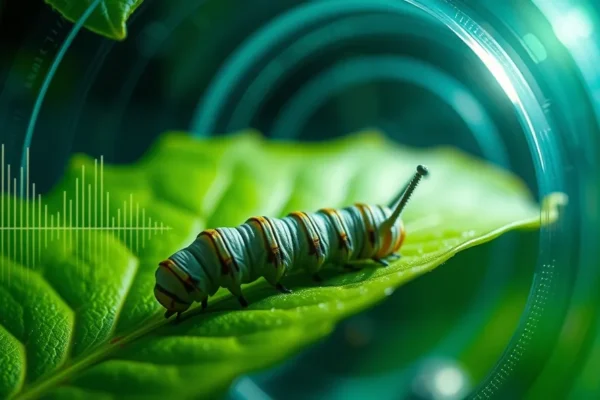
The Silent World of Caterpillars Offers a Blueprint for Better Microphones
Imagine a world of sound so delicate that a whisper is a roar. This is the reality for many insects, and groundbreaking research into caterpillar hearing, conducted in meticulously quiet chambers, is unlocking secrets that could revolutionize our microphone technology. Scientists are looking to these tiny creatures, studying their unique ways of detecting vibrations, to engineer more sensitive and versatile sound-capture devices for a range of applications. This scientific discovery, focused on understanding caterpillar hearing, is a prime example of how nature can inspire technological leaps.
Unraveling the Mystery of Insect Acoustics
For decades, scientists have been fascinated by how insects perceive sound. Unlike humans, who rely on complex ear structures, many insects detect sound through their bodies or specialized organs that are far less obvious. The recent research delving into caterpillar hearing is particularly intriguing because it challenges our assumptions about what constitutes a “hearing” mechanism. By placing caterpillars in an ultraquiet chamber, researchers could isolate and study the subtle vibrations these larvae respond to. This approach, often referred to as studying insect acoustics or bioacoustics, aims to understand the fundamental principles of sound detection in organisms that have evolved in environments vastly different from our own. The problem this research addresses is the limitation of current microphone technology, which can be bulky, power-hungry, and not always sensitive enough for certain detection tasks.
How Tiny Bristles Tune into Sound
The key to understanding caterpillar hearing lies in their bodies themselves. Caterpillars, as many of us know, are covered in small hairs or bristles. Scientists discovered that these bristles are not just for touch; they act as tiny antennas, vibrating in response to airborne sound waves. Think of it like a field of grass swaying in the wind. Each blade of grass is a bristle, and the wind is the sound. The researchers found that different bristles on the caterpillar’s body vibrate at different frequencies, essentially creating a natural spectrum analyzer. This allows the caterpillar to differentiate between various sounds. When sound waves hit these bristles, they create minute movements. These movements are then transmitted through the caterpillar’s body to sensory neurons, which send signals to the brain. This sophisticated system allows them to detect threats, find food, or locate mates using sound cues without possessing conventional ears. The scientific discovery here is that this distributed sensory system, relying on the mechanical properties of bristles, can be far more sensitive and less prone to damage than a single, complex ear structure.
From Caterpillars to Cutting-Edge Microphones
This pioneering research, primarily conducted by teams at institutions like the University of Oldenburg in Germany and published in journals such as Current Biology, is moving beyond the laboratory. The goal is to translate this natural sound detection mechanism into improved microphone technology. Imagine microphones that are incredibly sensitive, capable of picking up the faintest sounds, much like a caterpillar detects the rustle of a predator. This could have profound real-world applications. For instance, in medical diagnostics, ultra-sensitive microphones could detect subtle bodily sounds that are currently missed, leading to earlier disease detection. In environmental monitoring, they could pick up the faint calls of endangered species or the early warning signs of geological activity. Even in consumer electronics, this could lead to microphones that perform better in noisy environments, making voice commands more reliable or enabling richer audio recordings. Currently, this is largely in the research and development phase, with early prototypes being explored by materials scientists and acousticians.
Beyond the Caterpillar: The Broader Field of Bioacoustics and Sound Detection
The work on caterpillar hearing is part of a larger scientific endeavor in bioacoustics, the study of sound production and reception in animals. Other researchers are exploring how other arthropod senses, like the hearing organs in crickets or the vibration sensors in spiders, can inspire new technologies. For example, research into bat echolocation has already led to advancements in sonar and ultrasonic imaging. While current microphone technology relies on various principles, such as condenser or dynamic elements that convert sound waves into electrical signals, the caterpillar approach offers a different paradigm. Instead of a diaphragm, future microphones inspired by caterpillars might use arrays of microscopic vibrating elements, mimicking the bristles, to capture sound with unprecedented fidelity. This approach could also lead to more robust microphones, less susceptible to dust or moisture, as the insect-inspired design is inherently simpler and more distributed.
Reshaping Sound Capture and Beyond
The implications of successfully mimicking caterpillar hearing mechanisms are far-reaching. In industries where noise pollution is a challenge, such as advanced manufacturing or urban planning, these new microphones could allow for more precise noise mapping and mitigation strategies. For search and rescue operations, enhanced sound detection could help locate individuals buried under rubble by picking up the faintest sounds. Economically, this could spur innovation in the audio technology sector, creating new markets for highly sensitive sensors and acoustic devices. Socially, it could improve accessibility for individuals with hearing impairments by providing more sophisticated assistive listening devices. The timeline for widespread adoption is likely still several years away, with significant engineering challenges to overcome. However, the fundamental scientific discovery in caterpillar hearing provides a clear and exciting path forward.
The Engineering Hurdles: From Bristles to Circuits
Despite the promise, significant limitations and challenges remain. Replicating the intricate mechanical sensitivity of caterpillar bristles with artificial materials is a complex engineering feat. The precise tuning of these artificial “bristles” to capture a wide range of sound frequencies, as elegantly done by nature, requires advanced material science and microfabrication techniques. Furthermore, translating the subtle neural signals that a caterpillar’s body interprets into a usable electronic output for our devices is another hurdle. Current microphone technology, while not as sensitive in all aspects, is mature, cost-effective, and widely available. Developing artificial systems that can match or exceed the natural efficiency and robustness of caterpillar hearing will require sustained research and investment. There’s also the challenge of miniaturization; creating an array of these microscopic sensors that is both effective and economical to produce at scale.
The Road Ahead: Next Steps in Bio-Inspired Acoustics
The future trajectory for this research points towards continued exploration of insect acoustics and the development of bio-inspired sensors. We can expect to see more sophisticated laboratory experiments that map the precise responses of caterpillar bristles to various sound stimuli. This will likely be followed by the creation of more complex artificial arrays that mimic these bristle systems. The development of new piezoelectric or microelectromechanical systems (MEMS) materials that can accurately translate vibrations into electrical signals will be crucial. Key developments to watch include advancements in nanoscale manufacturing, which will enable the creation of intricate vibrating elements, and improvements in signal processing algorithms that can interpret the complex data from these new sensor arrays. While it’s difficult to pinpoint an exact timeline, we might see early-stage commercial applications emerge within the next five to ten years, initially in specialized scientific or industrial fields before potentially reaching consumer markets.
Frequently Asked Questions About Caterpillar Hearing and New Microphones
What exactly is caterpillar hearing?
Caterpillar hearing refers to the scientific study of how caterpillars detect sound vibrations through specialized bristles on their bodies, rather than through conventional ears. This research explores their unique mechanisms of sound detection.
How is this research related to insect acoustics?
This research is a significant part of insect acoustics, which is the broader scientific field dedicated to understanding how insects produce, perceive, and use sound in their environment. Studying caterpillar hearing helps unlock broader principles of arthropod senses.
What is the main advantage of this bio-inspired approach to microphone technology?
The primary advantage is the potential for creating significantly more sensitive and potentially more robust sound detection devices, inspired by the efficient vibration-sensing capabilities of caterpillars.
When will microphones inspired by caterpillar hearing be available?
Currently, this technology is in the early research and development phase. While prototypes are being explored, widespread commercial availability is likely several years away, perhaps within the next decade.
Are there any competing approaches to improving microphone technology?
Yes, competing approaches include further advancements in existing MEMS microphone technology, as well as exploring other natural sound detection methods and novel acoustic materials.
What are the potential real-world applications of this technology?
Potential applications range from enhanced medical diagnostics and environmental monitoring to improved communication devices and advanced surveillance systems, leveraging advanced sound detection.
This article is based on ongoing scientific research into insect acoustics and bioacoustics. While the findings are promising, the translation of this research into practical, widely available technologies is still in its early stages and faces significant engineering challenges.











