

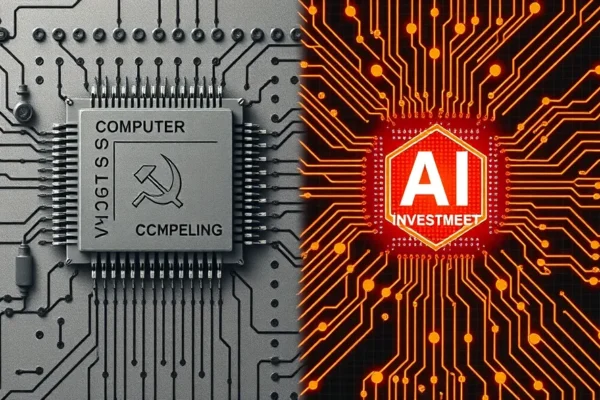
China’s State Media Cries “Cold War Tactic” Over AI Slowdown Claims, While Z.AI Fuels Global AI Funding Frenzy
A curious narrative has emerged in the global technology discourse, pitting accusations of a deliberate “AI slowdown” against a surging wave of investment in artificial intelligence. China’s state media has recently framed concerns about potential AI development caps as a “Cold War tactic” orchestrated by Western nations. This framing directly contrasts with significant private sector moves, such as the substantial $5 billion funding round secured by Z.AI, a burgeoning AI company, aimed at accelerating its AI development. This juxtaposition highlights the complex geopolitical currents influencing the race for AI dominance and the contrasting strategies being employed by different actors.
The Contrasting Moves: Accusations vs. Acceleration
The genesis of this discussion lies in recent commentary from Chinese state media outlets. Reports citing these outlets have interpreted discussions within Western tech circles and regulatory bodies about the potential risks of unchecked AI advancement and the need for careful development as an intentional effort to hinder China’s progress. This perspective suggests that claims of an “AI slowdown” are not genuine concerns about safety or ethics but rather a strategic maneuver to maintain a technological advantage. For instance, a report from Global Times, a prominent Chinese state-run newspaper, highlighted these concerns as a manifestation of a “tech Cold War.”
In stark contrast, the private sector is demonstrating a fervent commitment to accelerating AI development. Z.AI, a relatively new entrant in the artificial intelligence space, announced a colossal $5 billion funding round in late 2023. This significant technology investment, sourced from a consortium of venture capital firms and sovereign wealth funds, is explicitly earmarked for speeding up AI research, expanding its talent pool, and enhancing its AI infrastructure. This move signals a strong conviction in the market potential of AI and a race to achieve breakthroughs, rather than a pause.
The Strategic Rationale Behind the Divergent Paths
The strategic rationale behind China’s state media’s framing appears rooted in a desire to counter any perceived Western attempts to stifle its technological ascent, particularly in the critical field of artificial intelligence. By labeling discussions about an “AI slowdown” as a “Cold War tactic,” the intent is to galvanize domestic innovation, rally national sentiment, and potentially dismiss external calls for caution as protectionism. This narrative aims to foster an environment where rapid AI development is seen as a national imperative, directly challenging any external efforts to impose limitations or slow the pace of innovation, thereby safeguarding China’s position in the geopolitical tech landscape.
On the other hand, Z.AI’s massive funding round reflects a classic Silicon Valley growth strategy driven by the pursuit of market leadership and technological advancement. The company’s leadership, supported by its investors, believes that the future belongs to those who can develop and deploy more advanced AI capabilities faster than their rivals. The $5 billion in AI funding is intended to create a significant competitive moat, enabling Z.AI to attract top AI talent, invest heavily in proprietary research and development, and scale its AI solutions across various industries. This strategy is predicated on the belief that the economic and strategic advantages of leading in AI will far outweigh any potential short-term risks, thus driving rapid AI development.
Competitive Landscape: A Race for Dominance
This divergence in narrative and action creates a fascinating competitive dynamic. If China perceives Western calls for an “AI slowdown” as a genuine impediment, it could embolden its companies to push forward aggressively, potentially widening any existing gaps in certain AI applications. This could disadvantage Western companies if they adhere strictly to more cautious development timelines due to regulatory or ethical considerations. Conversely, Z.AI’s substantial funding and aggressive expansion plans position it as a significant challenger, not only to established AI giants like Google and OpenAI but also to emerging players globally. The massive infusion of capital allows Z.AI to potentially out-innovate and out-spend competitors, capturing market share and talent.
The broader competitive positioning sees the United States and its allies navigating a complex balance between fostering innovation and ensuring AI safety. China, meanwhile, appears to prioritize rapid advancement, potentially viewing it as a key differentiator in the global power balance. The success of companies like Z.AI, fueled by significant technology investment, could further intensify this competition, forcing other players to accelerate their own AI funding and development efforts to avoid being left behind. This creates a high-stakes environment where every funding round and every research breakthrough has significant competitive implications.
Industry Implications: Reshaping the AI Frontier
The contrasting narratives signal deeper industry trends. The emphasis on “AI slowdown” versus accelerated development highlights a growing divide in how the global AI industry perceives and manages risk. The substantial AI funding poured into companies like Z.AI suggests that the market consensus among investors remains overwhelmingly bullish on AI’s potential, driving significant capital into the sector. This influx of financial resources will likely accelerate the pace of innovation, leading to more sophisticated AI models and a wider array of AI applications appearing in the market sooner than anticipated.
Industry peers are likely to respond in several ways. Those primarily focused on AI safety and ethical development may face pressure to demonstrate tangible progress in their cautious approach, while also finding ways to accelerate their own research. Companies that are heavily invested in rapid development, akin to Z.AI’s strategy, will likely seek to capitalize on this funding environment, potentially leading to consolidation as larger players acquire promising startups or smaller companies struggle to keep pace. This dynamic could reshape the competitive landscape, creating clear leaders and a more segmented market based on speed of innovation and risk appetite.
Financial and Operational Impact: A Boost for AI Investment
The $5 billion in AI funding for Z.AI represents a significant financial injection that will directly impact its operational capacity. This capital will be deployed to scale up computing power, acquire specialized hardware, invest in research and development facilities, and attract top-tier AI researchers and engineers. Financially, this could translate into increased operational costs in the short term but is strategically aimed at generating substantial future revenue streams by enabling the development of highly competitive AI products and services. For Z.AI, this is a long-term play to build a dominant position in the artificial intelligence market.
While the direct financial impact on China from the “AI slowdown” narrative is less quantifiable, the sentiment could influence national investment priorities and the allocation of state resources towards AI research and development, aiming to counter any perceived Western restrictions. The potential for increased competition and accelerated innovation globally could also lead to greater demand for AI-related hardware and services, benefiting semiconductor manufacturers, cloud computing providers, and data analytics firms. The short-term financial impact is thus one of increased investment and expenditure across the board for companies aiming to lead in AI.
Execution Risks and Challenges Ahead
Despite the optimism surrounding significant AI funding, execution remains a critical challenge. For Z.AI, the $5 billion is a substantial resource, but its effective deployment is not guaranteed. The company faces the risk of misallocating capital, failing to attract and retain the best AI talent in a highly competitive market, or encountering unforeseen technical hurdles in developing advanced AI systems. The history of technology investment is replete with examples of well-funded ventures that ultimately failed to deliver on their promises due to poor execution or shifting market dynamics. Moreover, the rapid pace of AI development means that even significant investments can quickly become outdated if innovation slows or is surpassed by competitors.
In the context of China, the effectiveness of its state-driven AI strategy hinges on its ability to foster genuine innovation rather than simply directing resources. There’s a risk that a narrative focused on countering external pressure could lead to a less critical and potentially less innovative environment, where the pursuit of speed overshadows fundamental research or ethical considerations. Furthermore, geopolitical tensions could lead to trade restrictions or supply chain disruptions, impacting both Chinese and Western AI development efforts. The organizational and operational challenges for any large-scale AI initiative are immense, requiring robust management, agile development processes, and a clear understanding of market needs.
Stakeholder Implications: Shifting Dynamics in AI
The implications for stakeholders are diverse. For employees at companies like Z.AI, the substantial funding offers opportunities for career advancement and involvement in cutting-edge projects. However, it also implies a potentially demanding work environment driven by aggressive timelines. Customers could benefit from faster access to more advanced AI technologies, leading to improved products and services across various sectors. Investors in Z.AI are betting on significant future returns, driven by market leadership, while investors in the broader AI sector may see increased volatility and opportunity.
For employees in China’s AI sector, the state media’s narrative could foster a sense of national purpose, potentially driving increased dedication. However, it might also create pressure to conform to state-aligned goals. The global implications suggest a reshaping of the talent landscape, with intense competition for skilled AI professionals. Customers worldwide will likely experience the accelerating pace of AI deployment, with new tools and applications becoming available more rapidly. Investor sentiment in the technology sector will likely remain buoyant, with AI continuing to be a primary focus for capital allocation, though scrutiny on actual performance and execution will increase.
Outlook and Next Steps: Monitoring the AI Race
If Z.AI’s strategy succeeds, we can expect to see a rapid rollout of novel AI products and services from the company, potentially disrupting existing markets and setting new benchmarks for AI performance. Key milestones to watch would include significant product launches, the acquisition of notable AI talent, and the expansion of its customer base. Measurable outcomes could be reflected in market share gains, revenue growth, and its valuation in subsequent funding rounds or potential IPO. The timeline for such outcomes could range from 18-36 months to see significant market impact, with continued evolution thereafter.
For the broader narrative concerning China and the “AI slowdown,” the next steps involve observing whether Western nations indeed implement any form of AI regulation or if the discourse remains largely at the discussion stage. If concrete regulatory measures are enacted, it will be crucial to see how China responds and whether its aggressive development continues unabated. Monitoring the actual pace of AI advancement from both sides, as well as international collaboration or lack thereof, will be key indicators. Significant technological breakthroughs from any major player will likely shift the global conversation and prompt further investment and competitive responses.
Key Questions and Answers on China, AI Slowdown, and Z.AI Funding
Will China’s state media claims about an “AI slowdown” as a “Cold War tactic” impact global AI development?
This narrative could influence national priorities in China, potentially leading to increased state-backed investment and a focus on rapid domestic AI development. It may also embolden Chinese companies to accelerate their efforts, creating a more competitive environment for global AI firms.
How does Z.AI’s $5 billion in AI funding contrast with the idea of an AI slowdown?
Z.AI’s substantial funding represents a direct investment in accelerating AI development, actively pushing the boundaries of artificial intelligence. This contrasts sharply with any notion of a widespread, intentional pause, indicating a strong market belief in continued rapid progress and the pursuit of AI dominance.
What are the primary risks for Z.AI in its aggressive AI development strategy?
The primary risks for Z.AI include intense competition, the difficulty of attracting and retaining top AI talent, the potential for technological obsolescence due to rapid innovation, and the challenge of effectively deploying its significant capital to achieve its ambitious goals.
Why might China view Western discussions about an AI slowdown as a “Cold War tactic”?
China might perceive these discussions as an attempt by Western nations to deliberately impede its technological progress, particularly in a strategically vital area like AI, thereby seeking to maintain their own global technological leadership through indirect means rather than direct competition.
How long until we see measurable outcomes from Z.AI’s $5 billion AI funding?
While immediate operational expansions are likely, significant market impact and measurable financial outcomes such as substantial revenue growth or market share gains typically take 18-36 months to materialize in the fast-paced AI sector.
What are the broader implications of this geopolitical tech competition for the artificial intelligence industry?
This competition could lead to accelerated innovation, increased investment in AI research and development globally, and a potential fragmentation of AI standards or approaches. It also highlights the intertwined nature of technological advancement and international relations.
Business outcomes are subject to execution risk and market dynamics.











