

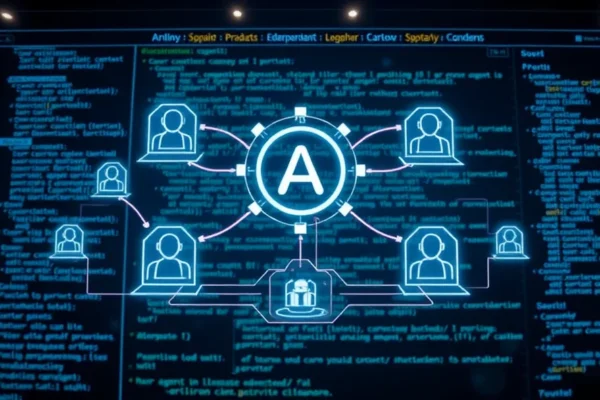
Claude Code’s new Projects feature, allowing multiple AI agents to collaborate, marks a significant step in how we approach complex tasks, particularly in software development. This innovation moves beyond single AI assistants to create a coordinated team, capable of tackling larger, more intricate challenges by working together, sharing information, and dividing labor. Announced recently by Anthropic, the company behind Claude, this development addresses the growing need for more sophisticated AI assistance in fields demanding intricate workflows and iterative problem-solving.
Unlocking Teamwork for AI Agents
For years, we’ve interacted with AI as individual assistants. You ask a question, it answers. You ask it to write code, it does. But what happens when a project requires multiple, specialized skills, or when a task is too big for one AI to handle efficiently? This is the problem Claude Code’s new Projects feature aims to solve. It allows distinct AI agents, each potentially with specialized expertise, to function as a cohesive unit. They can operate with shared goals, maintain a common understanding of the project’s progress through shared memory, and even work on different parts of a task simultaneously. This is a fundamental shift from solo AI performance to AI teamwork.
The significance of this announcement lies in its direct applicability to complex, multi-step processes. Think of building a new piece of software, debugging a large system, or even conducting intricate research. These tasks often benefit from diverse perspectives and parallel execution. By enabling AI agents to work together in this coordinated manner, Claude Code is essentially building a framework for automated workflows that mimic human project teams.
This innovation comes from Anthropic, a prominent AI safety and research company, building on their previous work with large language models like Claude. The details of this “Projects” feature were shared through their official announcements and technical discussions, highlighting a deliberate effort to enhance the practical utility of their AI models.
How These AI Agents Learn to Work Together
At its core, the Projects feature enables AI agents to engage in a form of collaborative intelligence. Instead of each agent operating in isolation, they are now part of a unified project environment. Imagine a construction crew where each worker has a specific role—an architect, a builder, an electrician. They all work towards the same blueprint, and they communicate constantly to ensure their individual tasks align with the overall construction plan. Claude Code’s Projects feature aims to replicate this dynamic for AI agents.
The key mechanisms behind this are severalfold:
- Shared Memory: This is akin to a project’s central notebook or a team’s shared whiteboard. All participating AI agents can access and contribute to this memory. It stores information about the project’s goals, past decisions, current status, and any relevant data. This ensures that each agent has a consistent and up-to-date understanding of the project, preventing redundant work or conflicting actions.
- Shared Goals: Just as a human team is united by a common objective, these AI agents are programmed with the overarching goals of the project. This guides their individual actions and ensures that their parallel tasks contribute to the final outcome.
- Parallel Tasks: This is where the “teamwork” aspect truly shines. Different AI agents can be assigned or can autonomously pick up different parts of a larger task. For example, one agent might focus on writing a specific module of code, while another simultaneously works on testing a different part, and a third agent might be responsible for documenting the progress. This allows for significantly faster completion times compared to a single agent working sequentially through all tasks.
- Coordination: The system includes mechanisms for agents to communicate, delegate, and synchronize their efforts. This is crucial to avoid issues like “merge conflicts,” where different pieces of work, if not properly integrated, clash. Think of it like a project manager overseeing the team, ensuring everyone is on track and that their contributions fit together seamlessly.
The practical application here means that a complex software development task, which might have taken a human developer days or weeks, could potentially be broken down and tackled by a team of AI agents in a significantly shorter timeframe. This orchestrated approach streamlines the development lifecycle and enhances productivity.
The Current Landscape of AI Collaboration
The “Projects” feature for Claude Code is currently in its advanced development and early access stages. While specific deployment dates for wider public access are often announced by companies like Anthropic, features like this are typically first rolled out to select partners or offered in beta programs. This allows for real-world testing and refinement before a broader release.
The primary use case driving this development is undoubtedly software development. Imagine a scenario where a small startup needs to build a complex application rapidly. Instead of hiring a large team, they could potentially leverage an AI team powered by Claude Code’s Projects. One agent could be tasked with designing the database, another with building the front-end interface, and a third with writing the back-end logic. They would all share a common understanding of the application’s requirements and work in parallel to bring it to life.
Beyond software, this technology holds promise for fields like scientific research, where multiple AI agents could analyze vast datasets, formulate hypotheses, and even design experiments collaboratively. Similarly, in content creation, agents could work together to research a topic, draft different sections of an article, and then refine the final piece.
The maturity level for this kind of AI collaboration is still early. While the underlying AI models are advanced, the coordination and project management layers are areas of active innovation. It’s moving from experimental to early-stage practical application, particularly within specialized developer tools and cloud sessions where complex workflows are common.
The Competitive Arena for AI Collaboration
The concept of multiple AI agents working together is a rapidly evolving area, and Claude Code is entering a competitive space. Several other major players and startups are exploring similar avenues in AI collaboration and distributed AI systems. Companies like Google with their Bard and Gemini models, Microsoft integrating AI into its Azure platform and Copilot tools, and OpenAI with its GPT series are all pushing the boundaries of what single and multiple AI agents can achieve.
Where Claude Code’s “Projects” feature might differentiate itself is in its specific architecture for coordinating these agents. While others might offer broad AI assistance, the emphasis on shared memory, explicit goal alignment, and parallel task execution as a coordinated “team” is a distinct approach. This mirrors some concepts seen in multi-agent reinforcement learning research, but applied to practical problem-solving in software and beyond.
Some competitors might focus on a more centralized AI that delegates tasks to sub-modules, whereas Claude Code’s approach seems to lean towards a more decentralized, team-based interaction between distinct AI personalities or agents. The advantage for Claude Code could lie in its ability to manage complexity and scale by breaking down large problems into manageable, parallelizable components, directly addressing the limitations of single AI models for very large tasks. However, the ultimate effectiveness will depend on the robustness of its coordination mechanisms and its ability to handle complex interdependencies between agents.
Reshaping Industries Through AI Teams
The implications of AI agents working together like a team are profound and far-reaching. In the software development industry, this could dramatically accelerate the pace of innovation. Instead of long development cycles, we might see rapid prototyping and iteration, allowing businesses to bring new products and services to market much faster. This could also democratize development, enabling individuals or small teams with great ideas but limited technical resources to bring complex software to life.
Economically, this could lead to increased productivity and efficiency across various sectors. Tasks that were once labor-intensive and time-consuming could be automated, freeing up human capital for more creative and strategic roles. New business models might emerge, centered around AI-powered project execution and automated workflows. The concept of “no-code” or “low-code” development could evolve significantly, with AI agents handling the heavy lifting of coding and integration.
Socially, the benefits could include faster development of solutions to pressing global issues, from climate change research to medical breakthroughs. However, there are also potential concerns. The displacement of human jobs in certain sectors is a significant consideration, requiring careful planning for workforce transition and upskilling. Ethical considerations around AI decision-making, accountability, and bias within these collaborative AI teams will also need to be addressed proactively.
In the short term, we are likely to see this technology integrated into specialized developer tools and platforms. In the medium to long term, as the coordination mechanisms become more robust and generalized, its impact could extend to nearly every industry that relies on complex problem-solving and project execution.
Navigating the Hurdles of AI Collaboration
Despite the exciting potential, the development of AI agents working in concert is not without its challenges. One of the primary technical hurdles is ensuring robust and reliable coordination. When multiple AI agents are involved, managing their interactions, preventing miscommunication, and resolving conflicts (like the aforementioned “merge conflicts” in code) becomes exponentially more complex than managing a single AI.
Shared memory, while crucial, needs to be managed effectively to avoid information overload or corruption. Ensuring that all agents have access to the most relevant and accurate information at any given time is a significant technical feat. Furthermore, the ability of these agents to accurately interpret and act upon shared goals, especially in ambiguous situations, is still an area of active research and development.
There are also challenges related to accountability and transparency. When an AI team makes a mistake, understanding which agent was responsible and why can be difficult. This is particularly important in critical applications like healthcare or finance. Debugging these multi-agent systems is significantly harder than debugging a single AI model.
For adoption, cost can be a barrier. Running multiple sophisticated AI agents in parallel, even with efficient cloud sessions, can be resource-intensive. Furthermore, building trust in these AI teams will be crucial for widespread adoption, especially in industries with high stakes. Users need to be confident that the AI collaboration is reliable, safe, and effective.
The Road Ahead for AI Teams
The trajectory for AI agents working together is clearly towards greater autonomy, sophistication, and broader applicability. We can anticipate several key developments in the coming years. Firstly, the refinement of coordination algorithms will likely lead to more seamless and efficient collaboration between agents. This could involve agents developing more nuanced communication protocols and better strategies for task delegation.
Secondly, specialization is likely to increase. We might see the development of AI agents tailored for very specific roles within projects, much like human specialists in a company. This could include AI agents expert in cybersecurity, AI agents focused on user interface design, or AI agents specializing in natural language processing for documentation.
Thirdly, integration with existing project management tools and code repositories will become deeper and more intuitive. The goal will be to make these AI teams feel like a natural extension of human workflows, rather than a separate, alien technology. We can also expect to see more advanced forms of self-correction and learning within these collaborative AI systems, allowing them to adapt and improve over time.
While specific timelines are difficult to predict, advancements in multi-agent systems are occurring rapidly. We are likely to see more robust and capable versions of these collaborative AI features emerge within the next 2-5 years, moving from specialized tools to more general-purpose project assistants.
Frequently Asked Questions About Claude Code AI Agent Projects
What exactly are AI agents in this context?
AI agents are distinct AI programs designed to perform specific tasks or functions. In Claude Code’s Projects feature, multiple of these agents can work together, sharing information and goals, much like individuals in a human team.
How does “shared memory” benefit AI collaboration?
Shared memory acts as a central knowledge base for all AI agents involved in a project. It ensures everyone has access to the same up-to-date information, preventing misunderstandings and duplicated efforts, which is crucial for effective project management.
Is this technology already available for general use?
Claude Code’s Projects feature is in advanced development and likely available through early access programs or for specific partners. Wider public availability will be announced by Anthropic as development progresses.
What are the primary applications for parallel tasks in AI projects?
The ability to perform parallel tasks is most beneficial in complex software development, scientific research, and large-scale data analysis, where different aspects of a project can be worked on simultaneously to speed up completion.
How does this differ from simply using one advanced AI model for a project?
Instead of a single AI trying to manage all aspects of a complex project, this feature allows for specialized AI agents to collaborate. This distributed approach, akin to a human team, can handle more intricate problems and execute tasks in parallel for greater efficiency.
What are the main challenges for AI collaboration technologies like this?
Key challenges include ensuring reliable coordination between agents, managing shared memory effectively, resolving inter-agent conflicts, and establishing clear accountability when errors occur, especially in sensitive software development or cloud sessions.
This article discusses emerging technology. Capabilities and availability are subject to ongoing research and development by Anthropic and the broader AI community. Specific timelines and feature sets may evolve.











