

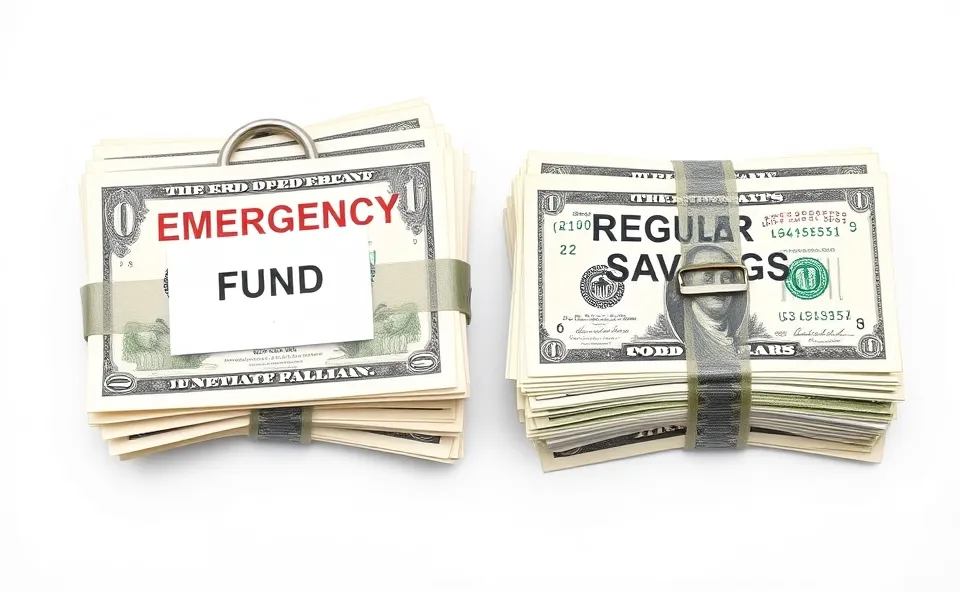
The Real Difference Between Your Safety Net and Your Wish List
Imagine you wake up on a Tuesday morning and find that your water heater has decided to quit on you. Or maybe your car makes a strange clunking sound and the mechanic tells you it will cost a thousand dollars to fix. In those moments, you do not want to look at your vacation fund and wonder if you can afford to skip a trip to the beach just to have hot water. This is where the conversation about emergency fund vs regular savings becomes so important.
At first glance, they both look the same. They are both piles of money sitting in a bank account, hopefully earning a bit of interest. But in the world of smart money management, they serve two completely different masters. One is designed for peace of mind, and the other is designed for progress.
A contingency fund, or what we call an emergency fund, is your financial insurance policy. It is money you set aside for the things you cannot see coming. It is not for a new laptop or a fancy dinner. It is for the “oh no” moments of life. Its main goal is protection. It keeps you from sliding into debt when life throws a curveball.
Regular savings, on the other hand, are for the things you actually want to happen. These are your savings goals. Maybe you are saving for a wedding, a down payment on a house, or a new gaming console. This money is for planned spending. While the emergency fund is about survival and stability, regular savings are about growth and enjoyment.
Why Everyone Is Talking About Financial Buffers Right Now
You might notice that more people are discussing financial planning and the savings vs emergency fund debate than ever before. There is a reason for this. The world has become a lot more unpredictable over the last few years. We have seen global health crises, sudden shifts in how we work, and prices for groceries and gas climbing faster than most people’s paychecks.
For a long time, many people treated their savings as one big pot of money. If they had five thousand dollars in the bank, they felt safe. But when a real crisis hit, they realized that much of that money was actually earmarked for other things. They found themselves spending their house deposit on medical bills or using their vacation money to cover a month of unemployment.
This realization has sparked a trend toward more intentional saving. People are no longer satisfied with just having “some money” in the bank. They want a clear strategy. They want to know exactly how much they have for a rainy day and how much they have for their dreams. This shift is driven by a desire for psychological safety. Knowing that your emergency fund is untouched allows you to spend your short term savings without feeling guilty or anxious.
The Old Way of Thinking About Money
To understand why this distinction matters, we have to look at how people used to handle their cash. In the past, the standard advice was simple: save a percentage of your income every month. You put it in a savings account, and you left it there. There was very little nuance. You had a “savings account,” and that was it.
The problem with this approach is that it lacks direction. When all your money is in one place, the boundaries blur. If you have ten thousand dollars in one account, it is easy to tell yourself that you can afford a new sofa, even if half of that money was meant to cover you if you lost your job. This is where liquidity comes into play.
Liquidity refers to how quickly you can turn an asset into cash without losing value. Cash in a bank account is highly liquid. However, when you mix your goals, you create a mental conflict. You have the liquidity, but you do not have the permission to spend it. By separating these funds, you create a system of checks and balances. You move from a passive way of saving to an active strategy of building savings that actually serve a purpose.
How Separating Your Cash Changes Your Life
When you clearly define the purpose of emergency fund money versus regular savings, the impact on your daily life is immediate. The most significant change is the reduction of stress. There is a specific kind of anxiety that comes from knowing one bad break could ruin your financial future. An emergency fund kills that anxiety.
Here is how the impact breaks down for most people:
- Debt Prevention: When a crisis hits and you have a dedicated fund, you do not need to reach for a credit card. This prevents high interest rates from eating away at your future income.
- Better Decision Making: When your “fun money” is separate, you can spend it freely. You no longer have to do mental gymnastics to figure out if spending money on a hobby will leave you vulnerable if the car breaks down.
- Risk Tolerance: Having a solid safety net actually makes you braver. You might be more likely to start a business or switch to a more fulfilling job because you know you have a cushion to fall back on.
- Consistency: It is easier to stick to personal finance tips when you have clear buckets. It feels like a game where you are filling up different containers rather than just watching a single number go up and down.
For businesses and freelancers, this is even more critical. Without a steady paycheck, the distinction between operating capital and a contingency fund can be the difference between staying in business or closing shop during a slow month.
The Next Step in Your Money Journey
So, where do we go from here? Once you have mastered the art of separating your emergency fund from your regular savings, the path forward becomes much clearer. You stop worrying about survival and start focusing on optimization.
The logical next step is usually to automate the process. Instead of manually moving money, most people are now using technology to split their paychecks automatically. One portion goes to the safety net, one to the goal fund, and one to daily spending. This removes the human element of temptation.
As the safety net grows to a comfortable size, usually three to six months of expenses, the strategy shifts again. You no longer need to aggressively fund the emergency side. Instead, you can pivot that energy toward long term wealth. This might mean looking into investments or higher yield accounts that offer better returns than a basic savings account.
The future of personal finance is all about these “buckets.” We are moving away from the idea of a single savings account and toward a diversified system of funds. By treating your money as a set of tools with different jobs, you stop being a servant to your bank balance and start becoming the manager of your financial future.
Common Questions About Managing Your Money
How much should I put in an emergency fund vs regular savings?
A good rule of thumb is to prioritize your emergency fund first. Aim for three to six months of basic living expenses. Once that is full, you can put the majority of your extra cash into regular savings for your specific goals. If you have a very stable job, three months might be enough. If you are a freelancer, aim for six or more.
Where is the best place to keep an emergency fund?
The key is liquidity. You want this money in a place where you can access it instantly, such as a high yield savings account. You do not want it locked in a long term investment or a retirement account where you might pay a penalty to take it out during a crisis.
Can I use my regular savings for an emergency?
Technically, yes, because it is your money. However, doing this defeats the purpose of financial planning. If you use your vacation fund to fix your roof, you have not solved the problem; you have just traded one goal for another. The goal of a contingency fund is to ensure your regular savings stay protected.
What counts as a real emergency for an emergency fund?
A real emergency is something that is unexpected, necessary, and urgent. Job loss, sudden medical bills, or a major home repair are classic examples. A sale on a great piece of furniture or a last minute invitation to a wedding is not an emergency; those should be covered by short term savings.
How do I start building savings if I have no extra money?
Start small. The most important part of building savings is the habit, not the amount. Even saving ten dollars a week into a dedicated fund creates the mental shift you need. Focus on creating a tiny safety net first before worrying about larger savings goals.











