

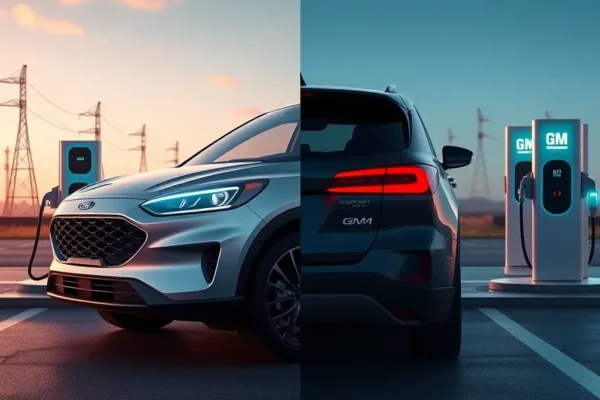
The Evolution of a Century-Old Rivalry
For over a hundred years, the competition between General Motors and Ford Motor Company has defined the global automotive industry. Traditionally, this battle was fought on the factory floors of Detroit, decided by engine horsepower, fuel efficiency, and the ability to mass-produce iconic internal combustion vehicles. However, a fundamental shift is occurring. The rivalry is no longer just about the mechanics of the car; it has moved into the realms of software, battery technology, and EV charging infrastructure.
In recent years, both companies have announced massive structural changes to pivot toward sustainable transportation. Ford has undergone a significant organizational split, separating its traditional internal combustion business into “Ford Blue” and its electric vehicle division into “Ford Model e.” This move was designed to allow the EV unit to operate with the agility of a tech startup. Meanwhile, General Motors has doubled down on its “Ultium” platform, a modular battery system designed to power everything from small cars to massive heavy-duty trucks. According to recent investor presentations and quarterly earnings reports, both companies are aggressively investing billions of dollars to secure their place in a future where the vehicle is an integrated part of the clean energy ecosystem.
This pivot was triggered by a combination of tightening global emissions regulations, significant government subsidies such as the Inflation Reduction Act in the United States, and a rapid shift in consumer demand. The focus has expanded beyond simply building an electric car to managing the entire lifecycle of energy, from the battery cell to how that car interacts with the smart grid.
Why Energy and Infrastructure are the New Battlegrounds
The decision to pivot toward electric vehicles and energy integration is not merely a response to environmental trends; it is a strategic move to capture new revenue streams. In the traditional business model, an automaker makes most of its profit at the point of sale. Once the car is sold, the relationship with the customer becomes largely transactional, centered on maintenance and parts.
By focusing on EV charging infrastructure and renewable energy integration, Ford and GM are attempting to move toward a “service-based” model. This involves a concept known as Vehicle-to-Grid (V2G) technology. V2G allows an electric vehicle to act as a mobile battery. When the energy demand on the power grid is high, the car can feed electricity back into the system. When demand is low, the car charges. For an automaker, this provides an opportunity to participate in the energy market, creating a continuous relationship with the customer and the utility companies.
Strategic analysis suggests that this move solves a critical problem: the “range anxiety” and “charging uncertainty” that currently prevent mass adoption of EVs. If a company can control or heavily influence the charging ecosystem, they reduce the barriers to entry for new customers. Furthermore, as the world moves toward clean energy, companies that own the technology connecting the car to the grid will be positioned as essential infrastructure providers rather than just hardware manufacturers.
The Competitive Landscape: Tesla and the New Challengers
While Ford and GM are rearranging their internal structures, they are doing so in the shadow of Tesla, which currently holds a dominant position in the North American EV market. Tesla’s advantage is not just in its vehicles, but in its vertically integrated ecosystem, including its proprietary Supercharger network. Recognizing this, both Ford and GM have made the strategic decision to adopt the North American Charging Standard (NACS), which allows their customers to access Tesla’s extensive charging network. This is a significant concession, but it is a pragmatic move to improve the customer experience.
The competitive landscape is further complicated by the rise of Chinese manufacturers like BYD, which benefit from highly efficient battery technology supply chains and lower production costs. This creates a “pincer movement” for American legacy automakers. On one side, they must fight Tesla for premium tech-focused buyers, and on the other, they must defend their market share against low-cost entrants.
In this environment, General Motors is positioning itself as a leader in scale and modularity through its Ultium platform, hoping to win on variety and mass-market availability. Ford Motor Company is leaning into its strengths in highly profitable segments, such as electric trucks and commercial fleets through its “Ford Pro” division. The winner of the GM vs Ford, Electric Vehicles race may not be the company with the fastest car, but the one with the most reliable and seamless energy connection.
How the Automotive Industry is Reimagining Mobility
The moves by these two giants signal a broader transformation in the automotive industry. We are witnessing the transition from “automotive manufacturing” to “mobility as a service.” This shift is reshaping how the entire sector operates. The industry is moving away from being purely mechanical and moving toward being software-defined. In a software-defined vehicle, most of the features and performance capabilities are controlled by code, allowing for over-the-air updates that can improve a car’s range or battery efficiency overnight.
This evolution also forces a new level of collaboration between automakers and the energy sector. For the smart grid to function, it must be able to handle the massive, intermittent loads created by millions of electric vehicles charging simultaneously. This is leading to new partnerships between car companies and utility providers to ensure that renewable energy sources, like wind and solar, are used efficiently to power these fleets.
Industry peers, including European manufacturers like Volkswagen and Stellantis, are following similar paths, investing heavily in software development and battery plants. The competitive landscape is being redrawn, where the ability to manage data and energy is just as important as the ability to weld steel.
The Economic Reality of Building an EV Future
The financial implications of this pivot are complex and involve a high degree of Capital Expenditure (CAPEX). CAPEX refers to the money a company spends to buy, maintain, or improve its fixed assets, such as factories and equipment. Both Ford and GM are spending tens of billions of dollars on new battery plants and assembly lines, which puts significant pressure on their short-term cash flow.
In the short term, the financial impact is a “transition squeeze.” While their traditional internal combustion engine (ICE) vehicles remain highly profitable and fund the transition, the EV divisions are often operating at a loss. For example, Ford’s “Model e” division has reported significant losses per vehicle sold as it scales up production. This creates volatility in stock market trends, as investors weigh the massive immediate costs against the promise of future profitability.
In the long term, the goal is to achieve high-margin revenue from software subscriptions and energy services. If they can successfully integrate their vehicles into the smart grid, they can move from the low-margin world of hardware manufacturing to the higher-margin world of technology and energy management. The timeline for this profitability is uncertain, but most analysts expect a multi-year period of heavy investment before the “scale effect” begins to lower costs and increase margins.
Critical Barriers to Strategy Execution
Despite the clear strategic direction, the risk of failure is significant. Transitioning a century-old company is not as simple as changing a product line; it requires a total cultural and operational overhaul. One of the primary execution risks is the supply chain. The production of electric vehicles depends heavily on specific minerals like lithium, cobalt, and nickel. Any disruption in the global supply of these materials can halt production and erase profit margins.
Furthermore, there is the challenge of software integration. Many legacy automakers have struggled to develop software that is as seamless and reliable as that of tech-native companies like Tesla or Rivian. Software bugs in an electric vehicle can be more than just a nuisance; they can affect critical safety and charging functions, leading to costly recalls and brand damage.
Regulatory risks also loom large. The transition is currently being driven by government incentives and mandates. If political climates shift and subsidies for clean energy or EVs are reduced, the economic math for these massive investments could change overnight. Historically, both Ford and GM have been successful at managing manufacturing cycles, but managing a global energy and software ecosystem is an entirely different discipline.
Shifting Priorities for Investors and Customers
This strategic pivot affects every stakeholder in the ecosystem. For employees, the transition requires massive retraining. The skills needed to build a high-performance engine are different from those needed to manufacture a high-density battery or write autonomous driving code. This shift can create organizational tension between the “old guard” of mechanical engineering and the “new guard” of software development.
Customers are also in a state of transition. While interest in sustainable transportation is growing, consumer behavior is still heavily influenced by price, convenience, and the availability of EV charging infrastructure. If the charging experience is not as easy as pumping gasoline, customers will remain hesitant.
For investors, the sentiment is a mix of cautious optimism and frustration. The market is looking for evidence that these companies can achieve “unit profitability”—making a profit on every single EV sold—rather than just reporting high total revenue. The volatility in stock market trends reflects this search for proof of execution. Investors are no longer just betting on how many cars a company can sell, but on how effectively they can manage the transition to a digital and electric future.
Key Milestones for the Next Five Years
As the rivalry between General Motors and Ford Motor Company continues, several key indicators will determine the success of their respective strategies. First, the industry will look for “cost parity,” the point where an electric vehicle costs the same to manufacture as an internal combustion vehicle. This is the holy grail for mass-market adoption.
Second, the maturity of the EV charging infrastructure will be a major milestone. We should watch for the expansion of NACS-compatible networks and the integration of seamless, “plug-and-charge” technology. Third, the successful deployment of V2G (Vehicle-to-Grid) services will be a signal that automakers have successfully moved into the energy sector.
Finally, investors will monitor the profitability of the specific EV divisions. The transition period will likely last until the late 2020s, by which time the companies will have either established themselves as leaders in the new mobility economy or been forced to consolidate their positions.
Strategic Questions Regarding the GM vs Ford, Electric Vehicles Transition
Will the transition to electric vehicles actually be profitable for Ford and GM?
Profitability depends on achieving economies of scale in battery technology and reducing the high costs of early-stage production. While current EV units may show losses, the long-term goal is to offset these through software services and energy integration.
How does the rivalry between GM vs Ford, Electric Vehicles differ from their past competition?
The old rivalry focused on mechanical performance and manufacturing volume. The new rivalry is centered on software integration, charging network access, and the ability to participate in the clean energy and smart grid markets.
What are the biggest risks to their current strategy?
The most significant risks include supply chain volatility for battery minerals, the difficulty of developing reliable vehicle software, and potential changes in government regulations or subsidies.
Why are they both adopting Tesla’s charging standard?
Both companies recognize that charging reliability is a primary barrier to consumer adoption. By adopting the NACS, they provide their customers with immediate access to a proven and widespread EV charging infrastructure.
How will this shift affect the automotive industry at large?
This shift is forcing the entire automotive industry to move toward a software-defined model and is creating a new intersection between the transportation and energy sectors.
Note: Business outcomes mentioned in this analysis are subject to significant execution risk, including market volatility, regulatory changes, and technological hurdles.











