

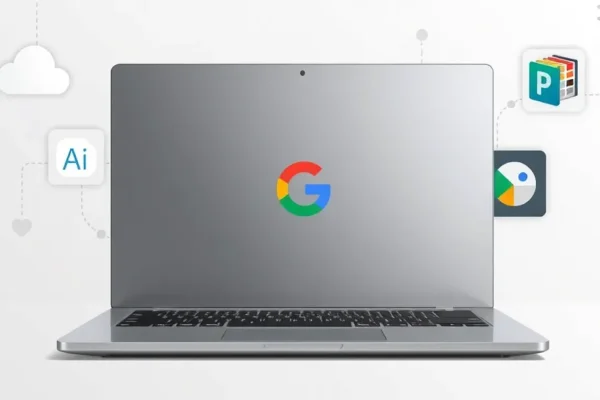
The tech world is abuzz with the arrival of a new contender in the laptop space: Googlebook laptops. This week marked the official launch of the first five models, signaling Google’s direct foray into hardware manufacturing, alongside established partners. These new devices aim to integrate Google’s vast ecosystem of software and AI capabilities into a seamless hardware experience. Let’s dive into what makes these Googlebook laptops noteworthy.
Introducing the Googlebook Laptops: A New Era of Integration
What exactly are Googlebook laptops? They represent a significant move by Google to offer its own branded laptops, developed in collaboration with major hardware manufacturers. The goal is to create devices that are deeply optimized for Google’s software, particularly its powerful AI tools and cloud services, offering a unified experience for users who live within the Google ecosystem. This launch addresses a long-standing desire among some users for hardware that is as intelligently integrated as Google’s software.
The problem these devices aim to solve is the fragmentation that can sometimes occur when using Google services on hardware from various manufacturers. While Chromebooks have long offered a Google-centric experience, these new Googlebook laptops promise a more robust and feature-rich platform, specifically engineered to leverage advanced AI and cloud computing. The significance of this launch lies in Google’s increased commitment to the hardware landscape and its ambition to set a new standard for AI-powered personal computing.
This announcement comes directly from Google’s hardware division, following months of speculation and leaks within the tech community. The initial lineup includes devices from renowned manufacturers, underscoring Google’s strategy of leveraging existing expertise while asserting its brand vision.
How Googlebook Laptops Bring AI and Cloud Together
At its core, the innovation behind Googlebook laptops lies in their deep integration with Google AI Pro and extensive cloud storage capabilities. Think of Google AI Pro as a highly intelligent assistant built directly into the operating system and applications. Instead of needing separate apps for complex tasks like advanced photo editing, intelligent summarization of documents, or sophisticated language translation, Google AI Pro can handle these functions natively, often in real-time.
For example, when you’re writing an email, Google AI Pro might suggest more eloquent phrasing or help you draft a reply based on context. In a creative application, it could assist with generating image variations or refining digital artwork. This is powered by sophisticated machine learning models that are constantly learning and improving, accessible directly on the device or through seamless cloud connections.
The cloud storage aspect, tightly interwoven with these laptops, acts like an infinitely expandable digital filing cabinet. Instead of worrying about filling up local hard drives, users can store vast amounts of data – documents, photos, videos, and applications – on Google’s secure servers. This not only frees up space on the laptop but also ensures that your data is accessible from any device with an internet connection, and it provides a robust backup solution.
The synergy between on-device processing for immediate AI tasks and cloud-based AI models for more intensive computations is key. The laptops are designed with powerful processors and optimized software to manage this interplay efficiently, ensuring a smooth and responsive user experience.
Current State and Real-World Applications
The launch of these first five Googlebook laptops places them firmly in the early adoption phase. These devices are not merely upgraded Chromebooks; they represent a distinct product category designed for users who demand cutting-edge AI integration and ample cloud resources. The initial models are available for preorder starting this week, with shipments expected to begin in late summer.
The manufacturers involved in this initial rollout include:
- Acer Googlebook: Known for its versatile and budget-friendly options, Acer’s entry is expected to offer a compelling balance of features and affordability.
- Asus Googlebook: Asus, a staple in high-performance and innovative laptop design, is likely bringing a premium option to the lineup, focusing on build quality and advanced features.
- Dell Googlebook: Dell’s reputation for robust business-class machines suggests their Googlebook will be a reliable workhorse, ideal for productivity and professional use.
- HP Googlebook: HP’s contribution is anticipated to be a stylish and user-friendly device, catering to a broad consumer market looking for seamless integration.
- Lenovo Googlebook: Lenovo, a leader in business and consumer laptops, is expected to offer a well-rounded device that combines performance, portability, and innovation.
Pricing for these initial Googlebook laptops is varied, reflecting the different configurations and target markets of each manufacturer. Early indications suggest a starting price point around $899 for entry-level configurations, with premium models potentially reaching up to $1,599. All models come bundled with a generous amount of Google Cloud storage – starting at 2TB for one year – and access to the premium Google AI Pro features.
Real-world applications are envisioned across various user groups. For students, AI Pro can assist with research summarization and essay structuring. Creative professionals can leverage AI for content generation and media enhancement. Business users can benefit from intelligent scheduling, automated report generation, and advanced data analysis facilitated by Google AI Pro. The ample cloud storage ensures that large project files and extensive media libraries can be managed effortlessly.
The Competitive Landscape for Googlebook Laptops
The introduction of Googlebook laptops enters a crowded and competitive laptop market. Google’s primary rivals in this space are established players like Apple with its MacBook line, and Microsoft with its Surface devices and Windows laptops. Apple has long championed its integrated hardware and software ecosystem, offering powerful AI features through its macOS and proprietary chips.
Microsoft, on the other hand, has been actively pushing AI integration into Windows, with its “Copilot” AI assistant now a prominent feature across many Windows PCs. The Surface line represents Microsoft’s own hardware efforts to showcase the best of Windows and AI capabilities. Beyond these giants, traditional PC manufacturers like Dell, HP, Lenovo, Acer, and Asus already produce a vast array of laptops running Windows and ChromeOS, each with their own strengths and weaknesses.
What differentiates Googlebook laptops is their specific, deep-seated integration with Google’s unique AI models and cloud infrastructure. While Windows PCs are incorporating AI, and Apple’s M-series chips offer powerful neural engines, Googlebook laptops are designed from the ground up to be the ultimate platform for Google AI Pro and its vast cloud services. This could offer a more cohesive and performant experience for users who are heavily invested in Google’s digital environment, such as Google Workspace users, Android app enthusiasts, and those who rely on Google Photos and Drive.
The advantage Google holds is its unparalleled data set and its deep expertise in developing large-scale AI models. If Googlebook laptops can effectively translate this into a superior user experience – offering AI features that are more intuitive, powerful, or seamlessly integrated than those on competing platforms – they could carve out a significant niche. However, they face the challenge of convincing users to switch from well-established Windows or macOS ecosystems.
Implications and Impact of Googlebook Laptops
The advent of Googlebook laptops has the potential to reshape several aspects of personal computing and the broader tech industry. For users, it promises a more intelligent and cloud-centric computing experience. Imagine a laptop that intuitively understands your workflow, proactively offers assistance, and seamlessly manages your digital life without the constant worry of storage limitations or performance bottlenecks for AI-driven tasks.
Economically, this launch signifies Google’s increased investment in hardware, potentially leading to new job creation in design, manufacturing, and software development. It also intensifies competition, which can drive innovation and potentially lead to more competitive pricing for high-performance, AI-integrated devices. For the partner manufacturers like Acer, Asus, Dell, HP, and Lenovo, this collaboration provides a new avenue for product development and market reach within the premium laptop segment, while also potentially shifting some of the brand identity towards Google’s ecosystem.
Socially, enhanced AI capabilities could democratize access to advanced computing tasks. Features that once required specialized software or significant technical skill might become accessible to a wider audience through intuitive AI interfaces. However, concerns about data privacy and the increasing reliance on AI will likely grow, requiring careful consideration and transparent practices from Google.
In the short term, the impact will be felt by early adopters and the tech enthusiast community. Long-term, if successful, Googlebook laptops could set new benchmarks for what users expect from their personal computers, pushing competitors to further enhance their own AI and cloud integrations. This could lead to a future where AI assistance is as standard as a keyboard and screen on every device.
Limitations and Challenges Ahead
Despite the promising launch, Googlebook laptops face significant hurdles. One of the primary challenges is adoption. Users are deeply entrenched in existing ecosystems, particularly Windows and macOS, which have decades of software compatibility and user familiarity behind them. Convincing a broad audience to switch to a new platform, even one with strong AI backing, is a monumental task.
Technical limitations also exist. While Google AI Pro offers advanced capabilities, the performance of on-device AI tasks will depend heavily on the specific hardware configurations. For highly intensive AI computations, reliance on cloud processing means that a stable and fast internet connection is crucial, which is not universally available. Users in areas with poor connectivity might find their AI experience degraded.
Cost is another potential barrier. While there are entry-level models, the premium features, generous cloud storage, and advanced AI capabilities are likely to position these laptops at a higher price point, making them less accessible to budget-conscious consumers. Furthermore, the longevity and reliability of Google AI Pro’s learning capabilities, and how it adapts to individual user needs over time, will be critical for long-term satisfaction.
Finally, the perceived privacy implications of an AI deeply integrated into a user’s device and connected to cloud services could be a significant concern for many users, necessitating clear communication and robust privacy controls from Google.
The Future Trajectory of Googlebook Laptops
The initial launch of these five Googlebook laptops is just the beginning. The future trajectory for this product line appears to be one of continuous refinement and expansion of AI capabilities. We can expect Google to iteratively improve Google AI Pro, making it more context-aware, predictive, and efficient. This might include advancements in natural language understanding, allowing for even more intuitive voice and text interactions.
We should also anticipate hardware improvements. Future Googlebook models will likely feature more powerful processors optimized for AI tasks, longer battery life, and potentially new form factors beyond traditional laptops. The integration with other Google products and services, like Android apps and Google Assistant, is also likely to deepen, creating an even more unified experience.
The timeline for next breakthroughs is difficult to pinpoint precisely, as AI development is rapid. However, based on current trends, we might see more sophisticated AI-driven productivity tools, enhanced accessibility features powered by AI, and perhaps even AI that can assist with hardware diagnostics and self-repair within the next two to three years. Google’s ongoing research in areas like federated learning could also lead to AI models that are trained on user data without compromising individual privacy, a key area to watch.
Key Questions and Answers About Googlebook Laptops
What are Googlebook laptops?
Googlebook laptops are a new line of personal computers designed and branded by Google, manufactured in partnership with companies like Acer, Asus, Dell, HP, and Lenovo. They are built to deeply integrate Google AI Pro and cloud storage for an optimized user experience.
How do Google AI Pro and cloud storage work on these Google laptops?
Google AI Pro acts as an intelligent assistant embedded within the system, performing tasks like content summarization, advanced writing suggestions, and data analysis. Cloud storage provides ample, accessible space for all user data, managed by Google’s infrastructure.
When will Googlebook laptops be available, and what is the pricing?
The first five Googlebook laptops are available for preorder now, with shipping expected in late summer. Pricing starts around $899 for basic models and can go up to $1,599 for premium configurations.
Are these Googlebook laptops better than traditional Windows laptops or MacBooks?
They offer a unique advantage for users heavily invested in the Google ecosystem, providing deeply integrated AI and cloud services. However, their superiority depends on individual needs and preferences compared to the extensive software libraries and established ecosystems of Windows and macOS.
What are the main benefits of owning a Googlebook laptop?
Key benefits include seamless access to powerful Google AI Pro features, a vast amount of bundled cloud storage, and a tightly integrated Google experience. They are designed for enhanced productivity and intelligent assistance.
What are the potential risks or downsides of Googlebook laptops?
Potential downsides include reliance on a stable internet connection for some AI functions, a potentially higher cost compared to some standard laptops, and user concerns about data privacy given the deep integration of AI and cloud services.
This article provides an overview of the newly launched Googlebook laptops based on the information available at the time of this writing. Further details on technical specifications and long-term performance will emerge as the devices become more widely available and reviewed.











