

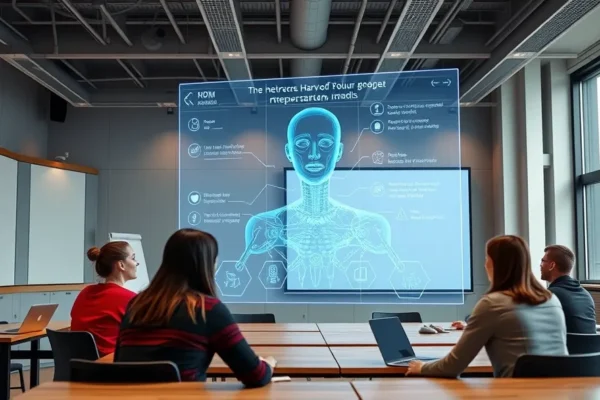
AI Avatars Lending a Hand at Harvard’s Startup Bootcamp
Harvard Business School (HBS) is piloting an innovative approach to mentor aspiring entrepreneurs, leveraging artificial intelligence (AI) avatars to deliver feedback during their startup pitch practice. This initiative, part of the HBS Foundry program, aims to provide students with more frequent and personalized guidance as they hone their business ideas and presentation skills. The use of these AI instructors marks a significant step in the integration of advanced educational technology within prestigious business programs, offering a scalable and consistent method for skill development in a crucial entrepreneurial phase. This development highlights the growing trend of AI being used not just for analytical tasks, but also for interactive and educational purposes, particularly within the dynamic field of entrepreneurship and startup acceleration.
Understanding the Tech Behind the Virtual Mentors
At its core, the HBS Foundry program utilizes AI avatars that are powered by sophisticated natural language processing (NLP) and machine learning models. Think of it like a highly advanced chatbot that can not only understand what you say but also analyze it for specific criteria and respond in a human-like manner, complete with visual representation. These AI avatars are trained on vast datasets of successful and unsuccessful startup pitches, business case studies, and expert feedback. When a student delivers their pitch, either verbally or in written form, the AI analyzes the content for clarity, persuasiveness, market viability, and financial projections, among other key elements. It then generates constructive criticism, offering suggestions for improvement. The avatar provides a visual and auditory layer, making the feedback feel more engaging than a simple text response. This allows for a more dynamic and interactive learning experience, simulating aspects of working with a virtual mentor.
HBS Foundry’s AI Feedback in Action
Currently, the HBS Foundry program is in an experimental phase, deploying these AI avatars to assist students within the HBS ecosystem. The primary use case is to offer immediate, scalable feedback to participants in their startup bootcamp and accelerator programs. Instead of waiting for a faculty member or mentor to become available, students can receive AI-driven insights on their pitch decks, business plans, and presentation delivery. This allows for iterative improvement cycles, where students can refine their pitches multiple times before presenting to human judges or potential investors. This form of digital feedback is particularly valuable in the fast-paced world of startups, where rapid iteration is key. While not yet available to the public outside of HBS, this pilot program offers a glimpse into the future of how educational technology can support entrepreneurship education.
The Competitive Landscape of AI Mentorship
The concept of AI-powered coaching and feedback is not exclusive to Harvard. Several edtech companies and academic institutions are exploring similar avenues. For instance, platforms like Cogito offer AI-driven customer service agents that provide real-time coaching to human agents, and some universities are experimenting with AI tutors for various subjects. In the entrepreneurship space, there are numerous startup accelerators and online learning platforms that offer AI-driven analytics on business plans. However, HBS Foundry’s approach, specifically integrating AI avatars for pitch feedback within a top-tier business school program, stands out. This approach emphasizes a more personalized and interactive feedback loop, aiming to mimic the nuanced guidance of experienced mentors. Competitors often focus more on data analysis or automated scoring, whereas Harvard’s integration of visual avatars suggests an attempt to create a more holistic and engaging simulation of human interaction.
Reshaping Entrepreneurship Education and Beyond
The implications of this AI avatar feedback system are significant for entrepreneurship education and potentially broader professional development. For students, it promises more accessible, personalized, and frequent feedback, accelerating their learning curve and increasing their confidence before high-stakes presentations. This can democratize access to high-quality mentorship, especially for individuals who may not have extensive networks or resources. Economically, it could lead to more robust startup ecosystems by equipping a larger number of entrepreneurs with better pitch-ready ideas. Socially, it offers a more inclusive learning environment, potentially reducing barriers to entry in entrepreneurship. In the short term, this will primarily impact business school students and accelerator participants. In the long term, similar AI feedback systems could become standard in corporate training, sales coaching, and even public speaking preparation.
Navigating the Hurdles of AI Feedback
Despite the promise, current AI avatar feedback systems face several limitations. One of the primary challenges is the nuanced understanding of human emotion and context. While AI can analyze pitch content, it may struggle to grasp the subtle cues of confidence, passion, or nervousness that a human evaluator picks up on. The feedback, while data-driven, might sometimes feel generic or miss the truly innovative aspects of a pitch that defy conventional metrics. There’s also the challenge of AI bias; if the training data is not diverse, the feedback could inadvertently favor certain types of businesses or presentation styles. Furthermore, the development and integration of such sophisticated AI systems require significant investment in technology and expertise, potentially limiting widespread adoption by smaller institutions or individual entrepreneurs in the immediate future. The current capabilities are largely focused on structured feedback based on identifiable patterns, rather than truly innovative or disruptive concepts that might fall outside the training data.
The Evolving Frontier of AI-Powered Mentorship
The future trajectory of AI avatars in educational settings, like the HBS Foundry program, points towards increasingly sophisticated interactions. We can expect these AI instructors to become more adept at understanding subtle human cues, providing more personalized and adaptive feedback, and even simulating different investor personalities for practice. Advances in AI will likely enable avatars to offer more creative problem-solving suggestions and even assist in brainstorming sessions. Researchers are working on developing AI that can better interpret emotional states and tailor feedback accordingly. Over the next few years, we may see these systems evolve from providing structured critique to offering more dynamic, conversational mentorship. The timeline for broader public access will depend on the success of these pilot programs and the cost-effectiveness of deploying such advanced AI technologies.
Frequently Asked Questions about Harvard’s AI Avatars
What exactly are these Harvard AI avatars?
These are sophisticated AI programs that simulate human instructors. They are used by the HBS Foundry program to provide students with feedback on their startup pitches, acting as virtual mentors.
How does the AI feedback from Harvard’s HBS Foundry program work?
The AI analyzes pitch content and delivery using natural language processing and machine learning, then generates constructive criticism and suggestions for improvement, presented by a virtual avatar.
Is this AI feedback technology available to everyone now?
Currently, the Harvard AI avatars are being piloted within the HBS Foundry program. It is not yet broadly available to the public or other institutions.
What are the main benefits of using AI avatars for startup bootcamp?
The primary benefits include providing scalable, consistent, and immediate feedback, allowing entrepreneurs to iterate and improve their pitches more efficiently. This could enhance entrepreneurship education.
Are there risks or limitations associated with this technology?
Yes, current limitations include the AI’s ability to fully grasp human nuance and emotion, potential for generic feedback, and the risk of AI bias if training data is not diverse.
When can we expect AI avatars to be widely used in educational settings like this?
Wider adoption will depend on ongoing development, cost-effectiveness, and successful pilot programs like the one at HBS Foundry. Significant advancements and accessibility could be seen within the next few years for various applications of virtual mentors.
This article discusses an emerging technology currently in a research and development phase within a specific educational institution. Capabilities and timelines are based on current understanding and stated intentions and may evolve.











