

A New Frontier at the Martian Moons
For decades, humanity has trained its gaze on the red planet, focusing on finding signs of ancient life or preparing for human arrival. Yet, just outside Mars’ atmosphere, two small, lumpy moons—Phobos and Deimos—have remained largely mysterious. Japan’s Aerospace Exploration Agency, known as JAXA, is set to change this with the Martian Moons eXploration (MMX) mission. This ambitious project aims to reach our Martian neighbor, land on Phobos, and return to Earth with precious cargo: Martian moon samples.
The MMX mission is a significant milestone for Japanese space exploration, representing the nation’s most complex planetary mission to date. By retrieving physical material from Phobos, scientists hope to solve long-standing debates about the origin of these moons—whether they are captured asteroids or chunks of Mars blasted into orbit by an ancient collision. According to JAXA’s official mission architecture, this research is critical for understanding the history of the inner solar system, as these moons may contain debris shed from Mars itself over billions of years.
How the MMX Mission Reaches its Target
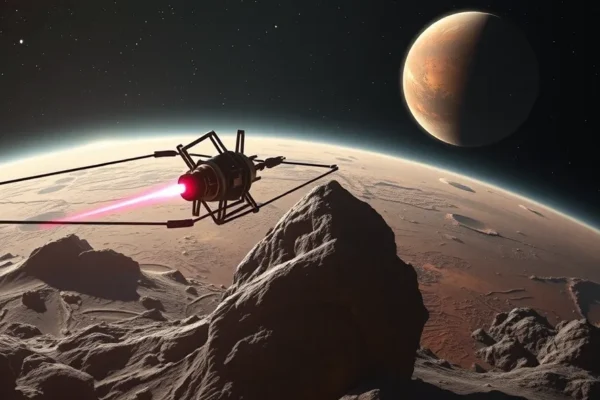
The MMX mission utilizes a sophisticated flight path to navigate the vast distance between Earth and Mars. Once the probe arrives at the Martian system, it will enter a “quasi-satellite orbit,” a complex trajectory that allows it to hover near Phobos without actually orbiting it in a traditional sense. Think of it like a hummingbird hovering near a flower; the probe must maintain its position relative to the moon’s weak gravitational pull while avoiding the instability of the Martian gravity well.
The core mechanism for gathering Martian moon samples involves a specialized landing and sampling apparatus. Unlike previous missions that used robotic arms, MMX will use a coring drill and a pneumatic sampler—a device that uses a puff of gas to stir up surface dust—to collect regolith, the loose layer of rock and soil on the moon’s surface. After the collection, the spacecraft will blast off from the moon’s surface and begin the long journey back to Earth. The landing and ascent phases are particularly delicate because Phobos has extremely low gravity, meaning the probe could drift away if not anchored correctly during the brief touch-and-go maneuver.
The Current State of Planetary Exploration
Space science is currently in a renaissance period characterized by a shift from simple flyby missions to active sample-return missions. While probes like NASA’s Perseverance are actively caching samples on the surface of Mars, those samples are not scheduled to return to Earth until the early 2030s at the earliest, pending complex budget and logistical coordination. In contrast, the JAXA MMX mission serves as a more focused, rapid-response effort.
Currently, the MMX spacecraft is in its final assembly and testing phase at JAXA’s Sagamihara Campus. The project has moved past the design and prototyping stages and is now undergoing environmental testing to ensure it can survive the harsh radiation and extreme temperature fluctuations of deep space. While the technology is not yet operational in the field, the heritage of this mission rests on the success of JAXA’s Hayabusa2 mission, which successfully returned samples from the asteroid Ryugu in 2020. This pedigree of success makes the MMX mission a highly anticipated venture in modern planetary research.
The Competitive Landscape of Mars Exploration
The race to explore the Martian environment is increasingly crowded, with international players adopting different strategies. NASA, the European Space Agency (ESA), and the China National Space Administration (CNSA) are all investing heavily in Mars probes. However, JAXA occupies a unique niche. While other agencies are primarily focused on the Martian surface, JAXA has prioritized Phobos as a scientific proxy for the red planet itself.
The primary advantage JAXA holds is its established expertise in small-body sampling. By specializing in landing on low-gravity, asteroid-like bodies, JAXA has developed a specific toolkit that gives it an edge over competitors who are still refining the architecture for large-scale surface retrieval. Furthermore, the MMX mission is a collaborative effort involving international partners, including NASA and the French space agency (CNES), who are providing critical instruments. This collaborative model differentiates the mission from the more nationalist space races of the past, focusing on sharing the burden and the findings of planetary research.
Broadening Our Understanding of the Solar System
The implications of this mission extend far beyond the technical success of the landing. If JAXA succeeds in bringing Martian moon samples back to Earth, it could fundamentally reshape our understanding of how water and organic materials were delivered to the inner planets. Because Phobos may contain “impact ejecta” from Mars, scientists essentially gain access to a collection of rocks from across the Martian surface without needing to navigate the complex terrain of the planet itself.
Economically, this mission strengthens the aerospace sector in Japan, fostering a high-tech job market for engineers, planetary scientists, and data analysts. Socially, it inspires the next generation of researchers, proving that even mid-sized space agencies can lead the world in high-stakes extraterrestrial exploration. The long-term impact involves building the foundation for future human missions to Mars; if we understand the radiation environment and surface conditions of the Martian system better, we minimize the risks for future astronauts.
Technical Limitations and Obstacles
Despite the optimism surrounding JAXA’s efforts, the MMX mission faces significant hurdles. The most pressing challenge is the unpredictable nature of the surface of Phobos. Because we have never landed there, we do not know the exact composition of the dust and rock. If the surface is too porous or too hard, the sampling mechanism may fail to collect the required amount of material. This is a common bottleneck in planetary science, where the “unknown unknowns” of the destination environment often lead to mission scope changes.
Furthermore, the timeline is susceptible to the harsh realities of space travel. Launches must align with the “Mars window”—the specific two-year period when Earth and Mars are closest. Any delay in development or testing can force a two-year postponement, which can lead to significant cost overruns. Additionally, the challenge of surviving deep space for several years puts immense strain on electronics, which can degrade under prolonged radiation exposure. These technical constraints mean that while the science is high-reward, the risk of partial or complete failure remains a reality of the sector.
The Path Forward for MMX
Looking ahead, JAXA has outlined a trajectory that moves from the launch phase to the sampling phase over the next five to seven years. The agency expects to reach the Martian system by 2026, with the return capsule touching down in the Australian desert shortly thereafter. The key developments to watch include the successful deployment of the rover being developed in partnership with the German Aerospace Center (DLR), which will act as a scout for the main spacecraft.
As the mission progresses, we can expect a steady stream of data that will provide the most detailed map of Phobos ever created. These insights will serve as the baseline for all subsequent Mars-related exploration. By the time the samples are brought to a lab for analysis, the global scientific community will have a clearer picture of whether Mars could have ever supported life, and how the Martian moons evolved alongside their parent planet.
Questions and Answers Regarding MMX
Is the JAXA MMX mission only about Mars?
No, while the mission focuses on Phobos, the primary goal is to collect Martian moon samples to better understand the formation of the Martian system and the history of the early solar system. It is a mission that bridges the gap between studying asteroids and studying terrestrial planets.
Who benefits from the data gathered by the Japan space mission?
The findings will be shared with the global scientific community, benefiting researchers at universities, government space agencies, and private planetary research firms worldwide. The data acts as a public resource for understanding how planets and moons evolve.
What are the risks of failure for this mission?
The primary risks include technical failure of the sampling mechanism, loss of communication in deep space, and difficulties navigating the unpredictable gravitational environment of Phobos. These are standard risks for any mission of this complexity.
How long until we see the results of the mission?
According to current JAXA schedules, the spacecraft is expected to arrive at the Martian system around 2026, with the sample return occurring several years later. This is a multi-year project that requires patience and long-term funding commitments.
How does this compare to other Mars exploration programs?
The MMX mission is distinct because it targets the moons rather than the Martian surface, allowing for a unique study of Martian material that has been displaced over time. It complements, rather than competes with, surface-level missions like the NASA Perseverance rover.
This article is based on the mission objectives outlined by the Japan Aerospace Exploration Agency (JAXA) as of 2024. As with all space exploration, timelines are subject to change based on launch windows, funding, and technical testing milestones.











