

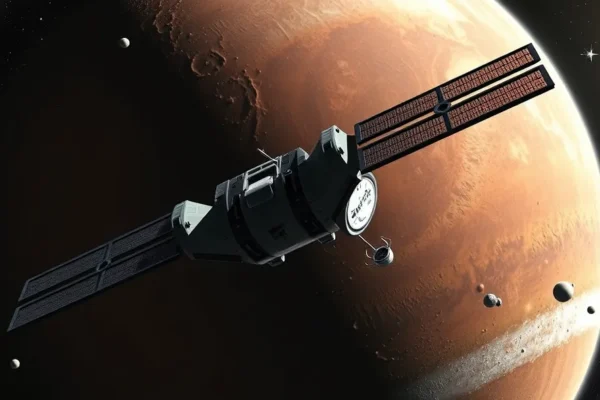
A New Frontier for the Japan Martian Moon Mission
Humanity has long been obsessed with Mars, but our gaze is shifting to the mysterious, potato-shaped moons that orbit our planetary neighbor. The Japan Martian moon mission, known officially as the Martian Moons eXploration (MMX) project, represents a pivotal leap in space exploration. Led by the Japan Aerospace Exploration Agency (JAXA), this mission aims to reach Phobos, the larger of the two Martian moons, to retrieve surface material and return it to Earth. By studying Phobos, scientists hope to solve the enduring mystery of whether these moons are captured asteroids or the result of a massive impact event on Mars itself.
This mission is significant because it marks the first time any space agency has attempted to land on and sample a moon of Mars. While previous missions have orbited or landed on the Red Planet, the MMX mission targets a unique geological environment. According to JAXA project documentation, the mission is designed to provide clues about the formation of the Martian system and the history of water in the early solar system. With the launch window targeting the mid-2020s, the international scientific community views this as a high-stakes effort to fill critical gaps in our understanding of planetary evolution.
How the MMX Space Probe Reaches and Samples Phobos
The core mechanism of this space exploration Japan project involves a sophisticated robotic lander designed to navigate the extremely weak gravitational environment of a small moon. Because Phobos has very little gravity, a traditional landing would be nearly impossible. Think of it like trying to land a spacecraft on a spinning, dusty ball that barely holds onto its own surface debris; if you press too hard, you might bounce off into deep space.
To overcome this, the MMX probe uses a combination of proximity sensors and a specialized sampling arm. The spacecraft will hover just above the surface to collect soil samples, a process sometimes called touch-and-go sampling. It will also use a specialized coring mechanism to dig deeper into the regolith—the loose, rocky material covering the surface—to retrieve sub-surface samples that have been shielded from space radiation for millions of years. Once the collection is complete, the probe will jettison its sample container, which will travel through the vacuum of space to land safely on Earth, much like the successful Hayabusa2 mission that retrieved material from the asteroid Ryugu.
Current State and Real-World Scientific Utility
Currently, the MMX mission is in its final assembly and testing phase. JAXA has already demonstrated the core technologies required for deep-space sample return, having successfully retrieved samples from two separate asteroids. The technology is considered highly mature, though applying it to the specific environment of a Martian moon presents new engineering hurdles.
This mission is not just a scientific endeavor; it is a collaborative international effort. Researchers from NASA and the European Space Agency are providing critical instruments for the spacecraft, such as sophisticated spectrometers to analyze the moon’s composition. While the mission is currently in the development stage, the hardware components are undergoing rigorous testing in simulated space environments to ensure they can survive the long transit to Mars and the volatile conditions of the Martian orbit. The public can track progress through the JAXA project website, which provides regular updates on the spacecraft’s construction and testing milestones.
The Competitive Landscape of Martian Exploration
Japan is not the only player interested in Martian exploration, though its approach to Phobos is distinct. NASA has historically focused on the Martian surface with its rovers, such as Perseverance and Curiosity, while China and the United Arab Emirates have recently deployed successful orbital missions. However, no other national agency currently has a dedicated mission to perform a sample return from the Martian moons.
The primary differentiator for the Japan Martian moon mission is its singular focus on Phobos. Where competitors prioritize mapping the surface of Mars or searching for biological signatures, JAXA is prioritizing the origin story of the Martian system. This focus gives JAXA a strategic advantage: by capturing material that is potentially pristine and unaltered by the harsh environment of the Mars surface, they are performing a type of archaeological study of the early solar system that is simply not possible with current rover technology.
Implications and Potential Scientific Impact
The scientific community expects that these Phobos samples will fundamentally change our understanding of planetary systems. If the samples prove to be pieces of Mars blasted into orbit by an ancient collision, they would contain the oldest fragments of Martian history ever studied on Earth. This could reshape our knowledge of how water and organic matter were distributed across the early solar system.
Economically and socially, the mission serves as a catalyst for deeper space cooperation. By sharing research and instruments, international agencies are building a shared foundation of knowledge that reduces the cost and risk of future human exploration. In the long term, understanding the composition of Phobos could provide insights into how to use such moons as “waystations” for future human missions to the Martian surface. If these moons contain ice or minerals that can be converted into fuel, they could become critical assets in the future infrastructure of interplanetary travel.
Limitations and Challenges in Deep Space Exploration
Despite the optimism, the Japan Martian moon mission faces significant bottlenecks. The most prominent is the communication delay between Earth and Mars, which can take up to 20 minutes each way. This forces the spacecraft to be highly autonomous; it must make split-second decisions without human intervention. If a navigation error occurs during the sampling phase, there is no way for mission control to “remote control” the craft to safety.
Furthermore, the physical environment of Phobos is unpredictable. While radar mapping has provided some data, the exact makeup of the surface is unknown. If the surface is too soft, the sampler might sink; if it is too hard, the drill might fail. These engineering uncertainties represent a significant risk. Additionally, the funding and political support required for such long-duration missions are always subject to shifting national priorities, making the timeline sensitive to changes in government budgets.
Future Trajectory and Milestones
The roadmap for the MMX project is clear. Following final integration and testing, the launch is expected to occur in the mid-2020s. After arriving in Martian orbit, the probe will spend approximately one year conducting observations and collecting the Phobos samples. The return journey is expected to be lengthy, with the goal of bringing the sample capsule back to the Australian desert by the end of the decade.
Looking further ahead, the successful analysis of these samples will likely trigger a new era of comparative planetology. Scientists will be able to cross-reference the Phobos materials with the samples currently being collected by the Perseverance rover on the Martian surface. This synergy between orbital and surface data will likely define the scientific agenda for the next two decades of Martian exploration.
Key Questions and Answers
What is the primary goal of the Japan Martian moon mission?
The primary goal is to land on Phobos, collect samples, and return them to Earth to determine the origin of the Martian moons and gather insights into the early history of the Martian system.
How does this mission differ from other Mars programs?
Unlike rovers that explore the surface of Mars, the Japan Martian moon mission is a sample-return mission targeting an orbital moon, which allows for the study of material that may have been ejected from Mars billions of years ago.
Is the technology for this mission mature?
Yes, the core technology is derived from JAXA’s Hayabusa2 project, which successfully retrieved and returned samples from a distant asteroid, though adjustments are needed for the specific gravity of Phobos.
What are the main risks associated with the Phobos samples?
The primary risks include the extreme difficulty of landing on a low-gravity body and the requirement for the spacecraft to operate autonomously due to the significant communication delay between Earth and Mars.
When can we expect results from this space exploration project?
The mission is currently in the late development phase with a launch planned for the mid-2020s, meaning scientific results will likely be available by the end of the decade once the return capsule is analyzed in Earth-based laboratories.
Disclaimer: This article discusses a mission currently in development. Technical specifications and timelines are subject to change based on JAXA’s ongoing research, testing outcomes, and international space agency collaboration schedules.











