

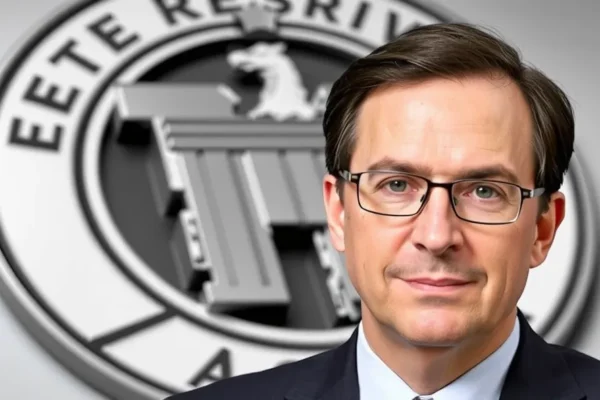
The Federal Reserve: A New Vision from Kevin Warsh
The Federal Reserve, often called the Fed, is the central bank of the United States. Think of it as the economy’s doctor. Its main job is to keep the economy healthy by managing things like job growth and the prices of goods and services, which we call inflation. It does this using tools like adjusting interest rates and influencing the amount of money available in the economy. Understanding the Fed is crucial because its decisions directly impact how much you pay for a loan, the return on your savings, and the overall stability of your financial future. Kevin Warsh, a former member of the Fed’s Board of Governors, has put forth a vision for the Federal Reserve that suggests significant changes to how it operates, moving away from strategies adopted over the past few decades.
How Kevin Warsh Sees the Fed Working Differently
Kevin Warsh’s perspective often emphasizes a return to more predictable and rules-based monetary policy. For decades, especially in recent times, the Fed has employed unconventional tools like quantitative easing (QE) – essentially, the Fed buying bonds to inject money into the financial system. Warsh has expressed concerns that these interventions can distort markets and create moral hazard, where financial institutions take on excessive risk knowing the Fed might step in.
His proposed changes often lean towards a clearer, more constrained approach. Imagine the Fed as a chef. In the past, the chef might have experimented with many exotic spices and complex cooking methods. Warsh suggests a return to simpler, time-tested recipes. He advocates for less discretionary action and more reliance on established economic principles, such as those found in Monetarism, an economic theory that emphasizes the role of money supply in influencing economic activity.
For example, instead of extensive QE, Warsh might prefer the Fed to focus primarily on adjusting a benchmark interest rate, known as the federal funds rate, which influences borrowing costs throughout the economy. His view is that this would make the Fed’s actions more transparent and easier for businesses and individuals to anticipate. This predictability, he argues, fosters more stable economic planning.
Why These Fed Changes Matter to You
These potential shifts in the Fed’s approach matter because they can influence the cost of borrowing money, the attractiveness of savings, and the stability of your investments. If the Fed adopts a more rigid, rules-based policy, it could lead to lower and more predictable interest rates. For individuals, this might mean more affordable mortgages or car loans, but potentially lower returns on savings accounts.
On a broader scale, changes at the Fed impact the entire economy. A more predictable Fed could lead to less volatility in financial markets, potentially benefiting businesses that rely on stable credit conditions. However, a Fed that is less willing to intervene during economic downturns might mean a slower recovery from recessions, potentially affecting job growth. Jerome Powell, the current Fed Chair, leads an institution that has navigated various economic challenges, and Warsh’s ideas offer a different philosophical lens through which to view the Fed’s role. Understanding these differing viewpoints helps people grasp the complex forces that shape economic policy and, consequently, their own financial well-being.
Historical Context and the Evolution of Fed Policy
The Federal Reserve was established in 1913 to provide a more stable financial system. Over its history, its tools and strategies have evolved significantly. In the mid-20th century, the Fed was often criticized for being too political. The era of Monetarism, championed by economists like Milton Friedman, gained traction in the latter half of the century, advocating for controlling the money supply to manage inflation.
The 2008 global financial crisis and the COVID-19 pandemic led the Fed to employ unprecedented measures, including large-scale asset purchases (quantitative easing) and near-zero interest rates. These actions, while aimed at preventing economic collapse, have also sparked debate about the Fed’s expanded role and the potential long-term consequences. Kevin Warsh’s critiques often stem from this recent history, suggesting that the Fed has strayed too far from its core mandates and has become overly interventionist, a departure from decades prior when its operational framework was more narrowly defined. For instance, data from the Federal Reserve shows that its balance sheet, a measure of its asset holdings, has grown exponentially since 2008, reflecting the extensive use of tools like QE.
Practical Implications of Warsh’s Vision
If the Federal Reserve were to adopt a framework closer to Kevin Warsh’s vision, it could mean a more predictable economic environment. This predictability is valuable for long-term financial planning, allowing individuals and businesses to make investment and spending decisions with greater confidence. For example, understanding that the Fed will adhere to clear rules for raising or lowering interest rates can help in planning for retirement or business expansion.
A common misconception is that the Fed’s actions are solely about controlling inflation. While controlling inflation is a key goal, the Fed also aims for maximum employment. Warsh’s emphasis on rules could mean that during periods of high inflation, the Fed would be compelled to raise interest rates more swiftly and predictably, even if it meant short-term pain for job growth. Conversely, during downturns, a rules-based approach might offer less immediate and forceful intervention compared to the crisis-driven policies of recent years. It’s important to watch how discussions around Fed governance and policy frameworks evolve, especially when the FOMC (Federal Open Market Committee), the Fed’s primary monetary policymaking body, convenes.
Connecting Warsh’s Ideas to Broader Economic Concepts
Kevin Warsh’s vision for the Federal Reserve connects to several fundamental economic ideas. His emphasis on rules-based policy is a direct counterpoint to discretionary policy, where policymakers have broad latitude to make decisions based on current conditions. This relates to the debate between “hawks” (who prioritize fighting inflation, often through higher interest rates) and “doves” (who prioritize economic growth and employment, often favoring lower interest rates) at the Fed.
His ideas also touch upon the effectiveness of monetary policy tools. While quantitative easing and forward guidance (communicating future policy intentions) have become standard, Warsh often questions their long-term efficacy and potential for unintended consequences. Understanding the principles of Monetarism, for instance, provides context for his concerns about the money supply and inflation. Furthermore, his perspective highlights the importance of central bank independence and accountability, ensuring that economic policy is guided by sound principles rather than short-term political pressures.
Frequently Asked Questions about Kevin Warsh and the Fed
What is Kevin Warsh’s main criticism of the Federal Reserve?
Kevin Warsh’s primary concern is that the Federal Reserve has become too interventionist and has strayed from a more predictable, rules-based monetary policy framework, particularly with the extensive use of unconventional tools like quantitative easing in recent decades.
How might Kevin Warsh’s vision affect interest rates?
A Fed guided by Warsh’s principles would likely rely more heavily on adjusting the federal funds rate according to clear rules, potentially leading to more stable and predictable interest rate movements compared to the more reactive, discretionary approach seen in recent years.
Does Kevin Warsh’s perspective align with Monetarism?
Yes, Warsh’s emphasis on controlling the money supply and adhering to predictable rules for monetary policy shares common ground with the principles of Monetarism, which advocates for monetary policy guided by predictable rules rather than discretionary adjustments.
How does this Fed change discussion impact inflation?
If the Fed were to adopt a stricter, rules-based approach as suggested by Warsh, it might lead to more aggressive and predictable responses to rising inflation, potentially bringing it under control more effectively but possibly at the cost of short-term economic growth.
Can individuals directly influence these Federal Reserve changes?
Individuals cannot directly influence the Federal Reserve’s policy decisions. However, public discourse, academic research, and the views of former officials like Kevin Warsh contribute to the ongoing debate about the Fed’s role and structure, which can indirectly shape future policy directions.
What are the risks of a more discretionary Fed policy?
A more discretionary Fed policy, as suggested by some critics including Warsh, risks market distortions, moral hazard (where financial institutions take excessive risks), and a lack of transparency, making it harder for businesses and individuals to plan their financial futures.
Financial situations vary; consult a professional for personal advice. This educational content is designed to provide general information about economic concepts and the Federal Reserve. It is not intended as personal financial advice. Decisions about investments, savings, and borrowing should be made in consultation with a qualified financial advisor who can assess your individual circumstances. Outcomes in financial markets and the economy can be unpredictable, and past performance is not indicative of future results.











