

A Fresh Way to Get Around Town
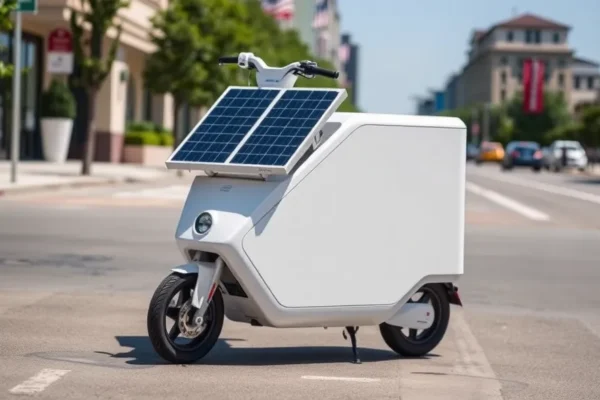
If you have ever found yourself staring at a dead battery on your electric scooter just miles from home, you know the frustration of modern urban transport. Otherlab, a design studio known for out-of-the-box thinking, has introduced a potential solution: the Lightfoot. This solar scooter is an urban scooter built with a unique twist—it has solar panels integrated directly into its wide, platform-style frame. It is essentially an eco-friendly transport tool that uses sun power to trickle-charge while you ride or park, keeping you moving without constantly hunting for a wall outlet.
This product is designed for city dwellers who rely on micromobility to bridge the “last mile” of their commute. Whether you are a student, a professional working in a dense city center, or someone who simply enjoys sustainable travel, the Lightfoot aims to remove the “range anxiety” that plagues traditional battery-only devices.
How the Lightfoot Fits Into Your Day
Think of the Lightfoot not as a high-speed racing machine, but as a reliable, rugged companion for your daily errands. Because it features a wider base than the typical rental scooter, it feels more like a miniature, stand-up utility vehicle. You are not standing on a narrow pole; you are standing on a stable, flat deck that happens to be harvesting energy from the sky.
If you commute to an office, you could park the Lightfoot in a sunny spot near the building entrance, letting it soak up energy while you work. By the time you head out for lunch or your commute home, you have gained a few extra miles of range without ever touching a charger. If you manage a busy household, this makes a quick trip to the grocery store or the local coffee shop feel more guilt-free. You are essentially using the sun to power your coffee run. It is designed to be a “set it and forget it” piece of new tech that handles the heavy lifting of energy management for you.
Who Should Consider This Solar Scooter
The Lightfoot is a specialized piece of hardware. It is best for commuters who have secure, outdoor parking where the scooter can be exposed to direct sunlight. It is also an excellent fit for eco-conscious riders who want to minimize their carbon footprint by relying more on solar energy than the power grid.
However, you should skip this if you live in a dark, basement apartment or work in an office where you are forced to store your scooter in a windowless garage. If you are looking for a lightweight scooter that you can easily carry up three flights of stairs, the Lightfoot might be too bulky for you. It prioritizes stability and energy collection over portability.
The Competition and Market Landscape
When you look at the wider market of urban scooters, the Lightfoot occupies a unique niche. Most competitors, like Segway or Apollo, focus on raw speed and portability. They use lightweight lithium batteries that you plug in every night. The Lightfoot is fundamentally different because it trades that portability for the convenience of self-charging.
In terms of value, you are paying a premium for the integrated solar technology. If your only goal is getting from A to B as cheaply as possible, a standard electric scooter will save you money upfront. But if you value the independence of not being tethered to a charging cable, the Lightfoot offers a different kind of long-term value that standard brands currently cannot match.
Getting Started With Your Lightfoot
You do not need an engineering degree to start using this device. The learning curve is quite gentle, largely because the vehicle is designed for stability. Because it has a wider platform than the average scooter, most riders find their balance almost immediately. Setup is straightforward, involving minimal assembly out of the box. Once the initial charge is complete, the solar system begins its work automatically whenever the light hits the panels. There are no complicated apps or finicky settings to manage, which is a breath of fresh air in a market full of overly complex gadgets.
The Real-World Pros
- Extended Range: The obvious benefit is the sun power. While it won’t charge instantly, the extra range added during a workday is significant for moderate commuters.
- Stable Ride: The deck is much wider and more comfortable than typical narrow-platform scooters, making it feel less twitchy on uneven pavement.
- Low Maintenance Habits: Because it is always pulling energy, you are less likely to end up with a “bricked” battery from leaving it uncharged for long periods.
- Sustainable Appeal: It feels good to know that a portion of your travel is powered by renewable energy rather than grid electricity.
The Honest Limitations
- Weather Dependency: If you live in a notoriously cloudy or rainy city, the solar benefit drops significantly, turning this into a standard electric scooter that is heavier than its rivals.
- Weight and Bulk: The technology that makes it solar-powered adds weight. It is not the kind of device you will want to carry onto a crowded bus or up a flight of stairs.
- Parking Requirements: It works best if you have a reliable outdoor spot. If your city is very dense and bike parking is always in the shade of skyscrapers, you lose the primary advantage of the product.
Price and Value Assessment
The Lightfoot comes in at a premium price point compared to entry-level budget scooters. As of late 2024, it is positioned as a mid-to-high-tier investment. Is it worth the price? If you are replacing a car for short trips, the fuel savings alone can justify the cost over a few years. However, if you only ride once or twice a week, the solar technology might be an expensive luxury rather than a necessity. Consider this a long-term transportation investment rather than a disposable gadget.
Final Verdict
The Lightfoot is a fascinating, innovative step forward for urban transport. It is not a one-size-fits-all solution; it is a specialized tool for the right environment. If you have an outdoor space to store it and a daily commute that falls within its range, it is a brilliant way to incorporate sustainable travel into your life. If you need something ultra-lightweight or live in a place with very little sunshine, you might be better served by a more traditional electric scooter. For those who fit the profile, though, it offers a level of freedom that is hard to find elsewhere.
Common Questions About the Lightfoot
Is the solar scooter worth the price?
It depends on your lifestyle. If you can use the sun to power your commute, it pays for itself in convenience and reduced electricity costs over time.
How long does it take to fully charge using solar energy?
Under optimal, direct sunlight, the solar panels provide a steady trickle charge. It is best to think of it as a way to maintain and extend your range throughout the day rather than a rapid-charging solution.
Can I ride this in the rain?
While the internal components are weather-resistant, it is always best to avoid heavy downpours to keep the electrical connections safe and the solar surface clean for efficiency.
Do I need special accessories?
A high-quality lock is essential, as this is a premium piece of tech that attracts attention. Other than that, a good helmet and basic safety gear are all you need.
Is the Lightfoot hard to learn how to ride?
Not at all. The wide deck makes it feel much more stable than standard rental scooters, so most adults find it very intuitive within a few minutes.
Product prices and availability vary by region. Verify current pricing before purchase.











