

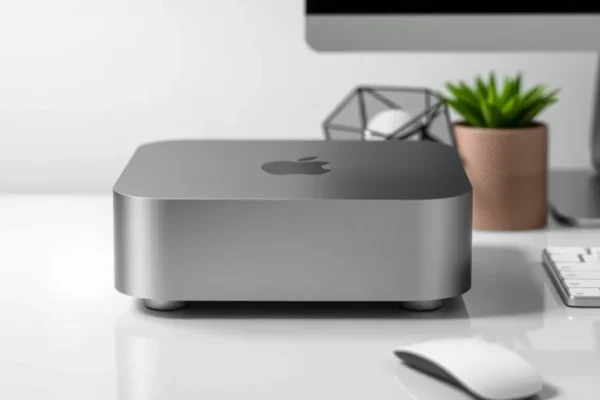
The Mac Mini has long held a special place in the Apple computer lineup, offering a compact desktop solution that punches above its weight. Now, with the rumored introduction of the 2026 Mac Mini powered by the M6 chip, we’re looking at a significant leap forward. This article delves into what this new Apple computer might bring to the table, exploring its powerful performance, sleek design, and the potential price implications.
A New Era for the Compact Desktop
The innovation surrounding the 2026 Mac Mini centers on its anticipated M6 chip. For those unfamiliar, Apple’s M-series chips are custom-designed processors that integrate the central processing unit (CPU), graphics processing unit (GPU), and other essential components onto a single chip. This “system on a chip” (SoC) design, pioneered by Apple starting with their M1 chip, allows for remarkable efficiency and power. The M6 chip represents the next generation in this lineage, promising even greater capabilities for everyday users and power users alike. The problem it aims to solve is providing desktop-class performance in an increasingly compact and energy-efficient form factor. This development is significant now as Apple continues its aggressive silicon roadmap, pushing the boundaries of what is possible in personal computing. While specific details on the M6 chip are under wraps, our analysis is based on Apple’s historical progression with its M-series chips, as well as industry expectations for advancements in processor technology. For instance, Apple’s own announcements and developer documentation for previous M-series chips (like the M4 chip) have consistently highlighted performance and efficiency gains.
Under the Hood The M6 Chip’s Engine
At its core, the M6 chip is expected to be a marvel of modern semiconductor engineering. Think of it like a highly efficient city planner. Instead of having separate buildings (CPU, GPU, memory) scattered across a large area, the M6 chip packs all the essential city services into a very compact, well-organized downtown core. This proximity allows for incredibly fast communication between different parts of the chip, leading to much quicker task completion. The M6 chip will likely feature an advanced CPU for handling everyday tasks and complex computations, a significantly upgraded GPU for graphics-intensive work and gaming, and a specialized Neural Engine for accelerating artificial intelligence and machine learning tasks. For the user, this translates to applications launching faster, smoother multitasking, more responsive creative workflows, and the ability to handle demanding software with ease. While the specific architecture remains proprietary to Apple, the trend with previous M-series chips has been to increase the number of processing cores, improve their individual performance, and enhance the interconnectivity between them, all while striving for better power efficiency. This means users can expect a powerful performance boost compared to the M4 chip and earlier generations.
The 2026 Mac Mini in Action
The 2026 Mac Mini, powered by the M6 chip, is poised to excel in a variety of real-world applications. For creative professionals, it could serve as a capable mini PC for photo editing, video rendering, and even light 3D modeling, all from a desk setup that takes up minimal space. Students and home users will benefit from its speed for research, writing, streaming, and managing digital life. Businesses looking for reliable and efficient workstations might find the Mac Mini an attractive, budget-friendly option for employee desktops, especially given its compact desktop design. The maturity level for this specific configuration is speculative, as the 2026 Mac Mini and M6 chip are not yet released. However, based on Apple’s product release cycles, we can anticipate its availability around early to mid-2026. When it does become available, it will be through Apple’s online store, retail stores, and authorized resellers.
The Competitive Arena
The compact desktop market is becoming increasingly competitive. While the Mac Mini has carved out a significant niche, it faces competition from various fronts. Intel-based mini PCs from manufacturers like Intel NUC, Beelink, and Minisforum offer Windows-based alternatives, often at lower price points. AMD also has powerful Ryzen-based mini PCs that deliver strong performance. Google’s Chromebooks, while different in their cloud-centric approach, also offer an entry-level computing experience in a compact form. What often differentiates the Mac Mini is its seamless integration with Apple’s macOS ecosystem, its exceptional power efficiency, and the tightly controlled hardware-software optimization. The M6 chip is expected to further widen this performance gap, particularly in specialized workloads that leverage its custom architecture, such as machine learning. However, competitors often have an advantage in terms of price flexibility and a wider range of pre-built configurations, catering to a broader spectrum of budgets and preferences.
Reshaping Desktops and Workflows
The advent of a 2026 Mac Mini with an M6 chip has significant implications. For individuals, it means desktop power can be housed in an even smaller footprint, freeing up desk space and reducing energy consumption. This could encourage more people to opt for a dedicated desktop machine over a laptop for their primary computing needs, especially if the cost remains somewhat budget-friendly. For businesses, it presents an opportunity to deploy more powerful, energy-efficient workstations that are easier to manage and house, potentially reducing IT infrastructure costs. Economically, it solidifies Apple’s position in the high-performance computing market and could drive further innovation in integrated chip design across the industry. Socially, it democratizes access to powerful computing for a wider range of users, enabling more sophisticated tasks to be performed at home or in small offices. In the short term, we can expect increased interest and demand for compact, powerful machines. In the long term, this could lead to a further shift away from bulky tower PCs towards more streamlined and integrated computing solutions.
Navigating the Hurdles Ahead
Despite the exciting prospects, there are limitations and challenges to consider for the 2026 Mac Mini. The most significant immediate challenge is likely to be its increased cost. As Apple pushes the envelope with its custom silicon, the price of its devices often reflects the advanced technology within. Previous Mac Mini models, while not cheap, have offered a relatively accessible entry point into the Apple ecosystem. The M6 chip’s advanced capabilities might push the 2026 Mac Mini into a higher price bracket, potentially making it less budget-friendly than some might hope. Furthermore, while the M6 chip promises powerful performance, the physical size of the Mac Mini still imposes thermal limitations. Sustained, heavy workloads might still lead to throttling, where the chip reduces its speed to prevent overheating, a challenge inherent in any compact desktop. The reliance on Apple’s proprietary ecosystem is also a limitation for users invested in other operating systems or software platforms. For users needing specific Windows-only applications, the Mac Mini remains an unsuitable choice without workarounds.
The Road Forward for Mac Mini
The future trajectory for the Mac Mini, especially with the M6 chip, points towards continued integration and performance enhancement. We can expect Apple to further refine the Neural Engine, making AI-powered features more prevalent and efficient across macOS. Future iterations might see even more advanced thermal management solutions, allowing the compact design to sustain higher performance levels for longer durations. Another key development to watch will be how Apple further differentiates the Mac Mini from its MacBook counterparts, potentially offering specialized configurations for developers or professionals. Based on Apple’s historical product cycles and silicon development, the M6 chip is likely just one step. We could see the M7 and M8 chips emerge in subsequent years, each building upon the foundations laid by their predecessors. The timeline for these next milestones is difficult to pinpoint precisely, but consistent annual or biennial updates to their core silicon have been the norm.
Key Questions and Answers
What is the 2026 Mac Mini?
The 2026 Mac Mini is an anticipated Apple computer model featuring a compact desktop design, expected to be powered by the next-generation M6 chip. It aims to deliver powerful performance in a small form factor.
What is the M6 chip?
The M6 chip is Apple’s upcoming custom-designed processor, integrating CPU, GPU, and other components onto a single chip for enhanced power and efficiency. It represents an advancement over the M4 chip and previous generations.
How powerful is the M6 chip expected to be?
While specific benchmarks are unavailable, the M6 chip is anticipated to offer significant performance improvements over its predecessors, delivering powerful performance for demanding tasks and everyday computing.
Will the 2026 Mac Mini be budget-friendly?
The cost of the 2026 Mac Mini is a point of concern. While it offers a compact desktop solution, Apple’s advanced silicon often comes at a premium, potentially making it less budget-friendly than some users might expect compared to older models or some mini PC competitors.
Who benefits from the Mac Mini with the M6 chip?
This Apple computer is expected to benefit creative professionals, students, home users, and businesses seeking a powerful yet compact desktop experience, offering a strong mini PC alternative.
When will the 2026 Mac Mini be available?
Based on Apple’s typical release schedules, the 2026 Mac Mini is anticipated to become available in early to mid-2026. Specific release dates will be announced by Apple closer to launch.
This article is based on industry analysis, historical product trends, and educated speculation regarding Apple’s future product roadmap. Specific features, performance figures, and pricing for the 2026 Mac Mini and M6 chip are subject to change and official confirmation by Apple.











