

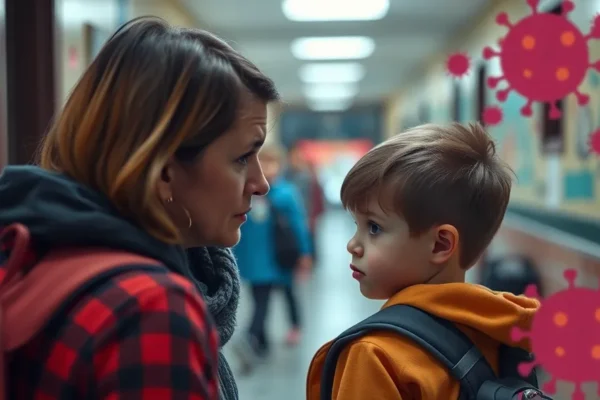
The Crisis of Modern School Safety
In the digital age, we often associate technology with silicon chips and software, but one of the most critical pieces of infrastructure in our society is biological: herd immunity. This term refers to the indirect protection from an infectious disease that happens when a population is immune either through vaccination or immunity developed through previous infection. Recently, rising measles outbreaks have begun to erode this invisible shield, creating a profound crisis for parents of immunocompromised kids.
The core problem is the collision between modern public health challenges and the necessity of school reopenings. As vaccine hesitancy continues to circulate in online forums and social media ecosystems, the vaccination rates for highly contagious diseases like measles have dipped below the threshold required to keep schools safe for the most vulnerable. According to the Centers for Disease Control and Prevention (CDC), measles is so contagious that if one person has it, 90 percent of the people close to that person who are not immune will also become infected. For a child with a compromised immune system—due to treatments like chemotherapy or organ transplants—the standard school environment has shifted from a place of learning to a high-stakes calculation of risk.
Understanding the Mechanics of Immunity
To understand why this is a technological and systemic failure, think of herd immunity like a firebreak in a forest. A firebreak is a gap in vegetation that stops a wildfire from spreading. In this analogy, the measles virus is the wildfire. Vaccinated children act as the dirt and cleared land that prevent the fire from jumping from tree to tree. When too many children remain unvaccinated, the firebreak disappears, and the wildfire can easily reach the most vulnerable “trees”—those children whose own immune systems cannot provide the protection they need to fight off the infection.
The technical mechanism at play involves the immune system’s memory. Vaccines introduce a weakened or dead version of a pathogen, teaching the immune system to recognize and neutralize the threat without the child having to experience the full-blown illness. For children with underlying health issues, their bodies often cannot mount this response, or the vaccines themselves might be contraindicated. Consequently, these children rely entirely on the surrounding population to act as a physical barrier against the disease. When that barrier fails, the protection is lost, and the public health system faces a massive failure in its primary goal: protecting the most fragile members of the community.
Current State and Real World Applications
Today, schools and health departments are using digital monitoring tools to track vaccination compliance, but these systems are often siloed. State health databases collect immunization records, while school districts operate their own entry requirements. The gap between these two systems means that in many regions, alerts regarding measles outbreaks reach parents of immunocompromised kids too late.
Some private school networks and high-density urban school districts have begun adopting integrated “health dashboard” technologies. These platforms allow administrators to visualize immunization clusters in real-time, helping them identify schools where herd immunity is dangerously low. However, this is currently an early-stage application. Most schools rely on manual paper record checks, a process that is prone to human error and difficult to scale. In terms of availability, real-time data transparency in schools remains a luxury found only in select districts that have prioritized investment in public health infrastructure.
The Competitive Landscape of Public Health
When discussing the management of childhood illness, the primary “competitors” are not different technologies, but different strategies of engagement. On one side are the traditional mandates, which require vaccinations for school attendance, subject to various medical and religious exemptions. On the other side is the growing movement toward decentralized health monitoring, where parents and schools use community-based reporting to stay informed.
The advantage currently lies with state-level mandates, as they are the only mechanism that can effectively enforce the maintenance of herd immunity. However, these mandates are increasingly challenged by social media-driven misinformation, which has created a fragmented landscape. Unlike previous decades, where public health messaging was centralized, the modern information environment makes it difficult for authorities to compete with the speed and emotional resonance of vaccine-hesitant narratives. Technology companies like Meta and Google have attempted to curb the spread of medical misinformation, but their algorithms often favor high-engagement content, which ironically creates an advantage for vaccine-hesitant perspectives.
Implications for Families and Society
The long-term impact of these measles outbreaks is a shift in the parental experience. For parents of immunocompromised kids, school safety has become a source of intense parental anxiety. This forces families into difficult, and often isolating, decisions. Should they pull their child from in-person learning and embrace homeschooling? Should they insist on remote access, effectively creating a two-tier system of education?
Economically, this situation is unsustainable. As families face the choice between keeping their children safe and maintaining their employment, the burden falls disproportionately on those who cannot afford private schooling or full-time childcare. The societal cost is a retreat from integrated public spaces. If we cannot ensure that schools are safe from preventable infectious diseases, we are essentially building a society that excludes children with health vulnerabilities from the fundamental experience of childhood: participating in a diverse, public classroom.
Limitations and Challenges in Safety Protocols
Why haven’t we solved this? The bottleneck is not a lack of vaccines, but a crisis of trust and data interoperability. We possess highly effective vaccines, but we lack a unified digital system that can communicate risk to parents without violating patient privacy laws, such as HIPAA in the United States. Furthermore, the politicization of public health has turned a matter of basic biological protection into an identity-based conflict.
Technical challenges also remain. For instance, creating a secure, privacy-preserving way for parents to know the immunization status of a classroom without exposing individual medical records is a significant engineering hurdle. While blockchain and decentralized identity protocols have been proposed as solutions, their adoption in state-run school systems remains years, if not decades, away.
Future Trajectory for School Safety
The trajectory of this issue will likely move toward more aggressive digital tracking and, perhaps, more restrictive attendance policies. As measles outbreaks become more frequent, school districts will likely be forced to adopt better analytical tools to track the “immunity health” of their student body. We can expect to see the development of more sophisticated “Early Warning Systems” that synthesize localized health data, hospital admission trends, and school attendance records to warn parents of heightened risks in their specific geographic area.
However, the most significant breakthrough will not be technical—it will be social. Until the discourse surrounding vaccine hesitancy is reconciled with the scientific consensus, even the most advanced data systems will struggle to restore the safety that herd immunity once provided. The focus over the next five years will be on creating transparent, accessible dashboards that allow for a better-informed school community, while policymakers grapple with the balance between individual liberty and the collective need for public health.
Key Questions and Answers
Is technology currently being used to make schools safer during measles outbreaks?
Yes, in some regions, schools are adopting digital immunization tracking systems to identify areas with low vaccination rates. However, these systems are not yet universal and remain in the early stages of adoption across most school districts.
What is the biggest challenge for immunocompromised kids in schools today?
The primary challenge is the decline in herd immunity caused by rising vaccine hesitancy. This forces parents to choose between the social and educational benefits of in-person schooling and the physical safety of their children, whose immune systems cannot protect them from highly contagious diseases.
Why is parental anxiety so high regarding childhood illness?
Parental anxiety is rising because infectious diseases that were once considered effectively managed in the West are returning. The loss of community-wide protection means that standard social environments, like classrooms, now carry a level of risk that necessitates constant vigilance from parents.
Who benefits from better data transparency in schools?
Everyone benefits, particularly immunocompromised kids and their families. Transparent data allows for proactive risk management, helping parents make informed decisions about when to send their children to school and when to prioritize remote learning to avoid exposure during local outbreaks.
How long until we see a mainstream solution to track school safety?
While individual districts are experimenting with better tracking tools, a national or mainstream solution is likely years away. The implementation of such systems requires both technological infrastructure and significant policy shifts to ensure data privacy and cross-agency cooperation.
Note: This article references research and data from public health authorities including the CDC and public health departments. The information provided is based on current trends in public health and educational policy as of 2024 and should not be considered medical advice. Public health strategies continue to evolve as new data on infectious disease transmission and school-based health protocols becomes available.











