

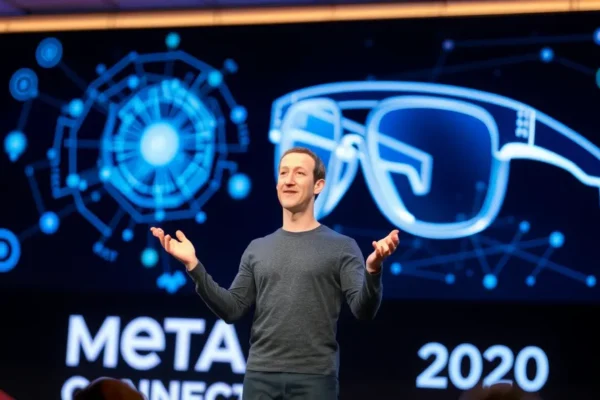
Meta Connect 2026 Unveiling Mark Zuckerberg’s AI and Smart Glasses Vision
This past week, Meta Connect 2026, held at the company’s Menlo Park headquarters, served as a pivotal moment for understanding Meta’s ambitious trajectory. CEO Mark Zuckerberg’s keynote address offered a deep dive into the company’s advancements in artificial intelligence (AI) and the evolving role of smart glasses, painting a vivid picture of Meta’s vision for the future of human-computer interaction. The focus was squarely on integrating AI into everyday devices and experiences, moving beyond traditional screens to more immersive and intuitive interfaces.
What’s New in Meta’s AI and Smart Glasses Ecosystem
The core innovation unveiled at Meta Connect 2026 centers on the deep integration of advanced AI into a new generation of smart glasses and the broader Meta ecosystem. This isn’t just about making existing devices smarter; it’s about creating a proactive, context-aware digital assistant that lives on your person. Mark Zuckerberg emphasized how this technology aims to solve the growing complexity of our digital lives by offering seamless access to information and assistance without requiring constant interaction with phones or computers. The significance lies in Meta’s commitment to making these powerful AI capabilities accessible through a wearable form factor, potentially redefining how we access and process information throughout our day. This announcement builds upon years of research in virtual reality (VR) and augmented reality (AR), aiming to bridge the gap between the digital and physical worlds in a more natural way. The company has been steadily releasing research and patent information hinting at these directions, but the 2026 keynote solidified the product strategy and integration plans.
How Meta’s AI and Smart Glasses Will Work
At the heart of Meta’s new approach is a sophisticated AI model, referred to internally as “Muse AI” during presentations. Think of Muse AI not as a simple chatbot, but as a highly capable personal agent that learns your habits, preferences, and context. Instead of you having to ask explicit questions, Muse AI can anticipate your needs. For instance, if you’re meeting someone for the first time, your smart glasses could discreetly provide you with a reminder of their name and a key fact about them, all processed in real-time.
The smart glasses themselves are evolving significantly. Gone are the bulkier prototypes of the past. The new hardware, demonstrated in concept and early development phases, aims for a sleeker, more fashionable design that resembles regular eyewear. These glasses are equipped with advanced sensors, including cameras and microphones, which feed data to the onboard AI. This data allows the AI to understand your surroundings and your activities. When you look at an object, the AI can identify it and offer relevant information. If you’re in a conversation, it can help with translation or note-taking. The processing power is a crucial element; while some tasks are handled locally for speed and privacy, more complex AI computations are offloaded to Meta’s cloud infrastructure, similar to how cloud gaming services stream high-end graphics to less powerful devices. The key technical element is the seamless, low-latency communication between the sensors, the local AI processing, and the cloud, all orchestrated to feel instantaneous to the user.
Current State and Real-World Applications
While Meta Connect 2026 showcased exciting future possibilities, the current state of this technology is a blend of ongoing development and limited early access. The smart glasses component, while improved, is still in its nascent stages of widespread consumer adoption. Meta has previously released Ray-Ban Stories smart glasses, which offer basic camera and audio features, but these do not possess the advanced AI capabilities discussed for 2026. These new, AI-integrated smart glasses are slated for a staggered rollout, beginning with developer programs and limited consumer beta testing in select markets in late 2027, according to Meta’s official product roadmap.
The AI capabilities, however, are being integrated into existing Meta products. For example, AI assistants are already enhancing features in Facebook, Instagram, and WhatsApp, offering better content recommendations and moderation. The vision at Meta is to have these AI functionalities accessible not just through dedicated hardware but also through existing devices, creating a unified AI future. Real-world applications for the advanced smart glasses are still largely aspirational, but potential use cases include enhanced navigation for pedestrians, real-time language translation during international travel, and productivity tools for professionals who need quick access to data during meetings or fieldwork. Companies in logistics and field service are particularly keen on early prototypes, envisioning improved efficiency and worker support.
The Competitive Landscape in AI and Wearables
Meta is not alone in pursuing an AI-driven future through smart wearables. The technology landscape is fiercely competitive. Apple, a major rival, is widely rumored to be working on its own augmented reality glasses and has a well-established AI assistant in Siri, which is continuously being developed. Google, with its long history in AI and previous attempts at smart glasses like Google Glass, remains a significant player, particularly with its AI innovations and smart assistant technology. Companies like Snap are also actively developing AR glasses and filters, focusing on social and creative applications.
Meta’s differentiator lies in its integrated approach. While others might focus on specific aspects like social AR or a singular AI assistant, Meta’s vision encompasses a comprehensive ecosystem where VR, AR, and AI work in tandem. The emphasis on a highly personalized, proactive AI agent like Muse AI, integrated into a discreet and fashionable smart glass form factor, aims to set them apart. However, Meta faces challenges in overcoming past public perception issues related to privacy and data usage, which could be a barrier to widespread adoption compared to competitors who have built stronger trust in these areas.
Implications and Impact on Industries and Society
The widespread adoption of Meta’s AI-integrated smart glasses and a sophisticated AI future could have profound implications. For industries, imagine fields like healthcare, where medical professionals could access patient data and diagnostic images in their line of sight during procedures, or retail, where employees could instantly check inventory and product information. This could lead to significant boosts in productivity and efficiency.
Socially, the impact could be equally transformative. On the positive side, it could foster greater inclusivity by breaking down language barriers and providing enhanced accessibility for individuals with disabilities. It could also lead to new forms of communication and entertainment, blurring the lines between the physical and digital. However, there are also potential concerns. The constant availability of AI assistants and the data collection required for personalization raise significant privacy questions. The potential for increased digital distraction and the impact on face-to-face human interaction are also areas of societal debate. In the short term, we can expect to see more sophisticated AI features embedded in existing devices. The longer-term impact of truly ubiquitous smart glasses will likely reshape urban planning, retail experiences, and the very nature of personal communication.
Limitations and Unresolved Challenges
Despite the ambitious vision, Meta’s AI and smart glasses technology faces significant hurdles. One of the primary limitations is battery life. Powering advanced AI processing and always-on sensors requires substantial energy, and current battery technology struggles to provide a full day of continuous use in such compact devices.
Another major challenge is the accuracy and reliability of AI in complex, real-world scenarios. While Muse AI is designed to be proactive, misinterpretations or inaccurate information could lead to frustrating or even harmful outcomes. The “black box” nature of some AI models also makes it difficult to understand why a particular decision was made, posing challenges for debugging and user trust. Furthermore, the cost of advanced smart glasses remains a barrier; current high-end AR/VR devices are expensive, making mass adoption difficult. Regulatory hurdles, particularly concerning data privacy and the use of cameras in public spaces, are also significant. Meta’s ability to address these technical, ethical, and economic challenges will be crucial for realizing their vision.
The Future Trajectory of Meta’s AI and Smart Glasses
Looking ahead, the trajectory for Meta’s AI and smart glasses appears to be one of continuous refinement and integration. The next few years will likely see iterative improvements in hardware design, making the glasses lighter, more comfortable, and more powerful. The AI models will become even more sophisticated, moving towards greater natural language understanding and contextual awareness. We can expect to see a deeper convergence of virtual reality and augmented reality experiences, with smart glasses serving as a gateway to both.
Key developments to watch include advancements in display technology for AR overlays, more efficient onboard AI processing chips, and breakthroughs in battery management. Meta has indicated a long-term commitment to this space, suggesting a phased rollout of increasingly capable hardware and software. Expert consensus suggests that while a truly seamless and universally adopted smart glass experience is still several years away, perhaps by the early to mid-2030s, the foundational work being laid now at events like Meta Connect 2026 is critical. The evolution will likely mirror that of the smartphone, starting with niche applications and gradually becoming an indispensable part of daily life.
Key Questions and Answers About Meta Connect 2026 Developments
Is Meta’s AI future with smart glasses available now?
No, the advanced AI-integrated smart glasses discussed at Meta Connect 2026 are not yet available to the general public. They are in development, with limited beta testing planned for late 2027. Current Meta products like Ray-Ban Stories offer basic smart features but lack the sophisticated AI capabilities unveiled.
What makes Muse AI different from other AI assistants?
Muse AI is envisioned as a proactive, context-aware personal agent designed to anticipate user needs rather than just respond to commands. Its integration into smart glasses aims to provide assistance and information seamlessly within the user’s field of view and daily activities.
Who are Meta’s main competitors in the AI and smart glasses space?
Meta faces competition from major tech companies like Apple and Google, both of whom are investing heavily in AI and wearable augmented reality technologies. Snap is also a notable player in the AR glasses market, particularly for social applications.
What are the biggest challenges Meta needs to overcome for smart glasses to succeed?
Key challenges include improving battery life for extended use, ensuring AI accuracy and reliability in real-world scenarios, reducing manufacturing costs to make the devices more affordable, and navigating complex privacy regulations and public perception regarding data usage.
How long until smart glasses become mainstream?
While timelines are speculative, industry analysts suggest that widespread mainstream adoption of advanced smart glasses could be a decade or more away, potentially by the early to mid-2030s. This depends on significant technological advancements and user acceptance.
What are the potential privacy concerns with Meta’s vision for AI and smart glasses?
The extensive data collection required for personalized AI and the always-on cameras and microphones in smart glasses raise significant privacy concerns. Users and regulators will need assurances about how data is collected, stored, and used to prevent misuse and maintain trust.
This article reflects the information presented at Meta Connect 2026 and draws upon general knowledge of the technology industry. Specific product availability, features, and timelines are subject to change by Meta.











