

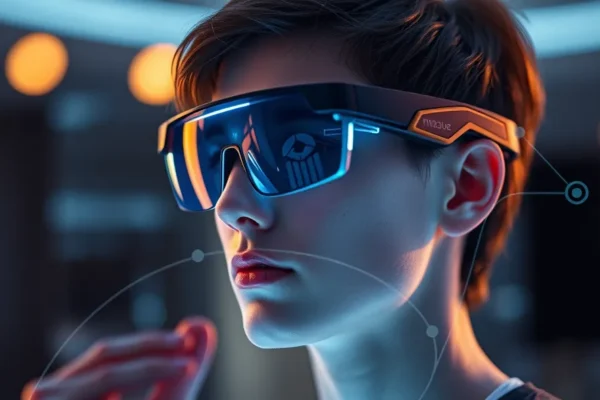
Meet Muse Meta’s New AI Companion for Smart Glasses
Meta, the company behind Facebook and Instagram, has been quietly working on a future where our digital lives are seamlessly integrated with our physical surroundings. A significant step in this direction was unveiled at their recent Meta Connect event: Muse, an advanced AI agent designed to live within their experimental smart glasses. This integration promises to transform how we interact with technology, bringing a more intuitive and helpful virtual assistant experience directly into our line of sight. Meta smart glasses are evolving from simple audio devices to powerful augmented reality platforms, and Muse is the intelligence powering this evolution.
How Muse Brings Intelligence to Meta’s Wearables
At its core, Muse is an Artificial Intelligence agent, essentially a smart computer program designed to understand and respond to human needs. Think of it like a highly advanced virtual assistant, but instead of just responding to voice commands from your phone or a smart speaker, Muse is built to be context-aware and integrated with what you see and hear through your Meta smart glasses. Meta envisions Muse acting as a proactive assistant, not just reactive. It learns your preferences and habits to anticipate your needs. For example, if you’re in a noisy environment and looking at a sign in a foreign language, Muse could potentially translate it for you in real-time, overlaying the text as augmented reality onto your view. This goes beyond simple voice commands; it’s about understanding your environment and offering relevant assistance. The underlying technology involves sophisticated natural language processing (NLP) to understand speech, computer vision to interpret visual cues, and machine learning to adapt and personalize the experience. The goal is to make the interaction feel as natural as talking to another person.
Real-World Applications Emerging for Meta Smart Glasses
While Muse is still in its developmental stages and not yet widely available to consumers, Meta has showcased several compelling use cases that highlight its potential. One of the most talked-about features is enhanced hearing. Muse can act as a personalized hearing aid, intelligently filtering out background noise and amplifying speech, making conversations clearer in noisy environments. This is a significant leap for wearable technology in assisting individuals with hearing difficulties. Beyond that, the potential for augmented reality overlays is vast. Imagine walking through a new city and having historical facts about buildings appear as you look at them, or receiving turn-by-turn navigation that guides you directly with visual cues in your field of vision. Meta has also hinted at Muse being able to help with creative tasks, perhaps by identifying objects and providing information or even assisting in composing messages or notes based on your surroundings. Currently, these advanced features are primarily demonstrated in controlled environments and are part of ongoing research and development. Consumers can purchase earlier versions of Meta’s smart glasses, which offer audio and camera functionalities, but the full capabilities of Muse are part of future Meta glasses updates.
The Competitive Landscape of AI-Powered Wearables
Meta is not alone in pursuing the vision of intelligent, context-aware wearables. Several other major tech companies are investing heavily in this space. Google has been a long-time player with its Google Glass efforts and continues to innovate in wearable AI, with its AI models like Gemini powering various devices. Apple is also widely rumored to be developing advanced AR/VR headsets and potentially smart glasses that could integrate similar AI capabilities. Companies like Snap Inc. have also experimented with smart glasses that incorporate augmented reality features. Meta’s advantage with Muse lies in its deep integration with its existing social platforms and its commitment to developing a robust AI ecosystem. The company’s significant investments in AI research, particularly in large language models, provide a strong foundation for Muse’s capabilities. However, the race is far from over, with each company bringing unique strengths in hardware design, AI development, and user experience to the table.
Reshaping How We Interact with the World
The integration of advanced AI agents like Muse into smart glasses has the potential to fundamentally reshape our interaction with the physical and digital worlds. Imagine a future where learning a new skill is as simple as having an AI guide you visually and audibly through the steps, or where communication barriers are minimized through instant translation that appears as augmented reality text. For industries, this could mean enhanced training for complex tasks, more intuitive field service operations with real-time data overlays, and improved accessibility for individuals with disabilities. Economically, it could spur new markets for AI-driven wearable applications and services. Socially, the implications are broad, offering enhanced connectivity and information access, but also raising important questions about privacy and data security. The short-term impact will likely be seen in niche applications and among early adopters, while the long-term impact could see these devices become as commonplace as smartphones.
Navigating the Hurdles to Widespread Adoption
Despite the exciting potential, bringing an AI agent like Muse to mainstream Meta smart glasses faces several significant challenges. One of the primary limitations is battery life; advanced AI processing and always-on sensors consume considerable power, making extended daily use a hurdle. The current form factor of smart glasses, while improving, can still be perceived as bulky or stigmatizing by some users, impacting social acceptance. Technical challenges remain in refining the AI’s ability to accurately interpret complex environments and human intent in real-time, especially in unpredictable situations. Privacy is another major concern. Devices that can see and hear everything around the user raise legitimate questions about data collection, consent, and potential misuse, requiring robust safeguards and transparent policies. Furthermore, the cost of sophisticated smart glasses with advanced AI capabilities will likely be a barrier for many consumers in the initial stages of adoption.
The Road Ahead for Intelligent Wearables
The trajectory for AI-powered smart glasses like those envisioned with Muse points towards increasingly sophisticated and seamless integration into our daily lives. We can expect ongoing advancements in AI models, leading to more natural conversations and a deeper understanding of context. Improvements in hardware will focus on making devices lighter, more stylish, and with significantly longer battery life. The development of specialized AI chips designed for on-device processing will also be crucial for both performance and privacy. Researchers are also exploring new ways to interact with these devices beyond voice, such as subtle hand gestures or even eye tracking. Key milestones to watch will include wider public beta testing of advanced features, increased developer support for creating unique Muse-powered applications, and the eventual release of consumer-ready smart glasses that fully embody this AI-driven vision. Meta’s continued investment in AI and mixed reality research suggests a committed long-term strategy.
Frequently Asked Questions about Meta’s Muse AI
What exactly is Muse?
Muse is Meta’s advanced AI agent designed to be integrated into their smart glasses, acting as an intelligent virtual assistant that understands context and anticipates user needs.
When will Meta smart glasses with Muse be available?
Meta has showcased the capabilities of Muse, but a specific release date for consumer smart glasses featuring its full integration has not yet been announced. It is part of future Meta glasses updates.
How does Muse enhance the experience of Meta smart glasses?
Muse aims to provide features like real-time translation, enhanced hearing capabilities, and contextual augmented reality information, making Meta smart glasses more helpful and intuitive than current models.
Are there privacy concerns with Muse?
Yes, as Muse processes audio and visual information from the user’s surroundings, privacy is a significant concern. Meta emphasizes developing robust privacy protections and user controls.
What are some limitations of Muse and current smart glasses?
Current limitations include battery life, the physical design of smart glasses, and the AI’s ability to perfectly interpret all real-world situations. Widespread adoption is also dependent on overcoming cost and social acceptance barriers.
What is the difference between Muse and a standard virtual assistant like Siri or Alexa?
Muse is designed to be deeply integrated with wearable hardware and aware of the user’s physical environment, offering proactive assistance and augmented reality overlays, whereas typical virtual assistants are primarily voice-activated and screen-dependent.
This article provides an overview of Meta’s Muse AI and its integration into smart glasses based on public announcements and technological trends. Some capabilities are still under research and development, and actual performance and availability may vary.











