

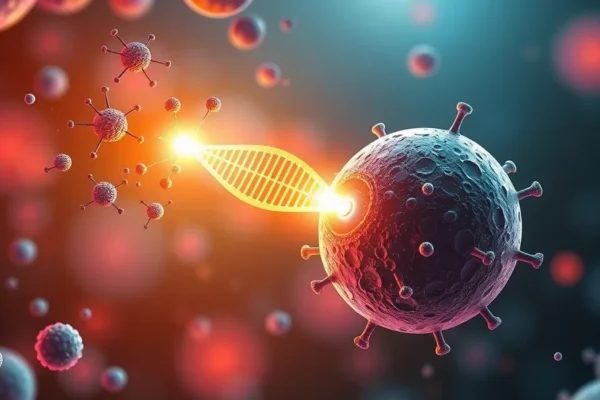
A New Era in Cancer Treatment: mRNA and Nanoparticles Team Up
In the ongoing battle against cancer, a significant medical breakthrough is emerging: a novel cancer therapy leveraging “smart” nanoparticles to deliver mRNA directly to tumors. This innovative approach aims to reprogram the body’s own immune cells, turning them into potent cancer-fighting agents. This development represents a leap forward in immunotherapy, offering a more targeted and potentially less toxic way to combat the disease. The recent progress in this field, particularly driven by advancements in nanomedicine and a deeper understanding of mRNA technology, has generated considerable excitement among oncologists and researchers worldwide.
The Promise of Precision: How This Cancer Therapy Works
At its core, this new cancer therapy harnesses the power of messenger RNA (mRNA) and tiny, engineered particles known as nanoparticles. To understand this, let’s break down the key components. mRNA, like a temporary instruction manual, carries genetic information that tells cells what proteins to build. In this therapy, the mRNA is designed to instruct immune cells to recognize and attack cancer cells more effectively.
The challenge, however, is getting this delicate mRNA instruction manual precisely where it needs to go – directly into the tumor microenvironment and to the immune cells within it. This is where nanoparticles come in. Think of these nanoparticles as highly sophisticated delivery vehicles. They are microscopic spheres, far smaller than a human hair, engineered to encapsulate the mRNA. These “smart” nanoparticles are designed with specific surface molecules that act like a homing beacon, allowing them to seek out and bind to cancer cells or specific types of immune cells residing within the tumor.
Once the nanoparticle reaches its target, it releases the mRNA. This mRNA then enters the immune cells, like T-cells, which are crucial players in the immune system’s defense against disease. The mRNA instructs these T-cells to produce specific proteins on their surface. These proteins act as flags, enabling the T-cells to identify and aggressively target cancer cells for destruction. It’s a form of immunotherapy, where the patient’s own immune system is supercharged to fight the cancer.
Early Stages and Emerging Applications
While this mRNA nanoparticle cancer therapy is still in its developmental stages, early research and preclinical studies have shown promising results. Companies like Moderna, known for its mRNA COVID-19 vaccines, are actively exploring its potential in oncology. Their research, detailed in scientific publications and company presentations, focuses on developing personalized cancer vaccines and novel therapies that utilize this dual mRNA-nanoparticle approach. The goal is to create treatments that are not only effective against various types of cancer but also minimize the side effects often associated with traditional chemotherapy.
Currently, this technology is primarily in the preclinical and early clinical trial phases. This means it’s being tested in laboratory settings and in small groups of human patients to assess its safety and efficacy. Concrete real-world applications for widespread patient use are still some years away, but the momentum in nanomedicine and mRNA research suggests a rapid progression.
Navigating the Competitive Landscape
The field of cancer treatment is highly competitive, with numerous approaches vying for prominence. Traditional treatments like chemotherapy and radiation remain mainstays, while newer forms of immunotherapy, such as checkpoint inhibitors, have already revolutionized cancer care. Checkpoint inhibitors, for instance, work by releasing the “brakes” on the immune system, allowing it to attack cancer cells more effectively.
The mRNA nanoparticle approach differentiates itself by offering a more direct method of programming immune cells. Instead of simply releasing the brakes, it provides specific instructions for the immune system to recognize and target cancer. This precision tumor targeting could potentially overcome some of the limitations of broader immunotherapy approaches.
Other companies and research institutions are also exploring nanoparticle-based drug delivery systems for cancer, including those delivering chemotherapy drugs or gene-editing tools. The unique aspect of the current innovation lies in the direct use of mRNA to reprogram immune cells specifically for cancer recognition, all facilitated by these advanced nanoparticles. The advantage of this mRNA-nanoparticle strategy lies in its potential for high specificity and its adaptability, as mRNA sequences can be tailored to target different types of cancer.
Reshaping Oncology and Beyond
The implications of a successful mRNA nanoparticle cancer therapy are far-reaching. If proven effective and safe, it could lead to more personalized cancer treatments. By analyzing a patient’s specific tumor, doctors could potentially design mRNA payloads to create highly individualized therapies, a concept akin to a bespoke suit tailored for each patient’s needs.
Economically, this could spawn new markets within the pharmaceutical and biotechnology sectors, focusing on nanomedicine manufacturing and personalized mRNA production. Socially, the impact would be profound, offering renewed hope and potentially better quality of life for cancer patients by reducing treatment-related toxicities. While still in its early stages, the long-term vision is a shift towards less invasive, more effective cancer treatments that empower the body’s own defenses.
Overcoming Hurdles: Challenges Ahead
Despite the immense promise, significant challenges remain. One of the primary hurdles is ensuring the safe and precise delivery of nanoparticles to the tumor while avoiding off-target accumulation in healthy organs. Nanoparticles, while designed to be biocompatible, can still elicit immune responses or accumulate in organs like the liver and spleen, leading to potential toxicity.
The stability of mRNA is another concern. mRNA molecules are inherently fragile and can be degraded by enzymes in the body. The nanoparticles must effectively protect the mRNA until it reaches its target cells. Furthermore, scaling up the production of these complex nanoparticles and mRNA payloads to meet global demand presents manufacturing and cost challenges. Regulatory approval processes for such novel therapies are also rigorous and time-consuming. The long-term effectiveness and potential for resistance development in cancer cells are also areas that require extensive investigation.
The Road Forward: Future Trajectories
The future trajectory for mRNA nanoparticle cancer therapy appears bright, driven by continuous innovation in both nanomedicine and mRNA biology. Key developments to watch include advancements in nanoparticle design for enhanced tumor penetration and reduced systemic toxicity. Researchers are exploring novel materials and targeting strategies to improve the precision of these delivery systems.
We can expect to see more sophisticated mRNA designs capable of eliciting stronger and more durable anti-cancer immune responses. The integration of artificial intelligence and machine learning may also play a role in identifying optimal mRNA sequences and nanoparticle formulations for specific cancer types. While timelines are difficult to pinpoint precisely for groundbreaking medical technologies, it is reasonable to anticipate that further clinical trials will yield more data over the next five to ten years, potentially paving the way for broader clinical adoption.
Frequently Asked Questions
What exactly is mRNA cancer therapy?
mRNA cancer therapy uses messenger RNA (mRNA) encapsulated in nanoparticles to instruct a patient’s immune cells to recognize and attack cancer cells. This approach aims to harness the body’s natural defense mechanisms for cancer treatment.
How do nanoparticles help deliver mRNA for cancer therapy?
Nanoparticles act as tiny, protective delivery vehicles that carry the fragile mRNA directly to tumor sites or specific immune cells. Their surfaces can be engineered to target cancer cells, ensuring the mRNA reaches its intended destination.
Is this mRNA nanoparticle cancer therapy available now?
Currently, this technology is largely in the preclinical and early clinical trial stages. It is not yet widely available as a standard cancer treatment, though research is progressing rapidly.
Who stands to benefit most from this new cancer treatment?
Patients with various types of cancer could potentially benefit. The personalized nature of mRNA therapies means they might be adaptable to individual tumor profiles, offering new hope for previously hard-to-treat cancers.
What are the main risks or limitations of this technology?
Key challenges include ensuring precise delivery to tumors, potential for nanoparticle toxicity in healthy organs, and the stability of mRNA in the body. Further research is needed to fully understand and mitigate these risks.
How does this compare to existing cancer immunotherapies?
While existing immunotherapies often “release the brakes” on the immune system, this mRNA approach directly instructs immune cells with specific targets. This aims for a more precise and potentially potent anti-cancer response.
This article discusses emerging medical research. The capabilities and timelines presented are based on current scientific understanding and company announcements. Further research and clinical trials are required to establish the full safety and efficacy of these novel therapies.











