

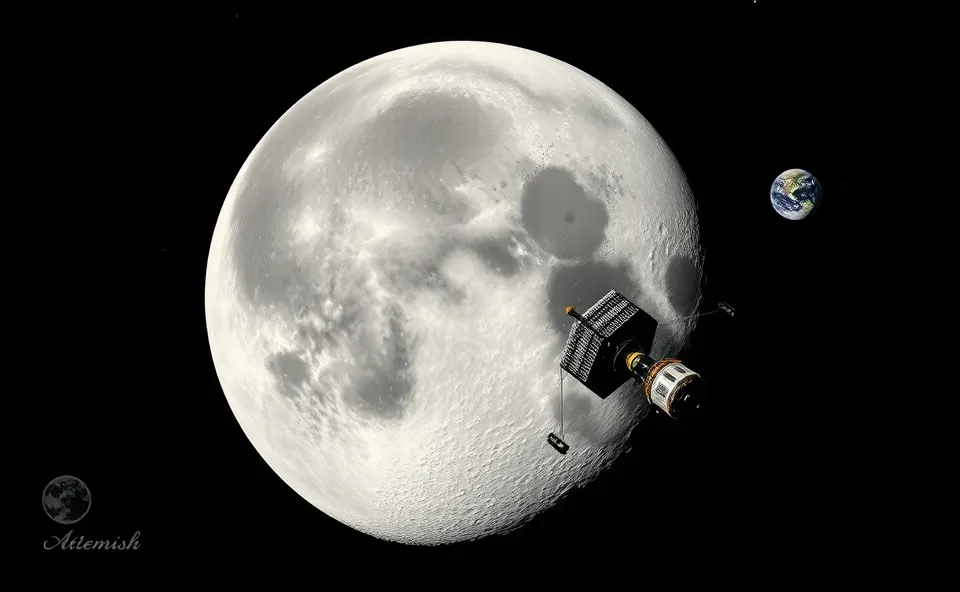
Our Epic Return to the Moon’s Mysterious Far Side
Imagine setting sail into an endless ocean, going further than anyone has ever been in that type of vessel. That is essentially what NASA’s Artemis mission did, sending a spacecraft designed for humans on an incredible journey around the Moon. This wasn’t just any trip around our celestial neighbor; it was a mission that saw the Orion capsule venture to the truly remote and often unseen far side of the Moon, smashing a space record for human-rated spacecraft and paving the way for our return to deep space exploration.
You might have heard about it, but let’s break down what truly happened. The Artemis I mission, an uncrewed test flight, launched with the powerful Space Launch System rocket. Its main goal was to prove that the Orion spacecraft was safe and ready to carry astronauts. During its roughly 25-day mission, Orion performed a series of maneuvers, including two close flybys of the Moon. On one of these passes, it dipped lower than any previous human-rated spacecraft, soaring just 80 miles above the lunar surface. But the real headline-grabber was its incredible distance from Earth.
Orion completed a distant retrograde orbit around the Moon, meaning it orbited in the opposite direction to the Moon’s own path around Earth, but at a much higher altitude. At its farthest point, the Orion capsule traveled a staggering 280,000 miles from Earth. This wasn’t just a record for Orion; it was the furthest any spacecraft designed to carry humans had ever traveled. This journey included significant time spent on the lunar far side, a region of the Moon that always faces away from us, hidden from view. It was a monumental first step, confirming that the technology and systems are robust enough to take humans on even longer and more challenging deep space journeys.
Why We Are Still Buzzing About This Moon Journey
So, an uncrewed flight happened a little while ago. Why are we still talking about it with such excitement? The reason is simple: what we saw during the Artemis I mission wasn’t an endpoint; it was just the very beginning of a much grander plan. The successful journey to the far side of the Moon was a crucial green light, a proof of concept that means we are now much closer to putting astronauts back on the Moon and eventually, on Mars.
Think of it like this: Before a long road trip, you test out the car. You make sure the engine works, the tires are good, and all the systems are ready for the journey. Artemis I was that ultimate test drive, and it passed with flying colors, especially in showcasing the capabilities of the Orion spacecraft to handle the rigors of a multi-week moon journey and deep space environment. This success has directly cleared the path for Artemis II, which will carry a crew of four astronauts around the Moon, including a flyby of the lunar far side, but without landing. Following that, Artemis III will aim to land humans on the Moon for the first time in over 50 years.
The lessons learned from this initial NASA mission are still being analyzed and applied. Every piece of data, from radiation levels to spacecraft performance during its extended lunar orbit, feeds into the design and planning for future crewed missions. It keeps the dream of sustainable human presence on the Moon alive and trending, because we know the foundation has been laid firmly and successfully.
Setting the Stage for a New Era of Human Spaceflight
To really appreciate the significance of the Artemis mission‘s journey to the far side of the Moon, it helps to glance back at history. For decades after the Apollo program ended in the early 1970s, human spaceflight largely focused on Earth orbit, with missions to the Space Shuttle and the International Space Station. While incredibly valuable, these missions didn’t push the boundaries of deep space exploration in the same way Apollo did.
The original Apollo program was a monumental achievement, culminating in humans walking on the Moon. However, it was also very much a product of its time – a race, with a specific, time-limited goal. When it ended, the infrastructure and the drive to return to the Moon faded away. We learned a tremendous amount from Apollo, but we also realized that merely “visiting” wasn’t enough for long-term goals.
That’s where NASA Artemis steps in. It’s not just about flags and footprints; it’s about establishing a sustainable presence. The vision is to build a long-term base on the Moon, setting up the infrastructure needed for extended stays, scientific research, and eventually, a stepping stone for missions to Mars. This renewed focus on lunar exploration, especially charting the unexplored lunar far side, represents a strategic shift. It means developing new technologies, new international partnerships, and a new way of approaching space travel that is designed to last for generations. The Artemis I flight was the first tangible proof that this ambitious new chapter of human spaceflight is well underway.
The Impact of Our Extended Lunar Orbit on Future Tech and Exploration
The successful journey to the far side of the Moon with Artemis I carries significant weight, touching everything from the technology we use to our collective human aspirations. For starters, this mission was a massive validation of the new Space Launch System rocket and the Orion spacecraft. These are not just bigger versions of old rockets; they represent a leap in engineering designed for the unique challenges of deep space exploration.
Think about the data collected during Orion’s extended lunar orbit. Scientists and engineers now have crucial insights into:
- Radiation Shielding: How well Orion’s systems and future Artemis crew will be protected from harmful space radiation far beyond Earth’s magnetic field.
- Propulsion Systems: The efficiency and reliability of engines and thrusters for long-duration missions.
- Life Support: Though uncrewed, the mission tested environmental controls and other systems critical for human survival in deep space.
- Communications: Maintaining reliable communication with Earth from extreme distances, especially when the Moon itself blocks the signal from the lunar far side.
These insights directly impact the design of future spacecraft, not just for the Moon but for Mars and beyond. Businesses in the aerospace sector are already innovating, developing new materials, propulsion methods, and digital tools inspired by the demands of the Artemis mission. This isn’t just about NASA; it’s about an entire ecosystem of companies and research institutions pushing the boundaries of what’s possible. The successful test flight also rekindles public interest and inspires a new generation to pursue careers in science, technology, engineering, and mathematics, ensuring a pipeline of talent for humanity’s ongoing quest to explore.
What Comes Next in Our Return to the Far Side and Beyond
With the success of Artemis I securely in the history books, what’s on the horizon for the Artemis mission? The path forward is already clearly defined, building logically on the foundational test flight to the far side of the Moon.
The immediate next step is Artemis II. This mission will take a crew of four astronauts on a multi-day journey around the Moon. They will perform a lunar flyby, just like Artemis I, pushing the Orion spacecraft and its crew further into deep space than any humans have traveled in over 50 years. This will be an essential dress rehearsal, testing critical systems with humans on board, before the ultimate goal of landing.
Following Artemis II, we will see Artemis III. This is the mission that will finally return humans to the lunar surface. It aims to land the first woman and the first person of color near the Moon’s South Pole, an area believed to hold water ice and crucial resources for future lunar settlements. This mission will mark a historic moment, not just for the individuals involved, but for all of humanity as we once again step foot on another celestial body.
Beyond these initial crewed missions, the NASA Artemis program envisions an ambitious future:
- Gateway: An orbiting outpost around the Moon that will serve as a staging point for lunar surface missions and a research laboratory.
- Lunar Base: Establishing a permanent human presence on the Moon, enabling long-duration scientific research and resource utilization.
- Mars Missions: Using the knowledge, technology, and experience gained from the Moon as a springboard for sending humans to Mars.
Each step builds on the last, with the uncrewed journey to the far side of the Moon by Artemis I proving that we are not just dreaming of these possibilities, but actively building them into reality.
Your Questions About the Artemis Mission Answered
What is the significance of the Artemis I mission’s journey to the far side of the Moon?
The Artemis I mission was an uncrewed test flight that successfully sent the Orion spacecraft farther than any human-rated spacecraft has ever been, including extended time on the far side of the Moon. This journey proved that the vehicle and systems are safe and capable of supporting future human spaceflight, paving the way for astronauts to return to the Moon and eventually travel to Mars.
Did the Artemis I mission land on the Moon?
No, the Artemis I mission was an uncrewed test flight that orbited the Moon and returned to Earth. Its primary goal was to test the Orion spacecraft and the Space Launch System rocket in a deep space environment, including a distant lunar orbit and a flyby of the lunar far side, without attempting a landing.
What does the term “far side of the Moon” actually mean?
The “far side of the Moon” refers to the hemisphere of the Moon that always faces away from Earth. Because the Moon’s rotation period matches its orbital period around Earth, we only ever see one side from our planet. The far side has a different topography, with fewer large maria (dark plains) and more craters compared to the near side. The Artemis mission explored this region from orbit.
What makes the NASA Artemis program different from the Apollo missions?
While both aim to send humans to the Moon, the NASA Artemis program is focused on establishing a sustainable presence rather than just brief visits. It involves building an orbiting lunar Gateway and a base on the surface, with the ultimate goal of using the Moon as a stepping stone for deep space exploration to Mars. It also emphasizes new technologies and international partnerships.
When will astronauts travel to the far side of the Moon with the Artemis crew?
The Artemis II mission, planned for the near future, will carry a crew of four astronauts on a multi-day journey around the Moon, including a flyby that will take them to the lunar far side. This will be the first time humans travel to this remote region of the Moon since the Apollo era, setting a new space record for distance traveled by a human crew.











