

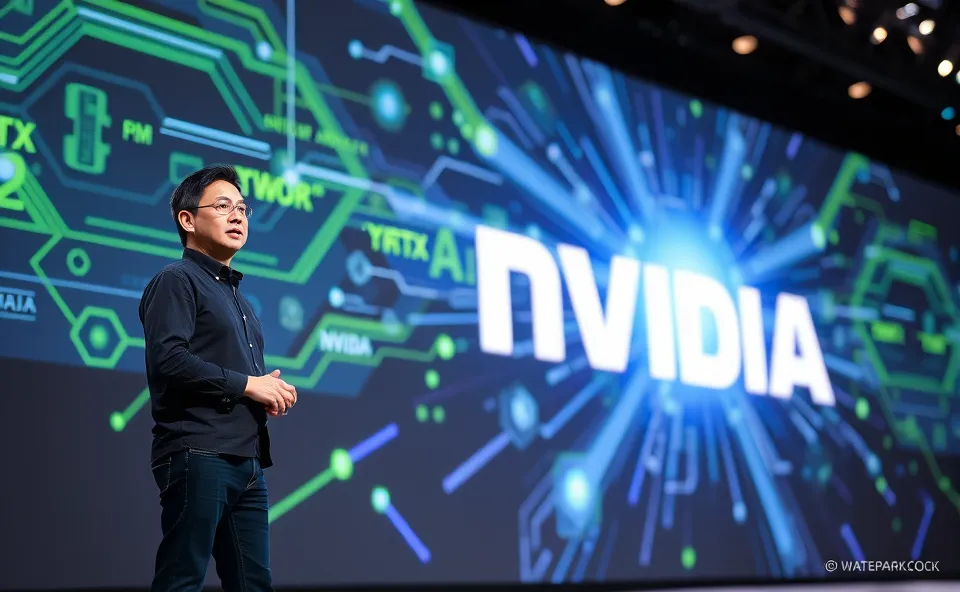
A Glimpse Into Tomorrow: Jensen Huang’s Vision at Nvidia GTC
If you’ve been following the whirlwind of technological advancements lately, you’ve probably heard the name Jensen Huang, the dynamic CEO of Nvidia. His recent keynote speech at the annual GTC conference wasn’t just another industry event; it was a powerful statement about where technology is headed and how Nvidia’s future is deeply intertwined with that path. Imagine gathering all the brightest minds in AI and computing in one place, and then having one person lay out a roadmap for the next decade. That’s essentially what happened.
Huang, known for his signature leather jacket and ability to make complex topics feel exciting, unveiled a series of groundbreaking innovations. The star of the show was undoubtedly the new Blackwell GPU architecture, a monumental leap in computing power designed specifically for the insatiable demands of artificial intelligence. But it wasn’t just about faster chips; he painted a picture of “AI factories” and a new era for robotics, all powered by Nvidia’s comprehensive ecosystem. It felt less like a product launch and more like a declaration of a new industrial revolution, with Nvidia’s silicon and software at its core.
Why Everyone’s Talking About This Moment in the Tech Industry
So, why is this particular GTC keynote resonating so strongly right now? It boils down to timing and Nvidia’s unique position. The world is in the midst of an AI explosion. Every major company, from startups to established giants, is scrambling to integrate AI into their products and services. This demand creates an unprecedented hunger for computing power, and for the vast majority of advanced AI work, that power comes from GPUs.
Nvidia, under Jensen Huang’s leadership, isn’t just a participant in this boom; it’s the primary enabler. The announcements at GTC directly address the biggest bottlenecks facing AI development today: scale, speed, and efficiency. When a company with such a dominant market share in a critical technology announces something revolutionary, the entire tech industry pays attention. It’s not just about what Nvidia is building; it’s about what everyone else can now build because of Nvidia. This keynote speech wasn’t just news; it was a clear signal of acceleration for the entire AI landscape, making it a hot topic for anyone interested in innovation and market shifts.
From Gaming Graphics to AI Dominance: The Nvidia Story
To truly appreciate the magnitude of the recent GTC announcements and what they mean for Nvidia’s future, it helps to glance back at their journey. Nvidia didn’t start as an AI company. Founded in 1993, they rose to prominence by creating powerful Graphics Processing Units, or GPUs, primarily for the gaming market. Their GeForce series became a household name among PC gamers, pushing the boundaries of realistic visuals.
However, the real turning point, spearheaded by Jensen Huang, was the realization that the parallel processing capabilities of GPUs – designed to render millions of pixels simultaneously – were also perfectly suited for the complex computations required by machine learning and AI. This foresight led to a strategic pivot. Nvidia started investing heavily in software platforms like CUDA, making their GPUs accessible to researchers and developers outside of gaming. They essentially created the toolkit for the modern AI revolution before many even fully understood its potential. This long-term commitment to innovation in semiconductors and software laid the groundwork, transforming Nvidia from a gaming hardware company into the undeniable leader in AI infrastructure, a position clearly reinforced by the recent GTC keynote.
The Impact: What This Means for Innovation and Markets
The implications of Jensen Huang’s GTC keynote are far-reaching, touching everything from cutting-edge research to everyday business operations and the broader global market. For starters, the new Blackwell architecture is a game-changer for AI development. It offers unprecedented performance and efficiency, meaning researchers can train larger, more complex AI models faster and with less energy. This isn’t just an incremental improvement; it pushes the boundaries of what’s currently possible in areas like drug discovery, climate modeling, and truly advanced generative AI.
For businesses, Nvidia’s vision of “AI factories” is transformative. Imagine data centers specifically designed from the ground up to churn out AI intelligence, much like traditional factories produce goods. This concept will empower companies across industries to rapidly deploy and scale AI solutions, leading to advancements in automation, personalized customer experiences, and data analytics. From finance to healthcare to manufacturing, businesses will find new ways to leverage AI, fundamentally changing how they operate and create value. The robotics platform, meanwhile, promises to accelerate the deployment of intelligent robots in warehouses, factories, and even homes, further blurring the lines between the digital and physical worlds.
On a market level, this solidifies Nvidia’s position as a critical infrastructure provider, not just a chipmaker. Their integrated hardware and software stack creates a powerful ecosystem that is incredibly difficult for competitors to replicate. This kind of innovation has a ripple effect, driving investment and development across the entire tech industry and setting new benchmarks for performance and capability. The GTC keynote highlighted that Nvidia isn’t just selling chips; they are selling the future of computing.
Looking Ahead: What’s Next for Nvidia
Given the ambitious announcements at GTC, what does the road ahead look like for Nvidia’s future? It’s clear that the company is doubling down on its role as the foundational platform for artificial intelligence. We can expect to see continued rapid iteration on their GPU architectures, pushing the limits of speed and efficiency even further. The “AI factory” concept will likely evolve from a vision into a tangible reality, with more companies adopting Nvidia’s full-stack solutions to build their own AI-powered operations.
Furthermore, robotics will become an increasingly important segment for Nvidia. As their robotics platform matures and integrates more deeply with advanced AI, we will see smarter, more versatile robots deployed in a wider array of applications. This isn’t just about industrial automation; it’s about intelligent agents capable of complex tasks, from logistics to service industries. Finally, expect to see Nvidia continue to invest heavily in its software ecosystem. The strength of their hardware is amplified by the ease with which developers can utilize it, and maintaining that advantage will be key to their sustained leadership in the ever-evolving AI landscape. Jensen Huang’s strategy appears to be one of relentless innovation and comprehensive ecosystem development, ensuring Nvidia remains at the forefront of the technological revolution.
Frequently Asked Questions About Nvidia’s GTC and AI
What was the most significant announcement from Jensen Huang’s GTC keynote?
The most significant announcement was the introduction of the Blackwell GPU architecture, designed to power the next generation of artificial intelligence, alongside the vision for “AI factories” and advancements in their robotics platform.
How will Nvidia’s new technologies impact the future of AI?
Nvidia’s new technologies, especially the Blackwell GPU, will significantly accelerate AI training and inference, enabling the development of larger and more sophisticated AI models, pushing the boundaries of what AI can achieve across various industries.
Why is Nvidia so important in the current tech industry?
Nvidia is crucial because its GPUs and comprehensive software ecosystem are the foundational infrastructure for most advanced AI development globally, making it a key enabler for innovation across the entire tech industry.
What does this GTC event mean for Nvidia’s future growth?
This GTC event signals a clear path for continued strong growth for Nvidia’s future, solidifying its leadership in AI semiconductors and expanding its influence into new areas like “AI factories” and robotics.
How does this GTC keynote reflect Jensen Huang’s vision?
The GTC keynote strongly reflects Jensen Huang’s long-held vision of transforming computing with parallel processing and AI, showcasing Nvidia’s commitment to building comprehensive platforms, not just chips, to power the future of technology.











