

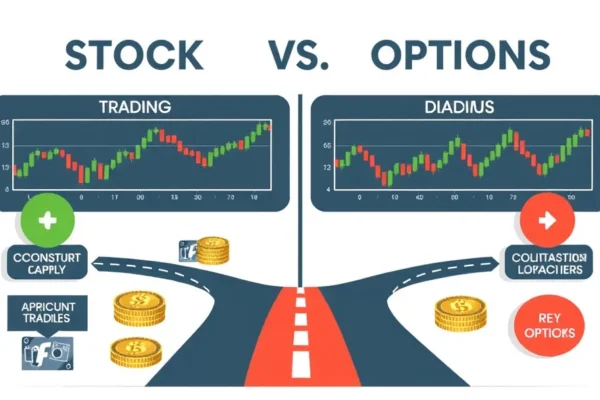
Stocks and Options A Friendly Chat About Your Investment Choices
Ever found yourself scrolling through investment news or chatting with friends about making your money work harder? You’ve probably heard the terms “stock trading” and “options trading” thrown around. They sound similar, and they both involve the market, but they’re actually quite different beasts. Think of it like comparing buying a whole pizza to buying just a slice or two, but with the possibility of owning the whole pizzeria later. Let’s break down options trading versus stock trading in a way that makes sense, no finance degree required.
Why the Buzz Around Options Trading and Stock Trading Right Now?
You might be seeing more chatter about options trading and stock trading lately for a few reasons. The market has been a bit of a rollercoaster, with plenty of ups and downs. This kind of environment often makes people look for different ways to invest, whether it’s the straightforward approach of stock trading or the more complex, potentially faster moving world of options. Plus, as more people get comfortable with online brokerage accounts and the general idea of investing, they start exploring beyond just buying shares. It’s a natural progression for many curious investors wanting to understand all the financial instruments out there.
A Quick Look Back: The Basics of Stock Trading
Let’s start with the familiar friend: stock trading. When you trade stocks, you’re essentially buying a tiny piece of ownership in a company. If you buy shares of, say, TechGiant Inc., you become a shareholder. Your investment’s value goes up when the company does well and the stock price climbs, and it goes down if the company struggles. It’s a pretty direct relationship. You own the asset, and its price movement is your profit or loss. You can hold onto these stocks for a long time or trade them frequently. The core idea is owning a piece of the business. This has been the bedrock of equity trading for ages.
Stepping into the World of Options Trading
Now, options trading is a bit more nuanced. Instead of buying ownership, you’re buying a contract that gives you the right, but not the obligation, to buy or sell an underlying asset, like a stock, at a specific price on or before a certain date. These are called call options and put options.
Think of a call option like a down payment on a house. You pay a small fee (the option premium) for the right to buy the house at today’s price for the next few months. If house prices shoot up, you can exercise your option, buy the house at the agreed lower price, and immediately sell it for a profit. If prices fall, you just let the option expire, and your loss is limited to that initial down payment. A put option is the opposite; it gives you the right to sell an asset at a set price, useful if you think the price will go down.
Key Differences: Risk, Return, and How It All Works
This is where options trading and stock trading really diverge. Let’s put options vs stocks under the microscope.
Risk Profile
Stock Trading: Generally considered less risky, especially for long-term investors. Your maximum loss is the amount you invested if the stock goes to zero. Your potential gain is theoretically unlimited as the stock price can keep rising.
Options Trading: Can be significantly riskier, especially if you’re not careful.
- Buying Options (Calls or Puts): The risk is limited to the premium you pay for the option contract. If the market doesn’t move as you predicted before the expiration date, the option can expire worthless, and you lose your entire investment in that option.
- Selling Options: This is where the risk can become very high, even unlimited in some cases if you sell naked call options. Because you have the obligation to fulfill the contract if exercised, a large adverse price movement could lead to substantial losses. This is why risk management is absolutely crucial in options trading.
Return Potential
Stock Trading: Returns are typically more gradual and tied to the company’s performance and market movements over time. Think steady growth or predictable dividends.
Options Trading: Offers the potential for much higher percentage returns in a shorter period. Because you’re using leverage with a smaller upfront investment (the premium), a small move in the underlying stock price can translate into a large percentage gain on your option. Conversely, losses can also be magnified if you’re on the wrong side of the trade.
Mechanics of the Trade
Stock Trading: You buy shares, and you own them. You can hold them indefinitely. Your profit or loss is realized when you sell the stock.
Options Trading: You’re dealing with contracts that have an expiration date. This time decay, known as theta, works against the option buyer and for the option seller. You need to consider not just the direction of the stock price but also how much time you have and the market volatility.
Here’s a quick comparison table:
| Feature | Stock Trading | Options Trading |
| :————— | :—————————————— | :——————————————————————————— |
| What you own | A piece of the company (equity) | A contract for the right to buy/sell at a specific price by a specific date |
| Primary Goal | Long-term growth, dividends, ownership | Speculation on price movement, hedging, income generation |
| Risk Level | Moderate (loss limited to investment) | Can be very high (especially selling options); buyer risk limited to premium paid |
| Return Potential | Moderate, often gradual | High, can be very rapid; also high potential for rapid loss |
| Time Horizon | Can be indefinite | Has an expiration date; time decay is a significant factor |
| Complexity | Relatively straightforward | More complex, requires understanding of variables like time decay and volatility |
What Does This Mean for You?
Understanding options trading versus stock trading is key to choosing the right investment types for your goals and comfort level. If you’re just starting out or prefer a more hands-off, steady approach, stock trading is likely your best bet. It’s a foundational element of building wealth. On the other hand, options trading can be a powerful tool for more experienced investors looking to amplify returns, hedge existing positions, or speculate on market volatility. However, it demands a deeper understanding of trading strategies and robust risk management.
For businesses, understanding these financial instruments can influence capital raising strategies or how they manage their own financial risks. For the technology sector, it means continued development of sophisticated trading platforms and analytical tools accessible through brokerage accounts.
Where Do We Go From Here?
The landscape of options trading and stock trading will continue to evolve. We’ll likely see even more user-friendly platforms emerge, making both investment types more accessible. Expect advancements in artificial intelligence and data analytics to play a bigger role in helping traders make decisions, whether they’re focused on equity trading or complex options strategies. The continuous innovation in financial instruments ensures that investors will have a growing array of tools at their disposal, but the fundamental principles of risk and reward will always remain.
Frequently Asked Questions About Options Trading and Stock Trading
What’s the easiest way to start with options trading versus stock trading?
For most beginners, starting with stock trading is recommended. You can open a brokerage account and begin buying shares of companies you believe in. Once you’re comfortable with the basics of the market and how your investments move, you can then explore options trading, perhaps starting with buying call options or put options on stocks you already understand.
Can you make more money with options trading than stock trading?
Yes, you can potentially make much higher percentage returns with options trading because of the leverage involved. However, this also means you can lose your investment much faster. Stock trading typically offers more modest, steadier gains over time.
Is options trading more risky than stock trading?
Generally, yes, options trading carries a higher risk, especially if you are selling options. While buying options limits your risk to the premium paid, the possibility of losing that entire amount is significant. Stock trading has a risk where you can lose your initial investment, but it’s often less volatile in the short term.
What are some common trading strategies for options vs stocks?
For stocks, common strategies include buy and hold, dividend investing, and swing trading. For options, strategies are more varied and complex, such as covered calls, protective puts, straddles, and strangles. The choice of trading strategies depends heavily on your market outlook and risk tolerance.
How do brokerage accounts handle options trading and stock trading?
Most online brokerage accounts offer access to both stock trading and options trading. However, to trade options, you’ll typically need to apply for a separate options trading approval, which involves demonstrating your understanding of the risks involved. Your brokerage account is the gateway to executing trades for both these financial instruments.











