

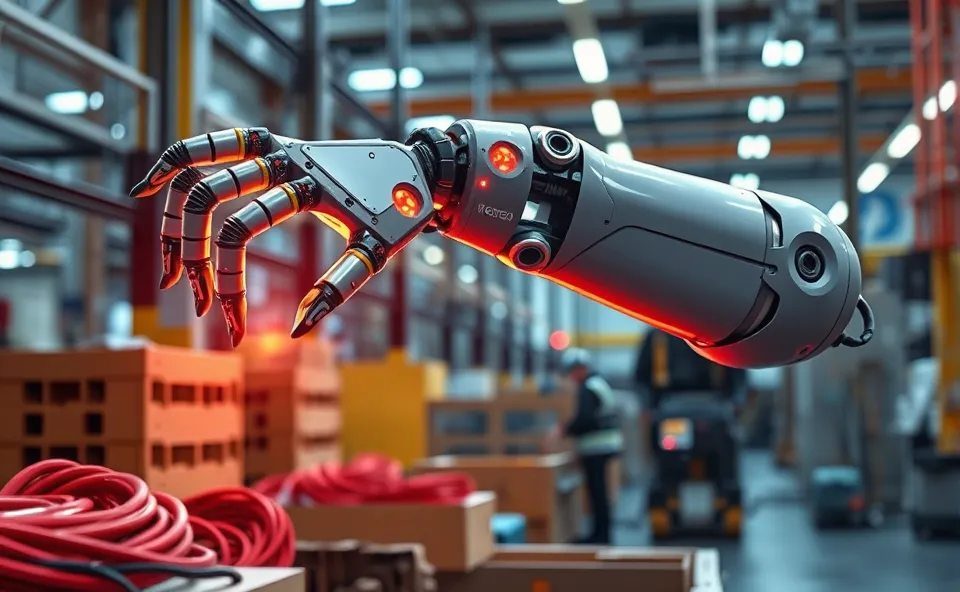
AI That Doesn’t Just Think, It Moves
Imagine AI that doesn’t just live inside your computer or phone. Think about AI that can interact with the physical world, pick things up, move around, and actually do tasks. That’s the heart of what we’re calling Physical AI. It’s not just about smart software anymore; it’s about giving intelligence a body, a way to experience and influence the real world around us. This is AI hardware meeting intelligent systems in a really exciting way.
Why All the Buzz About Physical AI Now?
You might be wondering why this is such a hot topic right now. Well, a few things have clicked into place. For years, AI has been getting smarter and smarter in the digital realm. We’ve seen incredible advances in machine learning and deep learning, making AI incredibly good at understanding data, recognizing patterns, and making decisions.
At the same time, the field of robotics has been steadily advancing. We’re building more sophisticated robots, with better sensors, more precise actuators, and more flexible designs. Think of the progress in smart factories, where robots are becoming more common and capable.
Physical AI is the point where these two powerful trends converge. It’s the idea of taking all that digital brainpower and putting it into a physical form that can operate in our world. The recent leaps in AI algorithms, combined with cheaper, more powerful hardware, mean we’re finally at a point where creating truly capable physical AI is becoming a reality, not just science fiction. This intersection is making real-world AI applications more feasible than ever before.
From Concept to Reality: The Building Blocks
So, how does this Physical AI actually work? It’s a blend of several key technologies.
At its core, you have advanced AI algorithms. These are the brains. They’re responsible for perception, decision-making, and learning. Think of sophisticated computer vision systems that allow robots to “see” and understand their surroundings, or natural language processing that lets them understand commands.
Then comes the AI hardware. This isn’t your average computer chip. It involves specialized processors designed to handle the massive amounts of data AI generates and the complex computations needed for real-time decision-making. This could include AI accelerators and specialized chips for robotics.
Sensors are crucial. These are the robot’s eyes, ears, and touch. They gather information about the environment—cameras for sight, microphones for sound, lidar for depth perception, and tactile sensors for feeling. Without good sensors, the AI has no real input from the physical world.
Robotics and mechanical engineering provide the body. This includes the motors, joints, and structures that allow the AI to move, manipulate objects, and navigate its environment. The sophistication of this physical form directly impacts what the Physical AI can do. We’re seeing incredible advancements in human-machine interaction, making these physical systems more responsive and adaptable.
Finally, learning and adaptation are key. Physical AI isn’t just programmed to do one thing. It’s designed to learn from experience, adapt to new situations, and improve its performance over time. This is where embodied AI truly shines, allowing systems to become more capable through interaction. This is the essence of intelligent systems taking shape.
What This Means for Our World
The implications of Physical AI are vast and touch many areas of our lives and industries.
For businesses, especially in manufacturing and logistics, this means increased automation. Smart factories can become even smarter, with robots that can handle more complex tasks, adapt to changing production lines, and even work more collaboratively with human employees. This can lead to greater efficiency, reduced errors, and improved safety. Manufacturing AI is moving beyond simple assembly lines to more dynamic and intelligent operations.
For consumers, we might start seeing more sophisticated service robots in our homes or public spaces, assisting with tasks, providing companionship, or enhancing accessibility. Think of robots that can truly understand your needs and respond in a helpful, physical way. This is the promise of autonomous agents that can genuinely assist us.
From a technological standpoint, Physical AI drives innovation across multiple fields. It pushes the boundaries of sensor technology, battery life, and actuator design. It also requires new ways of thinking about human-machine interaction, ensuring these systems are intuitive and safe to be around.
For workers, the impact is a mixed bag. While some repetitive or dangerous jobs might be automated, Physical AI also creates new opportunities in areas like robot maintenance, programming, and supervision. The focus shifts from manual labor to more skilled roles, emphasizing collaboration between humans and intelligent machines.
What’s Next on the Physical AI Horizon?
Looking ahead, the development of Physical AI is likely to accelerate. We can expect to see robots become more dexterous, capable of performing finer manipulation tasks. Their ability to understand and navigate complex, unstructured environments—like a cluttered home or a busy street—will improve dramatically.
The integration of AI hardware will become even more seamless, leading to more compact, energy-efficient, and powerful physical AI systems. This will unlock new possibilities for smaller, more agile robots.
We’ll also see a greater emphasis on safety and ethical considerations as these intelligent systems become more prevalent. Designing Physical AI that can understand and respect human boundaries will be paramount. The goal isn’t just to build smarter robots, but to build robots that can integrate safely and beneficially into our society. The future holds the potential for a more seamless partnership between humans and the intelligent physical world we are creating.
Frequently Asked Questions About Physical AI
What is the main difference between traditional AI and Physical AI?
Traditional AI primarily exists in the digital realm, focusing on data analysis, prediction, and decision-making within software. Physical AI, on the other hand, gives AI a body, enabling it to interact with and manipulate the real world through robotics and AI hardware. It’s about AI in robotics and real-world AI applications.
How does AI hardware contribute to Physical AI?
AI hardware, such as specialized processors and AI accelerators, provides the computational power needed for complex AI tasks like real-time perception, learning, and control within physical systems. This AI hardware is essential for the embodied AI to function effectively and efficiently in real-world AI scenarios.
Are robots the only form of Physical AI?
While robots are a prominent example, Physical AI can encompass any intelligent system that interacts physically with its environment. This could include smart devices with enhanced physical capabilities or even advanced prosthetics guided by AI. It’s a broad category for AI in robotics and embodied AI.
What industries are currently benefiting most from Physical AI?
Industries like manufacturing, logistics, and warehousing are early adopters, using AI in robotics for automation and efficiency. We’re also seeing growth in areas like healthcare with robotic assistance and exploration with autonomous agents. This represents the expanding frontier of real-world AI.
What are the key challenges in developing Physical AI?
Key challenges include improving sensor accuracy and robustness, developing more adaptable and energy-efficient AI hardware, ensuring safe human-machine interaction, and creating AI algorithms that can learn and generalize effectively in dynamic physical environments. Overcoming these hurdles is crucial for the widespread adoption of embodied AI and AI in robotics.











