

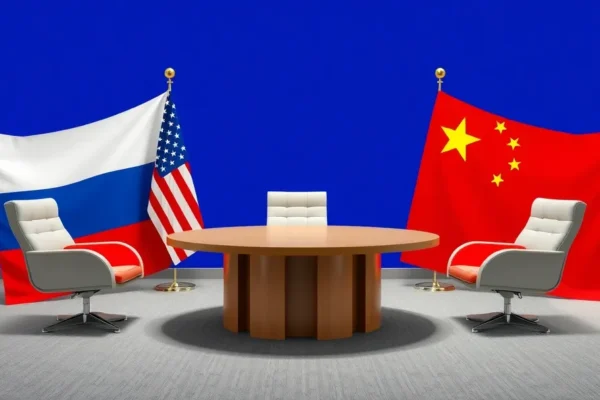
Russia Signals Openness to Russia-US-China Summit
Recent reports, notably from the Russian state news agency TASS, suggest that Moscow is open to the idea of a three-way summit involving Russia, the United States, and China. This potential Russia-US-China summit, a trilateral meeting that has been infrequently convened, comes at a time of heightened diplomatic tensions and complex international relations. The discussions, if they materialize, would likely involve key leaders such as Vladimir Putin, Joe Biden, and Xi Jinping, aiming to navigate a landscape increasingly defined by geopolitical competition and shifting global alliances. The willingness from Moscow to consider such a gathering, as reported, signals a potential shift in its approach to managing its relationships with the two other global powers.
Strategic Rationale Behind Moscow’s Potential Engagement
From a strategic perspective, Russia’s purported openness to a trilateral meeting can be understood as an effort to manage its complex foreign policy interests in a multipolar world. In the current geopolitical climate, where relations between Moscow and Washington are strained, and the relationship between Russia and China is multifaceted, a direct dialogue at the highest level could offer several strategic advantages. Firstly, it presents an opportunity to de-escalate existing tensions and establish clearer communication channels, particularly concerning issues like arms control, regional security in Eastern Europe, and the Indo-Pacific. Secondly, for Moscow, engaging in such a forum can be seen as an assertion of its global relevance and a way to shape the international agenda, rather than being passively subjected to it. The TASS report, citing unnamed diplomatic sources, hints at Russia’s desire to be a central player in discussions that impact global stability. This move aligns with a broader Moscow foreign policy objective of projecting influence and securing its national interests by actively participating in key global summits.
Competitive Context and Shifting Power Dynamics
The prospect of a Russia-US-China summit places these three major global powers in a dynamic competitive context. For the United States, under President Joe Biden, such a meeting could offer a chance to test the solidarity of the Russia-China alignment and explore areas of potential divergence. It also presents a platform to address critical global issues where cooperation, even with rivals, might be necessary, such as climate change or pandemic preparedness. For China, led by Xi Jinping, participating in a trilateral meeting allows Beijing to solidify its image as a responsible global stakeholder and to potentially influence the terms of global governance. It also provides an opportunity to gauge the strategic intentions of both Russia and the US. From a competitive standpoint, any perceived alignment or understanding reached during such talks could shift the balance of power. If Russia and China appear to be coordinating more closely, it would likely put increased pressure on the US and its allies. Conversely, if the summit reveals cracks in the Russia-China relationship, it could create new strategic openings for other global actors. The current geopolitical landscape is characterized by intense competition, and this potential summit is a significant development in that ongoing strategic maneuvering.
Industry Implications: Reshaping the Global Order
The implications of a successful Russia-US-China summit extend far beyond the immediate diplomatic sphere, impacting various global industries and sectors. In areas like energy, where Russia is a major producer and China a massive consumer, any agreements or understandings could influence global commodity prices and supply chains. In the technology sector, discussions about cybersecurity standards, data governance, and the future of artificial intelligence could set precedents for international regulations and market access. Defense and aerospace industries will closely watch for any shifts in strategic alliances or arms control agreements. The very fabric of global trade and investment can be influenced by the perceived stability or instability emanating from such high-level diplomatic engagements. If the summit leads to greater predictability and cooperation, it could foster a more favorable environment for global business. However, if it highlights deep-seated disagreements, it could lead to increased uncertainty and risk, potentially impacting cross-border investments and long-term strategic planning across industries. Peers in various sectors will likely be assessing how these geopolitical shifts might affect their operational strategies and market positioning.
Financial and Operational Impact: Navigating Uncertainty
The financial and operational impact of a Russia-US-China summit is inherently difficult to quantify precisely, as it hinges on the outcomes of the discussions. However, increased geopolitical stability, which such a summit could potentially foster, generally leads to more predictable market conditions, benefiting sectors reliant on global trade and investment. For instance, a de-escalation of tensions could lead to reduced risk premiums in financial markets, potentially boosting investor confidence and lowering the cost of capital for businesses operating internationally. Conversely, if the summit fails to yield concrete agreements or exacerbates existing tensions, businesses could face increased operational risks, supply chain disruptions, and volatile commodity prices. From an operational perspective, companies with significant exposure to Russia, China, or US markets might need to re-evaluate their risk management strategies, contingency plans, and supply chain resilience. The long-term financial impact will depend on whether any agreements reached translate into tangible policy changes that foster greater economic cooperation or, conversely, lead to increased fragmentation and trade barriers. Without specific announcements from the involved nations or detailed reports on potential agreements, projecting precise financial metrics remains speculative, but the overarching theme is one of managing strategic uncertainty.
Execution Risks and Challenges in Convening a Trilateral Meeting
The path to a successful Russia-US-China summit is fraught with significant execution risks and challenges. The current state of bilateral relations between the US and Russia, and the complex triangular dynamics between all three, present formidable obstacles. One primary risk is the potential for the summit to become a platform for public posturing rather than genuine negotiation, leading to a breakdown in communication and further entrenchment of existing positions. Historical precedents for such large-scale global summits show that outcomes are heavily dependent on the underlying willingness of all parties to compromise and engage constructively. For Russia, the challenge lies in balancing its strategic partnership with China against its desire to assert its independent foreign policy and to potentially leverage differences between the US and China. For the US, the concern might be about legitimizing certain Russian foreign policy actions by engaging at this level without achieving substantial concessions. Similarly, China faces the challenge of managing its relationships with both powers to its advantage. Organizational challenges include finding common ground on an agenda that satisfies all three nations and ensuring that any commitments made at the leadership level can be translated into actionable policies across their respective bureaucracies. Market or regulatory risks could emerge if the summit leads to new sanctions regimes or trade restrictions, impacting global commerce. Realistically, the difficulty in coordinating the interests and expectations of three such powerful and distinct nations means that any tangible progress would be a significant achievement.
Stakeholder Implications: A Global Ripple Effect
The implications of a Russia-US-China summit extend to a wide array of stakeholders. For employees within multinational corporations, increased geopolitical stability or instability directly affects job security, international assignments, and the overall business environment. Customers and clients could experience changes in product availability, pricing, and service delivery depending on how trade relations and supply chains are affected. Partners and suppliers will need to adapt to evolving market conditions and potential shifts in regulatory landscapes. Investor sentiment is particularly sensitive to geopolitical developments; a successful summit could boost market confidence and encourage investment, while a failed one could trigger volatility and risk aversion. The cultural and organizational shifts within governments are also notable, as diplomatic teams work to bridge significant divides. For the international community, the summit represents a critical juncture, where outcomes can either reinforce multilateral cooperation or underscore the trend towards geopolitical fragmentation, influencing global norms and international law.
Outlook and Next Steps: Monitoring for Strategic Shifts
Should a Russia-US-China summit take place and yield positive outcomes, the outlook could involve a period of cautiously managed de-escalation in key geopolitical flashpoints. Key milestones to watch would include any joint statements on arms control, regional security, or global health initiatives. Indicators of success might be the establishment of regular communication channels at various levels of government, or the announcement of specific, albeit potentially small, areas of cooperation. A timeline for measurable outcomes would likely be extended, as translating high-level agreements into concrete policy changes can take months or even years. Conversely, a failure to convene or a summit that ends with heightened rhetoric would signal continued diplomatic tensions and a more challenging period for international relations. In the short to medium term, market participants and industry observers will be keenly watching for any shifts in official policy statements from Moscow, Washington, and Beijing, as well as the actions of their respective diplomatic corps. The true impact will be revealed not just by the summit itself, but by the sustained follow-through and commitment of all parties involved.
Key Questions and Answers About the Russia-US-China Summit
Will a Russia-US-China summit actually happen?
While Russia has signaled openness to a Russia-US-China summit, its actual occurrence depends on the willingness of all three parties to agree on an agenda and find a mutually beneficial time. Past discussions about such meetings have not always materialized due to complex geopolitical considerations and existing diplomatic tensions.
Why is Russia interested in a trilateral meeting with the US and China?
Moscow’s interest in a trilateral meeting likely stems from a desire to assert its role as a major global power, manage its complex relationships with both the US and China, and potentially influence global agenda setting. It’s a strategic move within its Moscow foreign policy framework to navigate multipolarity.
What are the main geopolitical implications of such a summit?
The geopolitical implications are significant. A successful summit could lead to de-escalation in certain areas, potentially reshape global alliances, and influence the future of international relations. Conversely, a failed summit could exacerbate existing rivalries and deepen geopolitical divides.
How do Joe Biden and Xi Jinping view a potential Russia-US-China summit?
Both President Joe Biden and President Xi Jinping lead nations with complex relationships with Russia. Their perspectives would be shaped by strategic calculations regarding US-China relations, Russia-China cooperation, and opportunities to advance their respective national interests on the global stage.
What are the risks of holding a Russia-US-China summit?
The primary risks include the summit becoming a platform for grandstanding rather than constructive dialogue, failing to achieve any concrete outcomes, or inadvertently solidifying adversarial blocs. There’s also the risk that any agreements made may not be effectively implemented, leading to further disillusionment.
What are the chances of meaningful agreements coming out of a Russia-US-China summit?
Given the current level of diplomatic tensions and the divergent strategic interests of the three nations, the likelihood of sweeping, transformative agreements is generally considered low. However, incremental progress on specific, less contentious issues is possible, providing a foundation for future dialogue.
Business outcomes are subject to execution risk and external market conditions.











