

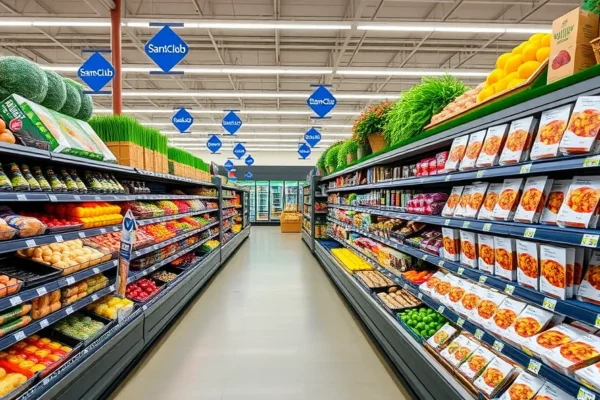
A New Strategy for the Kitchen Table
Sam’s Club, the membership-only retail division of Walmart Inc., is currently undergoing a significant shift in its approach to grocery shopping. Recent announcements from the company indicate a concentrated pivot toward fresh food, ready-to-eat meals, and expedited delivery services. This strategic move, which began gaining momentum throughout the 2023 fiscal year and into 2024, responds to evolving shopper behavior that prioritizes speed and quality without sacrificing the bulk-buy value proposition that defines the warehouse club model.
According to company earnings reports and executive statements from CEO Chris Nicholas, Sam’s Club is investing heavily in supply chain modernization to support these fresh categories. By integrating digital convenience tools with an enhanced culinary offering, the company aims to move beyond its traditional identity as a destination for dry goods and electronics, positioning itself instead as a primary grocery solution for the modern, time-pressed household.
The Strategic Push for Freshness and Speed
Why is Sam’s Club doubling down on fresh food now? The primary driver is a shift in consumer expectations. As retail trends evolve, households are increasingly looking for convenience food that bridges the gap between home-cooked meals and takeout. For a warehouse club, this represents a unique challenge: members want the low prices of bulk purchasing but require the immediate gratification of quick, high-quality, ready-to-cook options.
Strategically, this move solves a core growth problem. While dry goods offer high margins, fresh foods and prepared meals drive high-frequency visits. By increasing the frequency of trips, Sam’s Club deepens member loyalty and creates more opportunities for cross-selling. The company is leaning into this by optimizing its supply chain to reduce the time from farm to shelf, ensuring that its fresh offerings remain competitive with standard grocery retailers. This is not just a food initiative; it is a retention strategy designed to make the membership indispensable in the daily lives of consumers.
Navigating the Competitive Landscape
The landscape of the warehouse club industry is defined by a fierce rivalry between Sam’s Club and Costco Wholesale. While Costco has long held a reputation for high-quality fresh food, Sam’s Club is aggressively utilizing technology to differentiate its delivery services and digital shopping experience. By investing in its mobile app and “Scan and Go” technology, Sam’s Club aims to provide a frictionless experience that feels more modern than the traditional warehouse checkout.
This development creates a direct challenge for traditional supermarkets. While local grocery chains rely on convenience to justify higher price points, Sam’s Club is leveraging its massive scale to provide similar convenience at lower prices. This forces competitors to either lower their margins to compete on price or invest heavily in their own private-label prepared meal programs. The main winner in this dynamic is the consumer, though independent grocers who cannot match the supply chain efficiency of a national giant like Sam’s Club may find themselves increasingly squeezed.
Reshaping Industry Standards for Delivery
The broader retail industry is watching this move closely as it signals a maturation of food delivery models. For years, the industry struggled with the high costs associated with cold-chain logistics, which refers to the temperature-controlled supply chain required for fresh items. By refining its delivery services, Sam’s Club is setting a new benchmark for how large-format retailers can handle perishable goods at scale.
Industry peers are likely to respond by accelerating their own investments in digital infrastructure. We are seeing a trend where grocery shopping is no longer just about the physical store; it is about an omnichannel presence where the store acts as a fulfillment center. This is a sector-wide shift. Whether it is through proprietary delivery fleets or partnerships with third-party logistics firms, the ability to get fresh, high-quality food to the consumer’s doorstep with speed and safety has become the primary battleground in modern retail.
Financial and Operational Realities
From a financial perspective, the shift toward fresh food requires substantial capital expenditure. Warehouse clubs operate on thin margins, and the spoilage risks associated with fresh food can impact profitability if inventory management is not precise. According to recent quarterly data, Sam’s Club has seen strong membership growth, which justifies these investments in the short term. However, the long-term profitability of this strategy hinges on the company’s ability to maintain high inventory turnover.
Operationally, this move necessitates a structural shift in how stores are managed. Staff must now focus on food preparation and quality control alongside traditional inventory replenishment. The company is using data analytics to predict regional demand for specific ready-to-eat meals, allowing them to minimize waste. While this provides a strong path to revenue growth, the operational complexity is significantly higher than that of stocking non-perishable pantry items.
Execution Risks and Market Challenges
Despite the strategic logic, execution risk remains the primary hurdle. Fresh food is inherently more volatile than electronics or household goods. Supply chain disruptions, food safety concerns, and the difficulty of maintaining consistent quality across thousands of locations pose real dangers to the brand’s reputation. If Sam’s Club fails to deliver on the quality promise of its fresh food, it risks losing the very members it is trying to capture.
Historically, warehouse clubs have struggled with the balance between variety and simplicity. Adding too many ready-to-cook meal kits can lead to operational bottlenecks in the aisles and at the checkout. The company must carefully scale its ambitions to ensure that the “warehouse” experience—characterized by simplicity and efficiency—is not sacrificed for the sake of offering a vast menu of complex, perishable goods.
Impact on Members and Employees
For the Sam’s Club member, this shift represents a better value proposition. Access to affordable, high-quality convenience food allows households to reduce their reliance on expensive takeout and restaurant dining. For employees, the strategy requires new skill sets. The transformation of a warehouse worker into an associate capable of managing fresh food logistics and digital fulfillment is a significant cultural shift for the organization.
Investors have largely viewed these moves with optimism, as reflected in the stock performance of parent company Walmart. The market appreciates the commitment to digital transformation, viewing it as a defensive moat against Amazon and other e-commerce threats. The success of this strategy will be measured by its ability to increase the average “basket size” and improve the renewal rate of existing club members.
Outlook and Strategic Milestones
If this strategy succeeds, Sam’s Club will likely evolve into a hybrid model that functions as both a discount warehouse and a premium grocery provider. Key milestones to watch over the next 18 to 24 months include the expansion of private-label meal kit options and the reduction in delivery times for fresh items. Success will be evident if we see a sustained increase in high-frequency shopping trips among younger, urban-dwelling demographics.
Investors and analysts should monitor regional pilot programs as the company rolls out new delivery infrastructure. If the company can maintain its signature value proposition while providing the level of convenience found in high-end urban grocery stores, it will set a new, difficult-to-beat standard for the warehouse sector.
Strategic Q&A on Fresh Food at Sam’s Club
Will this strategy actually increase membership retention?
Yes, the analytical consensus suggests that increasing food-related touchpoints with members makes the membership more essential. By becoming a household’s primary source for both bulk goods and convenient, ready-to-eat meals, Sam’s Club creates a habitual reliance that is difficult for competitors to break.
Why didn’t Sam’s Club focus on meal kits sooner?
The company prioritized scaling its foundational warehouse business and digital infrastructure before moving into the high-complexity, high-spoilage category of fresh, ready-to-eat meals. They waited for the cold-chain logistics and data analytics to reach a maturity level where the risks to the bottom line could be managed effectively.
What are the risks of this pivot?
The primary risks are operational. Managing perishable inventory is vastly different from managing non-perishables. If the company experiences high levels of food waste or if quality varies significantly by location, it could damage the brand’s premium value proposition and hurt operating margins.
How does this impact the store environment?
Shoppers may notice a shift toward more refrigerated display space and increased focus on front-of-house meal solutions. This requires a store layout that prioritizes high-traffic flow for refrigerated items, which is a departure from the traditional, long-aisle warehouse format.
How long until we see measurable results?
We should look for evidence of success in upcoming quarterly earnings reports, specifically in the “grocery” category growth metrics and digital adoption rates. Full integration of these fresh food strategies across the entire store footprint is a multi-year project, so long-term impact will be more accurately assessed over the next two fiscal years.
Note: All business strategies and forward-looking statements described herein are subject to significant execution risk. Market success depends on complex variables including supply chain stability, consumer demand, and competitive responses, and no specific business outcome is guaranteed.











