

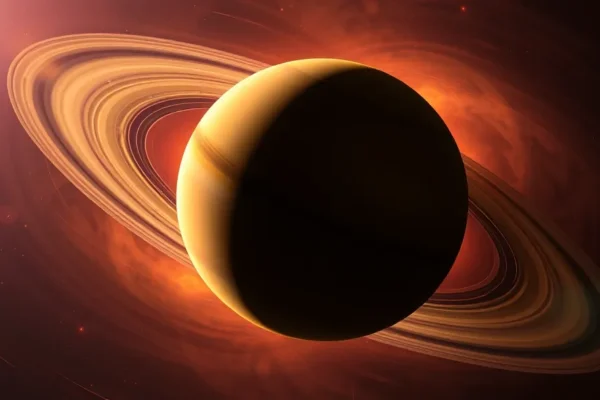
The New Mystery of the Saturn Geometric Shape
For decades, astronomers have been fascinated by the strange, orderly patterns found within the chaotic clouds of Saturn. The most famous of these is the Saturn hexagon, a massive, six-sided jet stream swirling around the planet’s north pole. However, recent astronomical findings suggest that this is not an isolated incident. Scientists have identified evidence of another potential Saturn geometric shape emerging within the planet’s mid-latitude atmospheric layers.
This discovery is not about a physical object like a crystal or a solid structure. Instead, it refers to highly organized, polygonal patterns within the Saturn atmospheric phenomena. These patterns are formed by the movement of gases and clouds, creating shapes that appear almost too perfect to be natural. This breakthrough is significant because it challenges our current understanding of how much order can exist within a turbulent gas giant planet.
The research driving these insights comes from a combination of decades of data collected by NASA’s Cassini mission and modern, high-resolution computational fluid dynamics. Researchers are using these tools to move beyond mere observation, attempting to recreate the very physics that allow such a perfect shape Saturn to exist. This represents a shift from asking “what is there” to “why does it form this way.”
The Physics Behind Planetary Geometry
To understand how a gas giant can produce a geometric shape, one must look at the intersection of celestial mechanics and fluid dynamics. A gas giant planet like Saturn does not have a solid surface. Its atmosphere is a deep, churning ocean of hydrogen and helium, driven by intense heat from the planet’s interior and the rotation of the planet itself.
Think of it like a massive, swirling bathtub. If you spin the water in a circular motion, you create various vortices and whirlpools. Now, imagine that the bathtub is spinning at incredibly high speeds and is being hit by different currents of water from multiple directions. The interaction of these currents can create stable, repeating patterns. In the case of Saturn, these patterns are known as Rossby waves.
Rossby waves are large-scale oscillations in the planetary atmosphere. They are caused by the variation in the Coriolis effect, which is the force that deflects moving objects due to the planet’s rotation. On Saturn, these waves can become “trapped” within certain latitudes. When these waves interact with the powerful jet streams—the high-speed “wind belts” that circle the planet—they can lock into a stable, repeating geometric pattern. This is how a hexagon or other polygonal shapes can emerge from what looks like a chaotic storm.
The core mechanism involves a delicate balance between the speed of the winds and the force of the planet’s rotation. If the winds are too fast or the rotation is too slow, the shape breaks apart into random turbulence. If the balance is just right, the atmosphere settles into a stable, geometric structure that can persist for years.
Current Scientific Capabilities and Applications
Today, we are in a period of intense data synthesis. While the Cassini spacecraft completed its mission in 2017, the scientific community is only now beginning to fully unlock the secrets hidden within its massive datasets. We are no longer just looking at pictures; we are using supercomputers to run “virtual Saturns” that allow us to test different atmospheric theories.
The technology used here is known as Computational Fluid Dynamics (CFD). This involves using complex mathematical equations to simulate how fluids—in this case, gases—move and interact. This level of research is currently in a stage of advanced maturity, where scientists are moving from basic simulations to high-fidelity models that can predict specific weather patterns on other planets.
The applications of this research extend far beyond our own solar system. By understanding how geometric shapes form in the atmosphere of a gas giant, astronomers can better interpret the light signatures coming from exoplanets—planets orbiting other stars. When we look at a distant planet, we cannot see its shapes directly; we can only see how its atmosphere absorbs and reflects light. Understanding the Saturn geometric shape helps us build the “translation key” needed to understand the weather on worlds trillions of miles away.
The Competitive Landscape of Planetary Modeling
The effort to map the atmospheres of gas giants is not a single-track race. There are several competing approaches to modeling these complex environments. On one side, you have the traditional observational astronomers, who focus on collecting the highest possible resolution data from telescopes and space probes. Their advantage lies in the raw accuracy of their findings.
On the other side are the theoretical physicists and computational scientists. They do not necessarily need a new telescope; they need better algorithms. They build mathematical models to see if they can “grow” a hexagon or a pentagon inside a computer simulation using only the laws of physics. Their advantage is the ability to test “what if” scenarios—such as what would happen if Saturn rotated twice as fast—which is impossible with real-world observation.
Currently, the most successful approach is a hybrid one. The observational data provides the boundaries of reality, while the computational models provide the explanation. The differentiator in this field is the sheer scale of computing power. The teams that can simulate the most layers of the atmosphere with the highest precision are the ones leading the way in explaining these unexplained phenomena.
Impact on Our Understanding of the Universe
The discovery of structured geometry in a chaotic environment has profound implications for how we view the cosmos. It suggests that order is a fundamental byproduct of physics, even in the most extreme environments. This shifts our perspective from seeing space as a place of random destruction to seeing it as a place of complex, predictable organization.
In the short term, this research refines our ability to navigate and study the solar system. In the long term, it has significant economic and social implications for the future of space exploration. As we prepare for missions to the moons of Jupiter and Saturn, such as the upcoming Europa Clipper, knowing how the atmospheres and gravitational pulls of these giants work is essential for landing spacecraft and ensuring their survival.
Furthermore, this knowledge accelerates our search for life. If we can accurately model the atmospheric stability of gas giants, we can more easily identify “habitable zones” around other stars. If a planet’s atmosphere is too turbulent, it might be inhospitable; if it shows signs of stable, organized weather patterns, it might be a much better candidate for further investigation.
Challenges and Technical Bottlenecks
Despite the excitement, there are significant limitations to our current understanding. The primary challenge is the sheer distance. Even with our most advanced telescopes, we are looking at Saturn through a thick veil of cosmic dust and distance. We cannot see “under” the clouds to see if these geometric shapes exist deep within the planet or if they are merely surface phenomena.
Another major bottleneck is the limitation of our current supercomputers. Simulating a whole planet with high precision requires more processing power than we currently possess. Most models have to make “simplifications”—they assume certain gases behave in certain ways or they ignore certain layers of the atmosphere to save on computing time. These simplifications can lead to errors in the model, meaning we might be seeing a “perfect” shape in our computer that wouldn’t actually exist in reality.
Finally, there is the problem of data aging. Much of our best data comes from the Cassini mission, which ended years ago. As our technology evolves, we find that older data may not have the resolution required to confirm the newest, more subtle geometric theories. We are essentially trying to build a high-definition map using a standard-definition photograph.
The Future Trajectory of Planetary Science
The next decade will be a transformative era for space discovery. The James Webb Space Telescope (JWST) is already beginning to provide new insights into the chemical compositions of planetary atmospheres, which will provide the necessary “ingredients” for better fluid dynamic models.
We are also looking toward a future of dedicated atmospheric probes. While current plans focus heavily on moons like Titan or Europa, the success of these missions will likely lead to new proposals for “atmospheric skimmers”—small, highly resilient probes designed to dive into the upper layers of gas giants to take direct measurements.
According to current scientific trajectories, we expect to see a breakthrough in “global circulation models” within the next ten to fifteen years. This will likely be driven by the advent of quantum computing, which could potentially handle the massive, multi-dimensional equations required to simulate a planetary atmosphere without the need for simplifications. This will allow us to move from predicting shapes to predicting the exact movement of a single storm on Saturn.
Frequently Asked Questions
Is the Saturn geometric shape a solid object?
No, the Saturn geometric shape is not a solid object. It is a pattern formed by the movement of clouds and gases within the planetary atmosphere, created by the interaction of winds and planetary rotation.
Why are these shapes considered “perfect”?
In mathematics and physics, these shapes are called “perfect” because they exhibit highly organized, repeating geometric symmetry that stands out against the otherwise chaotic and turbulent background of the gas giant’s atmosphere.
How can we see shapes on a planet so far away?
We do not see them with the naked eye. We use sophisticated spacecraft like Cassini and high-powered telescopes to capture images, which are then analyzed using complex mathematical models to identify the geometric structures.
Could these shapes exist on Earth?
While Earth has organized weather patterns like hurricanes, it lacks the specific combination of rapid rotation and deep, gas-only layers required to create permanent, large-scale polygonal shapes like the Saturn hexagon.
Will we send humans to study these shapes?
It is highly unlikely. Saturn is a gas giant with no solid surface and extreme pressure and radiation. Future exploration will likely rely on robotic probes and advanced remote sensing technology rather than human travelers.
What is the main difference between the hexagon and this new discovery?
The well-known Saturn hexagon is located at the north pole, while the newer findings suggest similar, potentially different geometric patterns occurring in the mid-latitude jet streams of the planet.
Note: This article is based on current astrophysical research and computational models. Scientific understanding of planetary atmospheres is an evolving field, and new data may alter these conclusions.











