

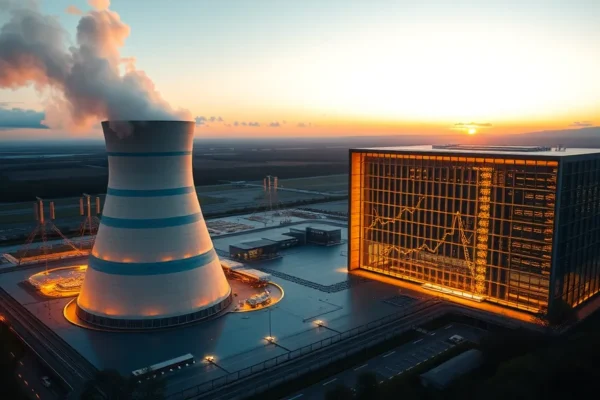
Powering the Future of AI: TerraPower’s Nuclear Leap for Data Centers
The insatiable demand for artificial intelligence (AI) is creating an unprecedented surge in energy consumption. As AI models become more complex and data centers proliferate, the need for reliable, large-scale, and crucially, carbon-free power sources has never been more urgent. Enter TerraPower, a company founded by Bill Gates, with its innovative approach to nuclear energy. TerraPower’s advanced reactor designs, particularly its Natrium reactor, offer a compelling competitive edge for the energy-intensive AI data center industry, promising a future where AI’s growth doesn’t come at the expense of our planet.
Understanding TerraPower’s Nuclear Innovation
TerraPower is developing advanced nuclear reactor technologies, aiming to provide safe, cost-effective, and emission-free electricity. Their flagship project, the Natrium reactor, is a type of Small Modular Reactor (SMR). SMRs are designed to be smaller, more factory-built, and easier to deploy than traditional large-scale nuclear power plants. The core problem TerraPower’s technology aims to solve is the challenge of providing consistent, massive amounts of power that data centers require, while simultaneously addressing the growing global imperative for sustainable energy solutions. This is particularly significant now as the rapid expansion of AI necessitates a fundamental rethink of how we power these digital hubs.
The company announced in late 2023 that it selected Wyoming for its first Natrium demonstration project, signaling a tangible step toward commercialization. This project, in partnership with PacifiCorp (a Berkshire Hathaway Energy company), is designed to demonstrate the technology’s viability for grid-scale power generation, a crucial precursor to its adoption by energy-hungry industries like AI data centers.
How TerraPower’s Reactors Work
At its heart, TerraPower’s Natrium reactor uses a molten salt fast reactor design. This differs from the water-cooled reactors that have been dominant for decades. Think of it like a more efficient, safer, and flexible engine. Instead of using regular water as a coolant, the Natrium reactor uses a liquid salt mixture that can operate at much higher temperatures. This high-temperature operation allows for more efficient electricity generation and, importantly, the ability to store excess heat in a molten salt storage tank.
This molten salt storage tank is key. Imagine a large thermos filled with hot salt. When electricity demand is low, the reactor can heat up more salt and store it. When demand spikes, the stored hot salt can be used to quickly generate steam and produce electricity, without needing to ramp up the nuclear reaction itself. This inherent flexibility makes it an ideal partner for the sometimes unpredictable energy needs of large industrial users, including data centers, and can help stabilize the broader power grid. Crucially, these reactors are designed to be inherently safer, with a passive cooling system that relies on natural forces like gravity and convection, rather than active pumps, to manage heat if power is lost.
Current State and Real-World Applications
Currently, TerraPower’s advanced reactor designs are in the demonstration and development phase. The first commercial-scale Natrium plant is planned for Wyoming, with construction expected to begin in 2025 and operation targeted for 2030, according to company statements. While no TerraPower reactors are currently generating commercial electricity, the company is actively engaged in licensing, design finalization, and supply chain development. The primary envisioned application for these reactors is to provide reliable, carbon-free baseload power to the electricity grid. However, the specific characteristics of the Natrium design, particularly its flexibility and potential for on-site heat integration, make it an attractive prospect for industries with massive and consistent energy demands, such as AI data centers. The energy consumption of AI data centers is already a significant concern, and the availability of advanced nuclear power could fundamentally change the calculus for their expansion.
The Competitive Landscape in Nuclear Energy
TerraPower is not alone in the race to develop next-generation nuclear power. Numerous companies globally are pursuing various SMR designs, each with its own technological approach and target market. Competitors include NuScale Power, which is developing a pressurized water SMR, and GE Hitachi Nuclear Energy, with its BWRX-300 boiling water reactor SMR. Other advanced reactor concepts, like those using different fuel types or cooling mediums, are also under research and development by entities like Rolls-Royce and Westinghouse.
TerraPower’s competitive edge lies in its unique molten salt fast reactor technology and its integrated energy storage capability. This storage offers a distinct advantage for managing fluctuating power demands, which is particularly relevant for AI data centers that can experience rapid shifts in energy usage. While other SMRs offer modularity and safety benefits, TerraPower’s ability to provide dispatchable, on-demand carbon-free power, coupled with its potential for higher thermal efficiency, sets it apart. The company’s association with Bill Gates and its strong financial backing also contribute to its visibility and momentum in a capital-intensive industry.
Implications and Impact on the Tech Industry
The successful deployment of TerraPower’s reactors could revolutionize how AI data centers are powered. Currently, many data centers rely heavily on the existing power grid, which is often still dominated by fossil fuels. This leads to a significant carbon footprint. TerraPower’s technology offers a path to provide massive amounts of sustainable energy, directly powering data centers or supplying clean electricity to the grid that serves them. This could enable the continued exponential growth of AI without a proportional increase in greenhouse gas emissions. Economically, this could lead to the creation of new high-skilled jobs in nuclear engineering, construction, and operations, as well as boost the localized economies where these reactors are built. Socially, it offers a tangible solution to the environmental concerns surrounding the rapid expansion of AI and digital infrastructure.
In the short term, the impact will be limited to the demonstration phase. However, in the long term, widespread adoption of advanced nuclear reactors like TerraPower’s could fundamentally alter the energy landscape for the tech sector, enabling a truly sustainable digital future. This shift towards cleaner energy sources is also being driven by increasing pressure from investors and the public for tech companies to demonstrate genuine commitment to carbon-free operations.
Limitations and Challenges Ahead
Despite the promising technology, TerraPower faces significant hurdles. The primary challenge is the demonstration project itself: proving the Natrium reactor can be built on time, on budget, and operate as designed. Nuclear energy projects are notoriously complex and expensive, and SMRs, while designed to be more cost-effective, still represent a substantial capital investment. Regulatory approval processes for new reactor designs are lengthy and rigorous, a critical factor that could impact deployment timelines. Public perception and acceptance of nuclear energy, though evolving, remain a consideration in many regions.
Furthermore, scaling up the manufacturing and supply chain for SMRs is a challenge that the entire industry is grappling with. The expertise and specialized materials required for nuclear construction are not as readily available as for other energy technologies. For AI data centers specifically, integrating a nuclear reactor directly on-site, while theoretically efficient, brings unique security and operational complexities. The initial cost of deploying these advanced reactors will likely be higher than traditional power sources, requiring significant upfront investment from data center operators or utility partners.
The Future Trajectory of TerraPower’s Technology
The future trajectory for TerraPower hinges on the success of its Wyoming demonstration project. If the Natrium reactor proves its viability and cost-effectiveness, it could pave the way for wider commercial deployment. We can expect to see further advancements in reactor design for increased efficiency and reduced costs, as well as innovations in fuel cycle management and waste disposal. TerraPower’s strategic partnerships with energy providers suggest a model where they supply power to the grid, which then serves industries like AI data centers. However, the possibility of dedicated, smaller-scale reactors for very large industrial complexes, including hyperscale data centers, could emerge as the technology matures.
Key developments to watch include progress on the Wyoming project’s construction milestones, updates on the licensing process, and potential new partnerships. As the AI sector continues its rapid expansion, the pressure to secure clean and reliable energy will only intensify, making advanced nuclear solutions increasingly attractive. Experts generally agree that SMRs, including TerraPower’s design, represent a critical component of the future low-carbon energy mix, but widespread commercial adoption is likely still a decade or more away for most applications.
Key Questions and Answers About TerraPower and AI Data Centers
What is TerraPower’s primary contribution to powering AI data centers?
TerraPower’s advanced nuclear reactor design, particularly the Natrium SMR, offers a potential source of large-scale, reliable, and carbon-free power crucial for the immense energy consumption of AI data centers.
How does TerraPower’s technology differ from traditional nuclear power?
TerraPower’s Natrium reactor uses molten salt as a coolant, allowing it to operate at higher temperatures and incorporate energy storage, offering greater flexibility and efficiency compared to traditional water-cooled reactors.
Is this technology ready for immediate use by AI data centers?
No, TerraPower’s reactors are currently in the demonstration and development phase. The first commercial plant is targeted for operation around 2030, meaning widespread availability for new data centers is still some years away.
Who are TerraPower’s main competitors in the SMR space?
Key competitors include NuScale Power and GE Hitachi Nuclear Energy, among others developing various Small Modular Reactor designs.
What are the biggest challenges for TerraPower and its AI data center applications?
Challenges include proving the technology’s economic viability, navigating complex regulatory approvals, scaling up manufacturing, and ensuring public acceptance of nuclear energy.
How long until TerraPower’s nuclear energy significantly impacts the AI data center industry?
Realistically, significant impact will likely be felt in the mid-to-late 2030s, contingent on the successful deployment and commercialization of their initial demonstration projects.
This article discusses emerging technologies and future potential. Claims about capabilities and timelines are based on company announcements and expert projections, and actual outcomes may vary. Further research and development are ongoing, and challenges related to cost, regulation, and public acceptance remain critical factors for successful deployment.











