

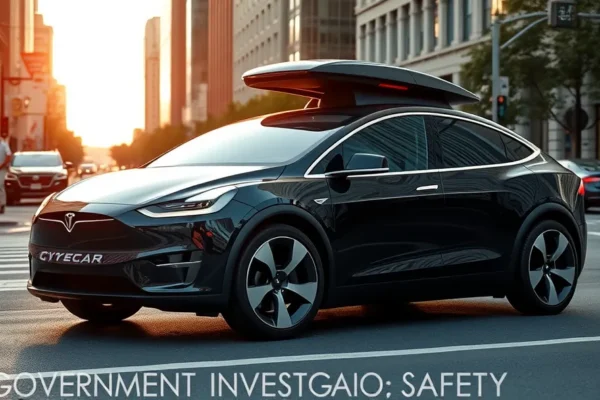
Meet the Tesla Cybercab: The Future of Transport or a Regulatory Headache?
Tesla has officially unveiled the Cybercab, their highly anticipated robotaxi, and it’s already making waves. This isn’t your typical car; imagine a sleek, futuristic pod designed from the ground up to drive itself. The big news? It ditches the steering wheel and pedals entirely, aiming to be a fully autonomous ride-sharing vehicle. For those of us who’ve dreamt of just hopping in a car and letting it whisk us away, the Cybercab promises to solve the hassle of driving, parking, and the general stress of commuting. It’s designed for anyone who uses ride-sharing services, businesses looking for efficient transport, or tech enthusiasts eager to experience the cutting edge of self-driving cars. With its ambitious design, the Cybercab launch has naturally sparked significant interest and, crucially, immediate scrutiny from the US government.
How the Cybercab Works in the Real World
So, what does a day with the Tesla Cybercab look like? Picture this: you’re running late for a meeting across town. Instead of hailing a regular ride-share, you pull out your phone, open the Tesla app, and request a Cybercab. A few minutes later, one arrives, looking like it just drove off a sci-fi movie set. You unlock it with your phone, and the door glides open. You settle into the comfortable passenger cabin, which might feel more like a lounge than a car interior. There are no controls for you to worry about – just sit back, relax, or catch up on emails. The Cybercab navigates through traffic, picks the best routes, and drops you off right at your destination.
Here are a couple of scenarios:
- For the Frequent Traveler: Imagine arriving at a new city’s airport. Instead of figuring out rental cars or expensive taxis, you pre-book a Cybercab. It’s waiting for you, ready to take you to your hotel efficiently and without you needing to navigate unfamiliar roads.
- For the Busy Parent: Juggling school runs, grocery shopping, and appointments can be exhausting. A fleet of Cybercabs could potentially handle those errands for you. You could schedule a pickup to take the kids to soccer practice while you finish up work, or have one pick up your groceries on its way home.
- For City Dwellers: Commuting in a busy city is often a chore. The Cybercab aims to make this seamless. You could use it for your daily commute, reclaiming that time to read, listen to podcasts, or simply decompress.
Who Should Be Excited About the Cybercab?
The Tesla Cybercab is clearly aimed at a specific segment of the market, but its potential reach is broad.
Best for: Early adopters, tech enthusiasts, and companies in the transportation or logistics sector who are keen to explore the frontier of autonomous ride-sharing. If you’ve been following Tesla’s Full Self-Driving (FSD) technology and are eager to experience its most advanced application, this is for you.
Good for: Regular users of ride-sharing services who prioritize convenience and are comfortable with technology. People who travel frequently for business or leisure and want a reliable, potentially more affordable, way to get around unfamiliar cities. Also, individuals who dislike driving or are looking for ways to reduce their reliance on personal vehicles.
Skip if: You’re someone who enjoys the act of driving and the control it provides. If you have concerns about the current limitations of autonomous vehicle technology, especially its regulatory compliance and safety standards. The absence of manual controls might be a significant drawback for many. Also, if you live in an area where robust 5G or Wi-Fi infrastructure is lacking, the reliance on constant connectivity could be an issue.
How the Cybercab Stacks Up Against Alternatives
Currently, the most direct alternatives to the Cybercab are traditional ride-sharing services like Uber and Lyft, and the prospect of owning a self-driving car in the future.
Compared to Uber and Lyft, the Cybercab promises a more integrated and potentially more efficient experience, especially if Tesla manages to build out its own fleet and network. The key difference is the full autonomy; you’re not getting a human driver. This could lead to lower per-mile costs for consumers in the long run if Tesla can scale effectively. However, traditional services offer immediate availability and a human element if needed.
The concept of owning a personal self-driving car is another alternative, but Tesla’s approach with the Cybercab is more about service than ownership, similar to how you’d use a taxi or ride-share. While Tesla does offer FSD on its consumer vehicles, the Cybercab is a dedicated autonomous vehicle platform.
In terms of safety and regulatory compliance, the Cybercab is facing significant scrutiny. Unlike existing ride-sharing vehicles that have human drivers responsible for adhering to road rules, the Cybercab’s entirely driverless nature puts a spotlight on its ability to meet stringent vehicle safety standards. This is where the NTSA probe becomes crucial.
Getting Started with the Cybercab: Setup and Ease of Use
For the end-user, the setup and use of the Cybercab are designed to be as simple as ordering a pizza. You won’t be installing anything or learning complex procedures.
- Getting Started: The primary interaction will be through a mobile app, likely Tesla’s existing app. You’ll book your ride, confirm your pickup location, and the app will guide you on when and where to expect your Cybercab.
- Ease of Use: Once the Cybercab arrives, you’ll likely use your smartphone to unlock the doors. Inside, it’s all about the passenger experience. There are no buttons or controls for you to operate; it’s designed to be intuitive – you get in, sit down, and go.
- Learning Curve: For passengers, there’s virtually no learning curve. It’s meant to be as simple as using any other ride-sharing service. The complexity lies entirely within the vehicle’s autonomous driving system and its navigation software.
- Common Frustrations: Potential frustrations might arise from the app not being intuitive, difficulty in locating the vehicle in busy areas, or the vehicle’s inability to understand complex pickup requests. However, these are common to most ride-sharing services.
Real-World Pros of the Cybercab
The Tesla Cybercab, if it lives up to its promise, offers several significant advantages for daily life.
- Ultimate Convenience: Imagine never having to worry about parking, traffic jams, or the stress of driving again. You can use your travel time for work, relaxation, or entertainment. This offers a glimpse into a future where transportation is truly a service.
- Potential Cost Savings: Over time, a fully autonomous fleet could theoretically reduce operating costs, translating into lower fares for riders compared to services that pay human drivers. This is a key selling point for widespread adoption.
- Increased Accessibility: For individuals who cannot drive due to age, disability, or lack of license, the Cybercab could offer unprecedented freedom and independence.
- Futuristic Experience: Beyond practicality, it offers a novel and exciting experience, allowing consumers to be at the forefront of technological innovation in transportation.
- Designed for Passengers: The interior is conceived as a comfortable space for riders, prioritizing comfort and functionality over driver controls. This could make travel more pleasant and productive.
Real-World Cons and Limitations of the Cybercab
Despite the excitement, the Cybercab faces significant hurdles and potential drawbacks.
- Regulatory Uncertainty and Safety Concerns: The most immediate con is the ongoing US government investigation into its safety, particularly due to the lack of a steering wheel and pedals. This probe by the NTSA raises questions about its compliance with current vehicle safety standards and its readiness for widespread public deployment. The safety of driverless technology in all conditions is still a concern for many.
- Dependence on Technology and Infrastructure: The Cybercab will rely heavily on advanced sensors, software, and potentially constant connectivity (5G/Wi-Fi) for navigation and operation. Any technological glitches, sensor failures, or loss of connectivity could lead to disruptions or safety issues.
- Limited Availability and Geographic Restrictions: Initially, the Cybercab will likely be available only in select, carefully mapped urban areas where Tesla is confident in its autonomous system’s performance. This means it won’t be an option for everyone, everywhere, anytime soon.
- Public Trust and Acceptance: While some are eager, many consumers are still wary of fully autonomous vehicles. Building public trust in a driverless system, especially one without traditional safety controls like a steering wheel, will be a significant challenge.
- The “What If” Factor: In unforeseen situations or emergencies, the absence of a human driver to take immediate, nuanced control could be a critical limitation.
Price, Value, and Affordability
The pricing structure for the Tesla Cybercab is still emerging, but the goal is to position it as a competitive and potentially more affordable alternative to current ride-sharing or car ownership in the long run.
- Cost of Entry: It’s not about buying the Cybercab as a personal vehicle; it’s about using it as a service. Pricing will likely be on a per-mile or per-ride basis, similar to Uber or Lyft. Tesla has indicated a goal of making it significantly cheaper than owning a car or using current ride-hailing.
- Value Proposition: The value hinges on convenience, time savings, and potentially lower operational costs. For frequent users of ride-sharing or for those looking to ditch car ownership, the value could be substantial.
- Hidden Costs: For consumers, there might not be many hidden costs beyond the fare itself. For Tesla, the massive investment in technology, fleet maintenance, and regulatory compliance represents the significant cost.
- Comparison to Alternatives: If Tesla can deliver on its cost projections, it could undercut Uber and Lyft. However, compared to public transport or cycling, the cost-per-mile might still be higher.
- Budget Alternatives: For those seeking budget-friendly transport, traditional public transportation, cycling, or even older models of ride-sharing services remain the most affordable options for now.
The Verdict: Who Should Get the Cybercab?
The Tesla Cybercab represents a bold leap into the future of transportation, but it’s crucial to understand who it’s truly for right now.
You should consider the Cybercab if: You are an enthusiastic early adopter of new technology, a frequent user of ride-sharing services in a city where it’s available, and you are excited by the prospect of fully autonomous travel without the need for human intervention. If the idea of reclaiming commute time for productive or relaxing activities appeals greatly, and you’re comfortable with the current stage of driverless technology and its ongoing regulatory scrutiny.
You should wait or look elsewhere if: You have any reservations about the safety or reliability of driverless cars, especially in the absence of a steering wheel and pedals. If you live outside of its initial deployment zones, or if you enjoy the act of driving and the control it offers. Consumers who prioritize immediate and widely available transportation options or those who are budget-conscious might find current alternatives more suitable.
Ultimately, the Cybercab is a glimpse into a potential future. Its immediate value is in its innovation and what it represents for autonomous vehicle technology. However, widespread adoption and true everyday practicality will depend heavily on navigating regulatory hurdles, building public trust, and proving its safety and reliability in diverse real-world conditions. It’s an exciting development, but one that requires patience and a clear understanding of its current limitations.
Common Questions About the Tesla Cybercab
What exactly is the Tesla Cybercab?
The Tesla Cybercab is an all-electric, fully autonomous vehicle designed specifically for ride-sharing. It notably lacks traditional controls like a steering wheel and pedals, operating entirely without a human driver.
Is the Cybercab available now?
As of its official launch, the Cybercab is not yet widely available for public use. It is undergoing development, testing, and facing regulatory review. Availability will likely be phased, starting in select markets.
Why is the US government investigating the Cybercab?
The US government, through agencies like the NTSA, is investigating the Cybercab due to its lack of a steering wheel and pedals. This raises questions about its compliance with existing vehicle safety standards and how it will ensure passenger and public safety in all driving scenarios.
How much will the Tesla Cybercab cost to ride?
Tesla aims for the Cybercab to be significantly cheaper than current ride-sharing services or car ownership. Pricing will likely be on a per-mile or per-ride basis, but specific rates are yet to be finalized for widespread public service.
Is Tesla’s Full Self-Driving (FSD) the same as the Cybercab?
While the Cybercab utilizes advanced autonomous driving technology, similar to what Tesla aims for with its FSD system in consumer cars, the Cybercab is a purpose-built robotaxi designed for zero human intervention. It represents a more advanced and dedicated application of driverless technology.
Will the Cybercab be safe without a steering wheel and pedals?
This is the central question being addressed by the government investigation. Tesla claims its advanced sensor suite, AI, and redundant systems will ensure safety. However, the public and regulators are still evaluating the robust safety of such a system in all potential driving conditions.
Product prices and availability vary by region. Verify current pricing before purchase.











