

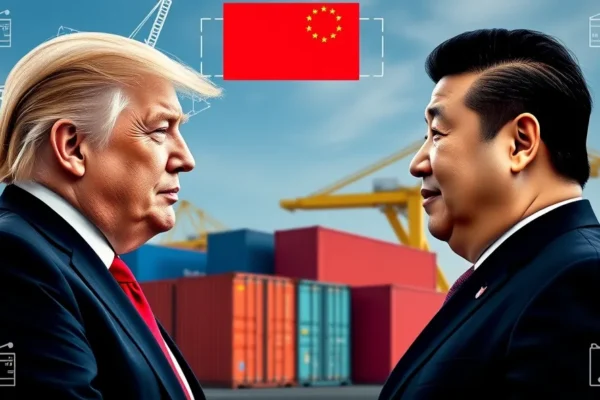
Understanding the Impact of International Trade Standoffs
At its core, a trade standoff is like a high-stakes negotiation between two households that buy and sell goods from one another but suddenly disagree on the rules of the game. When countries like the United States and China engage in a trade war, they are essentially arguing over the terms of their economic relationship. A trade war occurs when countries impose tariffs on each other. A tariff is a tax placed on imported goods, making products from the other country more expensive for local buyers.
Think of it like a neighborhood lemonade stand. If you and your neighbor agree to trade lemonade for cookies at a fair price, both sides benefit. But if one side suddenly adds a 20% tax to every cookie coming across the driveway, the other side will likely stop buying cookies or start taxing the lemonade in retaliation. Understanding this is vital because international trade is the engine that keeps global markets running. When this engine sputters, it affects the prices you pay at the grocery store and the value of your retirement savings.
How Global Trade Mechanisms Work
Trade relations function through complex supply chains. Imagine a smartphone: parts are designed in the US, manufactured in Asia, and assembled in China before being shipped globally. When the US and China experience economic tensions, they often use tariffs as leverage to force policy changes.
Consider a real-world scenario: if the US government places a tariff on imported steel from China to protect domestic steelworkers, the price of that steel rises. A US car manufacturer that relies on that cheap steel now has to spend more to build a vehicle. To maintain their profit margins, they raise the price of the car for you, the consumer. If China then hits back with tariffs on American agricultural products like soybeans, American farmers lose their biggest customers. This cycle of retaliation creates uncertainty, which makes business leaders hesitant to invest or hire new staff, ultimately slowing down the broader economy.
Why the Standoff Impacts Your Wallet
The US-China trade situation feels distant, but it touches your finances in several direct ways. First, there is inflation. When tariffs make imported components more expensive, those costs are passed down the chain. If it costs more to move and build things, the final price of everything from laptops to sneakers tends to go up.
Second, it affects your investments. Most retirement accounts, like 401(k)s, hold stocks in large companies that do business globally. When news of a trade war breaks, stock markets often drop because investors fear that lower profits and trade barriers will hurt company earnings. While those who benefit from protected domestic industries might see a temporary boost, the global economic slowdown generally creates an environment of risk that affects almost every investor.
The Current State of US-China Trade Relations
The history of this friction dates back to long-standing concerns regarding intellectual property, market access, and trade imbalances. According to the Office of the United States Trade Representative, the trade deficit with China has been a primary driver of US policy for years. Recent years have seen these diplomatic relations fluctuate from aggressive tariff hikes to temporary truces.
The most recent diplomatic meetings have been marked by a lack of significant progress. While officials continue to hold talks, the core issues remain unresolved. The upcoming discussions involving Trump and Xi are highly anticipated because leadership-level dialogue is often the only way to break the gridlock. Markets react sharply to these meetings; if Trump and Xi find common ground, global markets often rally on the hope of stability. If the meetings end without a clear roadmap, the economic tensions usually persist, keeping global trade in a state of suspended animation.
Practical Implications for Your Financial Decisions
When you see headlines about Trump and Xi or the state of US-China trade, you do not need to panic. However, it is a reminder to keep your financial house in order. During times of geopolitical uncertainty, the stock market can become volatile, meaning prices fluctuate more than usual. This is why having a diversified portfolio, which is the practice of spreading your money across many different types of investments, is so important. By not putting all your eggs in one basket, you reduce the risk that one specific trade event will ruin your long-term goals.
A common misconception is that you can “win” during a trade war by timing the market. This is rarely successful for individual investors. Instead, focus on your time horizon. If you are investing for retirement twenty years away, the short-term ups and downs caused by trade negotiations are usually just background noise. Watch for news regarding supply chain stability and inflation, as these are better indicators of your day-to-day purchasing power than any single day of diplomatic negotiations.
Connecting the Dots to Other Financial Concepts
Understanding the current US-China trade standoff connects directly to other fundamental financial concepts. For instance, the trade deficit is closely tied to currency valuation; when countries trade, they must exchange currencies, which affects the strength of the dollar. Additionally, this topic relates to supply chain management and geopolitical risk, both of which are essential components of macroeconomics. Understanding these concepts helps you see why the Federal Reserve might adjust interest rates in response to trade-related inflation.
Frequently Asked Questions
How does the trade war affect inflation in the US?
When tariffs are applied to imported goods, businesses often pass those additional costs on to consumers, leading to higher prices at the register. This contributes to inflation, which is the general increase in the price of goods and services over time.
Can individual investors control the impact of these trade tensions?
You cannot control global trade policy, but you can control your reaction to it. By maintaining a well-diversified investment portfolio and focusing on long-term goals, you can minimize the impact of short-term market volatility caused by trade disputes.
What happens if Trump and Xi fail to reach an agreement?
If diplomatic meetings between Trump and Xi do not result in a breakthrough, economic tensions typically remain elevated, which can lead to continued tariff enforcement and increased uncertainty for global businesses and investors.
Why do international relations matter for my savings?
Global markets are interconnected; when a major economy like China experiences trade friction with the US, it affects the profitability of multinational corporations. Since your savings are often invested in these companies, their financial performance directly impacts the growth of your investments.
What is a tariff and who pays for it?
A tariff is a tax imposed by a government on imported goods. While the government collects the tax from the importing company, those companies often pass the cost along to the final consumer through higher retail prices.
Disclaimer: This article is for educational purposes only and does not constitute financial, investment, or legal advice. Every individual’s financial situation is unique, and market conditions change frequently. You should consult with a qualified financial advisor or professional before making any significant financial decisions. Financial outcomes are never guaranteed, and past market performance is not indicative of future results.











