

Understanding the Gap in US and Chinese Borrowing Costs
Imagine you want to borrow money. You go to two different banks. One bank offers you a loan at a very low interest rate, while the other offers it at a much higher rate. Naturally, you’d be more inclined to borrow from the bank with the lower rate, right? This basic idea of borrowing costs applies to governments and big companies too, and it’s central to understanding the significant difference we’re seeing between borrowing costs in the United States and China.
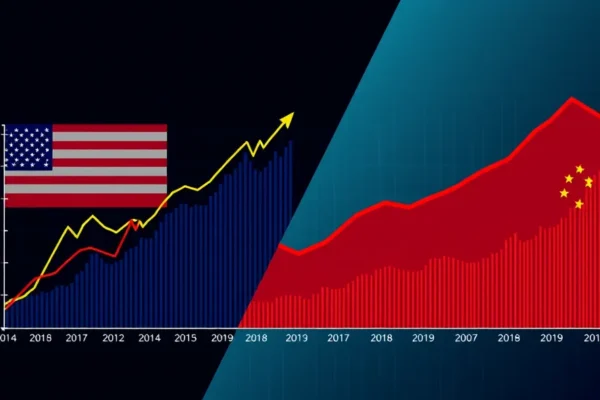
When we talk about borrowing costs for countries, we often look at the interest rates they pay on government bonds. Think of these bonds as IOUs (I Owe You) that governments sell to raise money. The interest rate on these bonds is essentially the price the government pays to borrow money. For the US, this often refers to Treasury yields, which are the returns investors get from holding US Treasury bonds. Recently, there’s been a notable divergence – a widening gap – between these borrowing costs in the US and China. This means it’s become relatively more expensive for the US government and US companies to borrow money compared to their Chinese counterparts.
Why should you care about this? Because these borrowing costs ripple through the entire global economy. They influence where money flows, how much things cost, and the returns investors can expect from their savings and investments. Understanding this divergence helps us grasp why certain countries might be growing faster, why some investments become more attractive than others, and what the future might hold for global financial markets.
How the US-China Borrowing Cost Divergence Works
This divergence is primarily driven by the actions and expectations surrounding the central banks of each country – the Federal Reserve in the US and the People’s Bank of China.
Here’s a step-by-step look at the mechanism:
1. Central Bank Policy: Central banks control the “money supply” and influence interest rates through various tools. A key tool is setting a target for short-term interest rates, which influences longer-term rates like those on government bonds.
- In the US: The Federal Reserve has been actively raising its target interest rate to combat inflation (a general increase in prices). Higher interest rates make borrowing more expensive, which is intended to cool down the economy and reduce price pressures. When the Fed raises rates, US Treasury yields tend to go up.
- In China: The People’s Bank of China has adopted a different approach. Facing slower economic growth and wanting to stimulate its economy, it has been keeping its interest rates relatively low, and sometimes even cutting them. This makes borrowing cheaper in China.
2. Investor Behavior: Investors look for the best returns on their money. If US bonds are offering significantly higher interest rates (yields) than Chinese bonds, investors might sell their Chinese bonds to buy US bonds, seeking that higher return. This increased demand for US bonds can push their prices up and their yields down, while the opposite happens in China – increased demand for Chinese bonds might push yields down in that market, or their lower relative yields make them less attractive.
3. Capital Flows: Money moves around the world seeking the best opportunities. When borrowing costs are lower in one country and higher in another, it can lead to significant shifts in capital flows – the movement of money between countries for investment.
- Scenario: Imagine an investor holding money. If US Treasury bonds offer a 5% yield, and Chinese government bonds offer only a 2% yield, the investor might be tempted to move their money from China to the US to earn that extra 3%. This movement of money is what we call capital flows.
Real-world Example: In recent years, as the US Federal Reserve aggressively hiked interest rates starting in 2022, US Treasury yields surged. For instance, the yield on the benchmark 10-year US Treasury note climbed significantly. Meanwhile, China’s central bank has maintained a more accommodative (lower interest rate) policy to support its economy, resulting in much lower yields on Chinese government bonds. This created a wide spread between US and Chinese borrowing costs, making US debt more attractive to investors seeking higher returns, and prompting capital to flow towards the US.
Why the Divergence in Borrowing Costs Matters
This widening gap between US and Chinese borrowing costs has profound implications, both for individuals and the global economy.
Personal Impact
- Investment Returns: For individuals saving for retirement or other goals, higher interest rates in the US can mean better returns on savings accounts, certificates of deposit (CDs), and newly issued bonds. However, if you have existing bonds, rising interest rates can decrease their market value because new bonds are being issued with higher, more attractive rates.
- Borrowing Costs for You: While this discussion focuses on government borrowing, the underlying interest rate environment influences what you pay for mortgages, car loans, and credit cards. If US interest rates are high, these borrowing costs for individuals are likely to be higher too.
- Currency Strength: Higher interest rates can attract foreign investment, increasing demand for the US dollar. This can lead to a stronger dollar, making imported goods cheaper for Americans but making US exports more expensive for people in other countries.
Economic Impact
- Global Capital Flows: As discussed, money tends to move from lower-yield environments to higher-yield environments. The divergence encourages capital to flow into the US and out of China. This can affect the exchange rates of the US dollar and Chinese Yuan, influencing trade and investment patterns worldwide.
- Economic Growth: Lower borrowing costs in China can stimulate domestic investment and consumption, potentially supporting its economic growth. Conversely, higher borrowing costs in the US can slow down economic activity by making it more expensive for businesses to expand and for consumers to borrow.
- Inflation: The Federal Reserve’s goal in raising interest rates is to curb inflation. If successful, this can lead to more stable prices. China’s lower interest rates are meant to stimulate its economy, which could potentially lead to increased demand and, in some sectors, inflationary pressures.
- Investment Risks: For global investors, this divergence presents both opportunities and risks. Investing in higher-yielding US assets might seem attractive, but investors must also consider the potential for currency fluctuations and the overall health of the US economy. Similarly, while Chinese assets might offer lower yields, they could be attractive for different reasons depending on an investor’s risk tolerance and market outlook.
Who Benefits and Who is Affected Negatively?
- Beneficiaries: US savers and investors looking for higher returns on safe assets might benefit from higher US Treasury yields. Companies in China that can borrow cheaply might see their expansion plans accelerate.
- Negatively Affected: US consumers and businesses looking to borrow money will face higher costs. Countries that are heavily reliant on exports to China might see slower demand if China’s economy slows down. Investors who have heavy exposure to Chinese assets might see their returns impacted by lower yields or potential currency depreciation.
Historical and Current Context of Borrowing Costs
The concept of countries borrowing money and paying interest is as old as organized economies. However, the modern context of global capital flows and central bank policy as drivers of borrowing costs is a more recent phenomenon, largely shaped by the post-World War II financial system and the increased globalization of financial markets.
Historically, borrowing costs for major economies have often moved in a similar direction due to coordinated global economic cycles and central bank policies. For example, during global recessions, central banks worldwide often cut interest rates simultaneously to stimulate growth.
The current divergence is largely a consequence of differing economic conditions and policy responses following the COVID-19 pandemic.
- US Context: The US experienced significant inflation post-pandemic, driven by a combination of supply chain disruptions, strong consumer demand fueled by stimulus measures, and energy price shocks. The Federal Reserve’s aggressive rate-hiking cycle, starting in March 2022, aimed to bring this inflation under control. This has pushed US Treasury yields to multi-year highs. For example, the yield on the 10-year US Treasury note has fluctuated but has remained elevated, often trading above 4% in recent periods, compared to near-zero levels a couple of years prior. (Source: US Department of the Treasury data).
- China Context: China, on the other hand, has faced challenges with slower economic growth, a struggling property sector, and lower inflation. This prompted the People’s Bank of China to keep interest rates low and even implement rate cuts to boost domestic demand and investment. Chinese government bond yields have remained substantially lower than those in the US, often trading in the 2-3% range for benchmark maturities. (Source: People’s Bank of China data).
This policy divergence is a key trigger for the current interest in US-China borrowing costs. It represents a significant shift from periods where their monetary policies were more aligned.
Practical Implications for Thinking About Your Finances
Understanding the gap in US-China borrowing costs can help you make more informed financial decisions, even if you’re not directly investing in international bonds.
- Investment Strategy: If you’re investing in fixed-income (bond) markets, the relative attractiveness of US versus Chinese bonds, or bonds from other countries, will depend on your risk tolerance and return expectations. Higher yields in the US might make US bonds more appealing for some, while others might seek diversification by looking at other markets, considering the potential for currency gains or losses.
- Global Economic Awareness: This divergence signals different economic trajectories. The US is focused on taming inflation even at the risk of slowing growth, while China is prioritizing growth stimulation. Keeping an eye on these trends can help you anticipate broader economic shifts that might affect your job prospects, industry, or the value of your investments.
- Currency Considerations: If you travel internationally or purchase imported goods, the strength of the US dollar (often influenced by interest rate differentials) can impact your costs.
Common Misconceptions and Corrections:
- Misconception: Higher US borrowing costs are always bad for the US economy.
- Correction: While higher borrowing costs can slow growth, they are a necessary tool to combat persistent inflation, which can be far more damaging to long-term economic stability and purchasing power.
- Misconception: Lower borrowing costs in China mean it’s a better investment destination.
- Correction: Lower yields in China reflect both its monetary policy and potentially higher economic risks or slower growth prospects for investors. It’s crucial to consider the full risk-reward profile, not just the interest rate.
What to Watch For:
- Central Bank Statements: Pay attention to announcements from the Federal Reserve and the People’s Bank of China regarding their interest rate policies and economic outlook.
- Economic Data: Look at inflation rates, GDP growth figures, and employment numbers from both countries. These provide context for central bank decisions.
- Treasury Yield Movements: Track the yields on US Treasury bonds as an indicator of the US borrowing cost environment.
Related Concepts to Deepen Understanding
To fully grasp the implications of US-China borrowing cost divergence, it’s helpful to understand several related financial concepts:
- Interest Rates: The foundation of borrowing costs. Understanding how central banks influence interest rates is crucial.
- Inflation: The general increase in prices and fall in the purchasing value of money. Central bank policies on interest rates are heavily influenced by inflation levels.
- Monetary Policy: The actions undertaken by a central bank to manipulate the money supply and credit conditions to stimulate or restrain economic activity. This is the direct driver of interest rate differentials.
- Fiscal Policy: Government actions related to spending and taxation. While monetary policy drives borrowing costs, fiscal policy can influence the demand for borrowing and overall economic health.
- Exchange Rates: The value of one currency for the purpose of trading. Interest rate differentials and capital flows significantly impact exchange rates.
- Bond Markets: The global marketplaces where debt securities (like government bonds) are issued and traded. Treasury yields are a key indicator from these markets.
- Capital Flows: The movement of money for investment purposes between countries. This is directly impacted by differences in borrowing costs and expected returns.
Frequently Asked Questions About US-China Borrowing Costs
Q1: How does the divergence in US-China borrowing costs affect global capital flows?
A1: It encourages capital to move from countries with lower interest rates (like China recently) to countries with higher interest rates (like the US recently) in search of better returns, influencing exchange rates and investment patterns worldwide.
Q2: What are Treasury yields, and why are they important in this context?
A2: Treasury yields are the interest rates investors receive for holding US government debt. They are a benchmark for borrowing costs in the US and directly reflect the market’s assessment of economic conditions and future interest rate expectations.
Q3: How does central bank policy influence these borrowing costs?
A3: Central banks like the Federal Reserve and the People’s Bank of China set benchmark interest rates. When they raise rates, borrowing costs for governments and businesses tend to rise, and when they lower rates, costs tend to fall.
Q4: Can individuals directly control US-China borrowing costs?
A4: No, individuals cannot directly control these large-scale economic forces. However, understanding them helps in making personal financial decisions regarding savings, investments, and borrowing.
Q5: What are the main risks associated with this economic divergence?
A5: Risks include volatile capital flows, currency fluctuations, potential for slower global growth if major economies tighten policy too aggressively, and increased investment risks for those exposed to either market.
Q6: How does this divergence impact the global economy’s inflation outlook?
A6: The US raising rates to combat inflation can help reduce global inflationary pressures over time, while China’s lower rates might support demand but could also contribute to inflation if that demand outstrips supply.
Disclaimer and Advice
This article provides general educational information about financial topics. It is not intended as personal financial advice, and it does not constitute a recommendation to buy or sell any specific investment. Financial situations vary greatly among individuals, and market conditions are constantly changing. It is crucial to conduct your own research and consult with a qualified financial advisor or professional before making any financial decisions or adjustments to your investment strategy. Investing involves risk, including the potential loss of principal, and past performance is not indicative of future results.











