

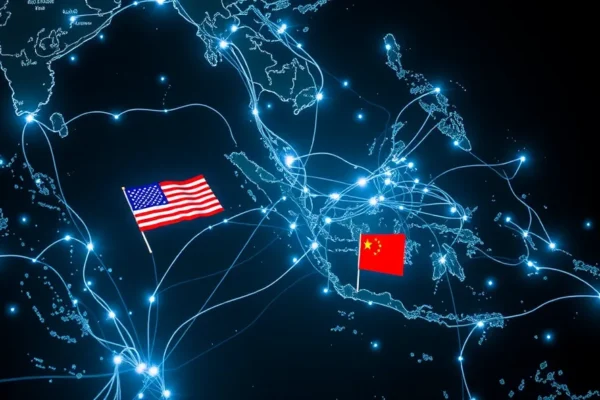
The Hidden Wires Connecting the World
When most people think about the internet, they imagine an invisible cloud floating above our heads. However, the reality is much more grounded. The internet is actually a massive, physical network of wires that run across the ocean floor. These are known as subsea cables. They are the essential internet infrastructure that allows data to travel from one continent to another in milliseconds.
Imagine if your city had only one single road connecting it to the rest of the country. If that road were blocked, no food, medicine, or mail could reach you. This is the concept of infrastructure. In the digital age, subsea cables are the “highways” of information. If a highway is blocked or controlled by someone you do not trust, your entire economy could come to a standstill. This is why the news of a new US cable project in Southeast Asia is such a significant economic and political event.
Understanding these physical connections is vital because they dictate how fast we can work, how safely we can trade, and how much we rely on certain global powers. As the world moves further into a digital-first economy, the companies and nations that control these “highways” hold immense influence over global markets.
How Subsea Cable Networks Function
Building a global internet network is a massive engineering feat. It is not as simple as dropping a string into the ocean. To understand how a project like this works, think of it as building a massive, underwater plumbing system, but instead of water, it carries pulses of light.
The process generally follows these steps:
- Route Planning: Engineers must map out the ocean floor to avoid deep trenches, underwater volcanoes, and busy shipping lanes. They must also consider the South China Sea, where political tensions are high.
- Cable Laying: Specialized ships carry thousands of miles of fiber-optic cable. These cables are heavily armored to protect them from anchors, fishing nets, and even shark bites.
- Landing Stations: The cable eventually reaches the shore at a “landing station.” This is a secure building where the underwater cable connects to the land-based fiber networks that bring the internet to your home or office.
- Data Transmission: Once connected, information travels as light through glass strands within the cable, moving at incredible speeds across the ocean.
To see this in action, imagine two countries, Country A and Country B. If Country A only has one cable that passes through Country C, Country A is at the mercy of Country C. If Country C decides to turn off the connection, Country A loses its connection to the world. The new US-funded project aims to provide alternative networks so that Southeast Asia internet connectivity does not rely on a single source or a single political ally.
This introduces the concept of a “dual tech stack.” A tech stack is the set of tools and hardware used to run digital services. A “dual tech stack” means that instead of the whole world using one set of tools (for example, only China tech), the world might split into two different systems: one backed by the US and one backed by China. This is similar to how some countries use different electrical plugs or different cellular networks.
Why Global Connectivity Matters to Your Wallet
You might wonder how a cable under the ocean affects your personal finances. While you may never see the cable, its presence affects the cost of living and the stability of your investments.
Impact on Economic Growth
High-speed, reliable internet is a primary driver of modern economic growth. For businesses in Southeast Asia, better connectivity means they can participate in global e-commerce, use cloud computing, and access international financial markets. When infrastructure improves, it often leads to job creation and increased productivity, which can drive up the value of local economies and businesses.
Market Stability and Geopolitical Tech Risk
In the world of investing, we often talk about “risk premiums.” This is the extra return investors demand to compensate them for taking on more risk. When there is a tech race between superpowers, the risk of “decoupling”—where the US and China stop using each other’s technology—increases. If a company relies heavily on China tech and those systems are suddenly restricted, that company’s stock could drop significantly. Diversifying infrastructure through projects like the US cable helps reduce this risk by providing more stable, predictable routes for data.
Digital Sovereignty and Costs
Digital sovereignty is the idea that a nation should have control over its own digital destiny, including its data and its networks. If a country has to pay high fees to a foreign power to access the internet, it can lead to higher costs for everything from streaming services to banking apps. By investing in their own or allied infrastructure, nations can protect their digital sovereignty and potentially lower long-term costs for their citizens.
The Growing Tech Race in the South China Sea
To understand why this $14 billion investment is happening now, we have to look at the history of how the internet was built. For many years, much of the world’s internet infrastructure was built by private companies with little regard for which nation controlled the physical lines. However, as technology became a tool of national power, governments stepped in.
In recent years, China has expanded its influence through initiatives like the “Digital Silk Road,” which involves investing heavily in digital infrastructure across developing nations. This has given China tech a massive footprint in many parts of the world.
In response, the United States and its allies have begun viewing internet security as a matter of national security. The South China Sea has become a focal point of this tension. Not only is it a vital shipping lane for physical goods, but it is also a crowded space for subsea cables. The US initiative to fund a $14 billion cable is a direct attempt to provide a secure, high-speed alternative for the Southeast Asia internet, ensuring that the region is not solely dependent on networks that might be subject to political pressure.
How to Think About Infrastructure in Your Financial Life
When you see news about massive infrastructure projects or geopolitical tension in the tech sector, you don’t need to be an economist to draw useful conclusions. Instead, look for the underlying themes of security and competition.
Watch for Decoupling
When you hear about “decoupling” or “dual tech stacks,” it means the global market is becoming more fragmented. For an investor, this means that “one size fits all” strategies might not work. A company that thrives in a China-centric tech ecosystem might struggle in a US-centric one.
Recognize the Importance of Physical Assets
In a world that feels increasingly digital, never forget that everything relies on physical assets. From the chips in your phone to the cables under the sea, physical reality dictates digital possibility. When analyzing sectors like telecommunications or technology, always consider the physical security of their supply chains.
Common Misconception: “The Cloud is Invisible”
A common mistake is thinking that digital services are independent of geography. They are not. They are tied to specific cables, specific landing stations, and specific political borders. Understanding this helps you realize why geopolitical news in the South China Sea can actually impact the stability of tech companies globally.
Connecting the Dots to Broader Economic Ideas
This topic does not exist in a vacuum. It is deeply connected to several other major economic concepts:
- Supply Chain Resilience: Just as companies try to avoid relying on one factory for parts, nations are trying to avoid relying on one network for data.
- Geopolitical Risk: This is the risk that political decisions or conflicts will impact markets and businesses.
- The Digital Economy: This is the part of the economy that is driven by digital technologies. Understanding infrastructure is key to understanding the growth of this sector.
Understanding these links can help you see why a single cable project is actually a massive piece of a much larger global puzzle.
Common Questions About Subsea Cables and Geopolitics
How does a US cable affect the Southeast Asia internet?
The US cable project aims to increase the speed, reliability, and diversity of the Southeast Asia internet. By providing more routes for data, it helps ensure that connectivity remains stable even if other cables fail or are disrupted.
Why is there a competition between China tech and US infrastructure?
This is part of a larger tech race for global influence. Both nations want to ensure that the standards and hardware used for the world’s digital communications align with their own interests and security protocols.
Does this create a “dual tech stack” for the world?
Yes, there is a growing possibility of a “dual tech stack,” where different regions of the world use different sets of hardware and software. This could lead to a more fragmented global internet that is divided along geopolitical lines.
What are the risks to subsea cable infrastructure?
Cables face physical risks like earthquakes, ship anchors, and fishing activities, as well as political risks like sabotage or intentional disconnection in areas like the South China Sea.
Can these geopolitical shifts affect my personal savings?
Indirectly, yes. Geopolitical shifts can lead to market volatility and changes in the value of tech companies. While you cannot control these shifts, being aware of them helps you understand the risks in your investment portfolio.
What is digital sovereignty?
Digital sovereignty is a nation’s ability to control its own digital data, networks, and technological infrastructure without being overly dependent on or controlled by foreign powers.
Disclaimer and Financial Education Notice
This is educational content, not financial advice. The information provided here is intended to help you understand the economic and geopolitical concepts behind current events. Financial situations vary widely; please consult a qualified financial professional or advisor for personal advice regarding your investments or financial planning. We do not guarantee any specific financial outcomes based on the trends discussed in this article.











