

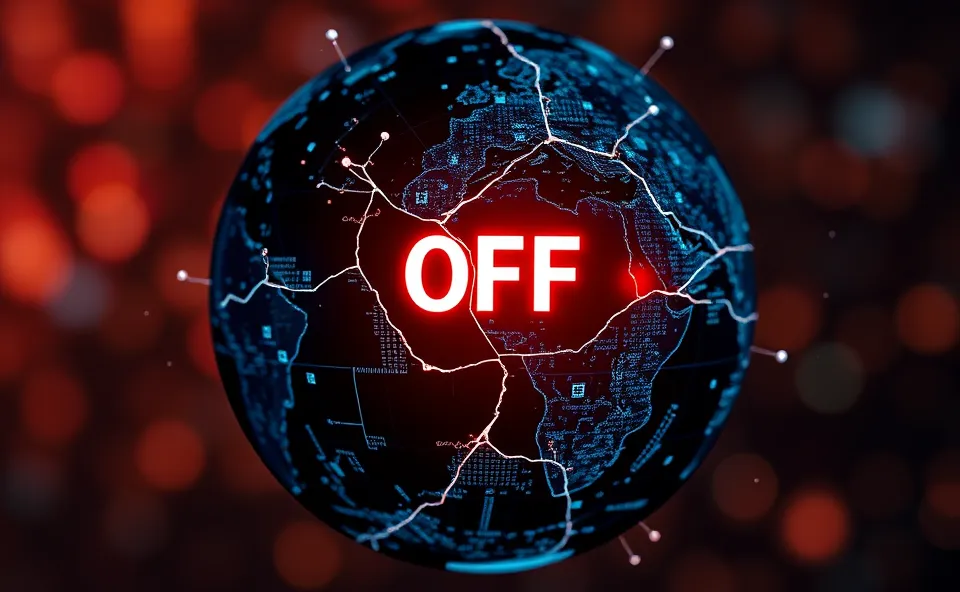
Imagine a World Suddenly Going Dark Online
Let’s talk about something that sounds like science fiction but has real world implications: the idea of the US activating a “kill switch” on its digital services and technology. What does that even mean? Basically, imagine the US government deciding to severely restrict or completely cut off access to a vast range of digital services and technologies that are deeply intertwined with the US. Think about popular apps, cloud computing platforms, essential software, and the very hardware that powers our connected lives. If such a switch were flipped, it wouldn’t just be a minor inconvenience; it could create a ripple effect across the globe, fundamentally altering how businesses operate and how consumers interact with the digital world.
Why Are We Talking About This Now?
This isn’t just some random thought experiment. The conversation around a potential US tech kill switch is gaining traction because of the increasingly complex geopolitical landscape. As nations grapple with issues of national security, technological sovereignty, and economic competition, the idea of using technology access as a lever becomes more prominent. We’re seeing a growing emphasis on controlling critical digital infrastructure and a concern about dependencies on foreign technologies, particularly those originating from or heavily influenced by the US. This has led to more serious discussions about contingency plans, even extreme ones, as countries try to secure their own digital future and mitigate perceived risks.
A Little History on Our Digital Ties
To understand why this is such a big deal, we need to look at how deeply integrated we’ve become. For decades, the United States has been at the forefront of technological innovation. Silicon Valley and American tech giants have built the digital highways many of us use daily. From the operating systems on our phones and computers to the cloud services that store our data and run countless businesses, US technology is everywhere. This dominance has fostered incredible advancements and conveniences, but it has also created a significant level of tech dependency. Many countries and businesses have built their entire digital infrastructure and supply chains around these US technologies. Therefore, any significant disruption to this access isn’t just about losing a favorite app; it’s about potentially destabilizing entire economic systems and digital economies that have been built on this foundation.
The Far Reaching Echoes of a Digital Disconnect
So, what happens if Washington actually activates something like a US tech kill switch? The impact would be immense and felt across multiple levels. For businesses, it could mean significant disruptions. Imagine companies that rely heavily on US cloud providers for their data storage and operations suddenly losing access. This could halt operations, lead to massive data loss, and cripple supply chains that are already showing vulnerability. Software bans, for instance, could force entire industries to scramble for alternatives, a process that is neither quick nor cheap. For consumers, the experience would be jarring. Popular social media platforms, search engines, communication tools, and online marketplaces that are US based might become inaccessible. This could lead to a form of digital isolation for those dependent on these services, forcing them to find new ways to connect and access information.
On a broader scale, this could accelerate internet fragmentation. Instead of a single global internet, we might see a splintering into national or regional digital spheres. This would not only create practical challenges for international business and communication but also raise questions about data localization and the flow of information across borders. The concept of technological sovereignty would move from a theoretical discussion to a stark reality for many nations, pushing them to develop or acquire their own independent digital infrastructure and technologies.
Furthermore, such an action would have significant geopolitical and economic consequences. It could be seen as a powerful form of technology sanctions, creating new battle lines in the ongoing geopolitical technology race. The global digital economy, which thrives on interconnectedness, would face immense pressure. Companies worldwide, even those not directly targeted, would have to reassess their own dependencies and risk exposure. This might spur a global push towards diversifying technological partnerships and investing more heavily in domestic technology development to avoid future shocks.
Navigating the Uncertain Path Ahead
Looking forward, the activation of a US tech kill switch, even if partially, would likely reshape the global technology landscape. We could see a more pronounced trend towards economic decoupling in the tech sector, where nations actively work to reduce their reliance on foreign, particularly US, technologies. This would spur investment in alternative technologies and digital infrastructure outside of US influence. The development of non-US based cloud services, operating systems, and hardware could accelerate. We might also see a greater emphasis on open source solutions and national champions in the technology space.
For businesses, this would mean a strategic imperative to build more resilient and diversified digital operations. It would involve a critical evaluation of their technology stack and a proactive approach to mitigating supply chain risk. Consumers might face a more fragmented digital experience, with a wider variety of service providers and potentially less global consistency. The push for technological sovereignty could also lead to increased government investment in domestic research and development, fostering new innovation ecosystems.
Your Burning Questions Answered
What exactly is a US tech kill switch?
A US tech kill switch refers to a hypothetical governmental action that could severely restrict or completely cut off access to certain digital services and technologies originating from or heavily reliant on the United States. This could involve blocking access to US-based software, hardware, or internet platforms for users or businesses in other countries or even within the US itself under specific national security circumstances.
How could a US tech kill switch affect the global economy?
The activation of a US tech kill switch could significantly disrupt the global digital economy. Businesses worldwide that depend on US technology for their operations, data management, or supply chains could face severe operational halts, leading to financial losses and a broader economic slowdown. It could also lead to increased costs as companies scramble to find and implement alternative technologies, potentially hindering innovation and cross-border commerce.
What does “technological sovereignty” mean in this context?
Technological sovereignty means a nation’s ability to control its own digital infrastructure, data, and technology without undue reliance on foreign powers. In the context of a US tech kill switch discussion, it highlights the drive for countries to reduce their dependence on US technology and develop their own independent digital capabilities to ensure their security, economic stability, and autonomy in the digital age.
Could a US tech kill switch lead to internet fragmentation?
Yes, a US tech kill switch could be a major catalyst for internet fragmentation. If US digital services become inaccessible in certain regions, those areas might develop their own distinct internet ecosystems. This would lead to a less unified global internet, making international communication and commerce more challenging and creating separate, potentially incompatible, digital networks.
What are the implications of software bans related to a US tech kill switch?
Software bans, as part of a broader US tech kill switch scenario, would force businesses and individuals to abandon or find replacements for essential US-developed software. This could range from operating systems and productivity suites to specialized industry software. The implications include significant migration costs, potential data compatibility issues, a learning curve for new software, and potential disruption to established workflows and business processes, impacting the overall digital economy impact.











