

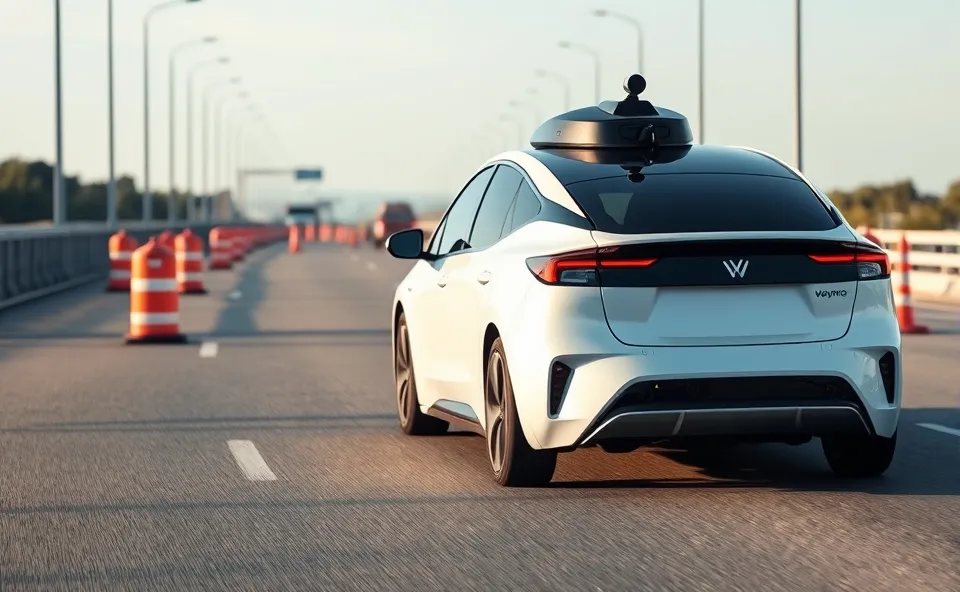
A sudden pause in the driverless dream
Imagine you are sitting in the backseat of a car. There is no one in the driver seat. The steering wheel moves on its own, and the car glides through the city streets with smooth, calculated precision. This is the promise of the robotaxi experience. It is supposed to be seamless, relaxing, and, most importantly, safe. But lately, that smooth ride has hit a bit of a bump in the road, specifically when it comes to construction zones.
Waymo, the leader in the autonomous driving space, has recently issued a software recall. Now, when we hear the word recall, we often think of a physical part breaking, like a faulty battery or a loose bolt. However, this is different. This is a brain problem rather than a limb problem. The issue lies deep within the self-driving car software that tells the vehicle how to interpret the world around it.
The core of the problem is how the vehicle handles the chaos of traffic construction zones. If you have ever driven through a construction area, you know it is a mess. There are orange cones, bright signs, temporary barriers, and often, lane markings that seem to disappear or change direction without warning. For a human driver, these are minor inconveniences. For a computer, these are massive puzzles. The Waymo software struggled to correctly read these shifting environments, which could lead to the car making unpredictable or overly cautious moves that disrupt traffic.
This is not a hardware failure. The cameras, the sensors, and the computers are all physically fine. The issue is purely about how the code interprets the visual data it receives. When the software encounters a complex setup of cones or a sudden change in a road layout, it sometimes fails to navigate the path correctly. This is why the company has moved so quickly to address the situation with a targeted Waymo software update.
Why everyone is talking about robotaxi safety right now
You might be wondering why this specific news is blowing up across tech blogs and social media. It is because the world is currently watching the progress of autonomous vehicles with a mix of excitement and intense scrutiny. We are in a transition period where the technology is moving from controlled experiments to real-world public services. In this stage, every single mistake is magnified.
Public trust is the most valuable currency in the autonomous driving industry. For people to ditch their personal cars and rely on a fleet of driverless taxis, they need to know that these machines can handle the “edge cases.” An edge case is a fancy way of saying a situation that is rare or messy, like a sudden construction zone or a weirdly shaped road barrier. When a company like Waymo, which has set the gold standard for much of this tech, encounters a setback, it forces everyone to stop and ask: are we actually ready?
The trending interest also stems from the sheer complexity of the problem. This is not just a minor bug. It highlights a fundamental challenge in the field of artificial intelligence. Teaching a machine to follow a straight line on a clear highway is relatively easy. Teaching a machine to navigate a world that is constantly being rebuilt, moved, and rearranged is incredibly difficult. This recall has become a symbol of the final, most difficult hurdle in the journey toward fully autonomous transport.
The long road to driverless technology
To understand why this is such a big deal, we have to look at how far we have come. The journey toward driverless car technology has been a decades-long marathon. We have moved from simple cruise control to advanced lane-keeping systems, and finally to the sophisticated sensor suites that Waymo uses today.
For years, the focus was on making the cars see. Companies poured billions of dollars into LIDAR, radar, and high-resolution cameras. They wanted to make sure the car could detect a pedestrian, a cyclist, or a parked car. And they succeeded. The “vision” part of the equation is better than ever. However, we are now entering the “reasoning” phase. It is no longer enough for the car to see a cone. The car must understand what that cone implies about the road ahead.
In the past, autonomous testing happened in very specific, highly mapped areas. These areas were predictable. But as Waymo and its competitors move into more diverse urban environments, they are facing the reality of the real world. Real roads are not static. They are living, breathing, and often quite messy entities. This recall is a natural, if slightly frustrating, part of the evolution from laboratory perfection to real-world utility.
What this means for the future of the industry
When a vehicle safety recall happens in the autonomous sector, the impact ripples through several different groups. For the everyday user, the immediate impact might be minimal. You likely won’t notice a difference in your ride, especially once the software update is pushed out. However, the psychological impact is real. Every time a news story breaks about a software error, it adds a layer of hesitation for potential passengers.
For the business and tech markets, this event serves as a reality check. It reminds investors and competitors that the path to scale is not a straight line. There will be setbacks. The companies that win will not be the ones that claim to be perfect, but the ones that demonstrate the most efficient way to find, fix, and deploy solutions to these complex problems.
The technical impact is perhaps the most interesting. This situation will likely drive a massive surge in research regarding sensor fusion and semantic segmentation. Semantic segmentation is a process where the AI identifies not just that an object exists, but exactly what it is and what its purpose is in that specific context. The industry will likely lean harder into training AI models specifically on construction data, using massive amounts of simulated and real-world footage to ensure that these “temporary” road changes are no longer a source of confusion.
- For developers: A renewed focus on training AI for high-uncertainty environments.
- For regulators: Increased pressure to create standards for how software updates are validated.
- For consumers: A lesson in the importance of continuous software evolution in modern vehicles.
Looking ahead to more predictable streets
So, where do we go from here? The outlook is not bleak, but it is more grounded. We are moving away from the era of “magic” technology and into the era of “refined” technology. The next phase of autonomous driving will likely be defined by how well these vehicles handle the unpredictable. We can expect to see much more robust Waymo software updates that are delivered more frequently, similar to how your smartphone receives patches to fix bugs.
We might also see better communication between cities and autonomous fleets. Imagine a world where a city’s digital infrastructure tells a Waymo car that a specific street has a construction zone two blocks away. This would allow the vehicle to prepare its logic before it even reaches the cones. This integration of smart cities and smart cars could be the key to solving many of the autonomous driving hazards we see today.
The goal remains the same: a world where transportation is safer and more efficient. This recall is not a sign of failure, but a sign of progress. It is a moment of refinement that helps ensure that when we finally do step into a driverless future, we can do so with complete confidence.
Frequently asked questions
What caused the recent Waymo recall?
The Waymo recall was triggered by a software issue that affected how the vehicles navigate through traffic construction zones. The autonomous driving software struggled to accurately interpret the complex layouts and temporary markers like cones and barriers, which could lead to unsafe or unpredictable driving behavior.
How does this affect overall robotaxi safety?
While this is a significant technical hurdle, it is being addressed through a targeted Waymo software update. The goal of the recall is to enhance robotaxi safety by ensuring the vehicle’s decision-making process is robust enough to handle the most chaotic real-world driving environments without hesitation or error.
Is self-driving car software reliable in construction zones?
Self-driving car software is highly reliable in standard driving conditions, but construction zones remain one of the most difficult challenges for all autonomous driving technology. These areas present high levels of visual uncertainty, which is exactly what the current software updates are designed to solve.
What is the benefit of a Waymo software update?
A Waymo software update allows the company to fix complex logic errors and improve the vehicle’s ability to understand its surroundings without needing to physically repair any hardware. This makes it possible to rapidly deploy improvements to the entire fleet to mitigate any identified autonomous driving hazards.
Will autonomous vehicles become safer after this?
Yes, because the data gathered from these real-world challenges is used to train better models. Every vehicle safety recall in this industry provides invaluable data that helps engineers refine the self-driving car software, ultimately leading to a more capable and trustworthy autonomous driving experience.











