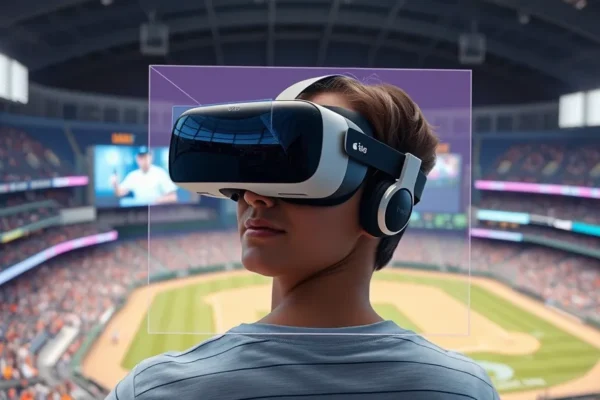
Bringing the Ballpark Home
For decades, the standard for watching professional baseball has been a compromise. You either pay for a premium seat to feel the grass and hear the crack of the bat, or you settle for the television experience, which offers a curated perspective but lacks the visceral sense of presence. The arrival of the Apple Vision Pro changes the geometry of this experience by introducing a new category of wearable technology known as spatial computing. This device allows fans to experience an immersive sports broadcast that bridges the gap between the stadium and the living room.
Spatial computing refers to a system where digital content is integrated into the physical world around the user. In the context of the MLB, this means transforming a standard broadcast into a three-dimensional environment. Apple has collaborated with major sports leagues to offer experiences via its VisionOS platform, enabling fans to place themselves at the center of the action. Whether you are a fan of the Red Sox tracking defensive maneuvers or a die-hard observer of the Yankees, the potential to simulate the atmosphere of Yankee Stadium from your own home is no longer science fiction.
The Mechanics of Virtual Presence
To understand how the Apple Vision Pro brings a game to life, think of it as wearing a high-definition window to another place. The headset uses a combination of two ultra-high-resolution micro-OLED displays—one for each eye—to create a visual field that feels physically present. When watching a game, the device processes a high-bandwidth video feed that provides depth perception, making players appear as if they are standing on a virtual field in your living room.
The device tracks your eyes and hands to navigate this space. You do not need a controller; you simply look at an element on the screen, like a scoreboard or a player statistic, and tap your fingers together to select it. The audio is equally vital. Apple utilizes Spatial Audio, which uses algorithms to simulate sound waves bouncing off walls. If Ceddanne Rafaela makes a play on the far left of your field of view, the sound of the crowd and the broadcast commentary shifts to match that spatial position. It creates an auditory landscape that mimics the natural way human ears perceive sound, tricking the brain into feeling as if you are physically in the bleachers.
From Demo to Daily Broadcast
Currently, the use of the Apple Vision Pro for immersive sports is in its early adoption phase. While major streaming services and the MLB have begun experimenting with 180-degree, high-resolution immersive video, this is not yet the standard way to consume every game of the season. Most current applications serve as high-end showcases for what is possible rather than a replacement for traditional cable broadcasts.
In practice, users can access apps like the Apple TV app to launch virtual environments. You might find yourself sitting in a simulated suite, viewing a massive, high-definition screen that spans the width of your room, or choosing to look down at a field-level view of the game. These applications are currently available to owners of the headset, but they function as a premium, boutique experience. For most users today, the technology is a window into the future of sports media rather than a ubiquitous service available on every streaming platform.
The Landscape of Immersive Viewers
The Apple Vision Pro is not the only player in the field of immersive sports. Competitors like Meta, with its Quest line of headsets, have spent years developing virtual reality environments for sports. However, the approach differs significantly. While Meta focuses heavily on gaming and social virtual reality where users inhabit cartoon-like avatars, Apple emphasizes “mixed reality,” where high-fidelity digital content is overlaid onto your actual physical environment.
The primary advantage for Apple is its integration with its existing ecosystem. Because the headset runs on the same underlying software architecture as the iPhone and Mac, the transition between watching a game and checking email or browsing the web is seamless. While Meta currently has a larger library of lower-cost VR content, Apple has prioritized the visual quality of the broadcast, betting that consumers will prefer a “theatrical” experience that feels like sitting in a high-end cinema over the more game-like, interactive environments favored by its rivals.
Redefining the Fan Connection
The shift toward virtual reality baseball will likely reshape how fans interact with the sport over the next decade. Economically, this could open new revenue streams for teams like the Yankees or the Red Sox. By offering virtual “front-row” tickets, teams could sell thousands of premium immersive experiences for a single game, bypassing the physical constraints of stadium seating. This could change the business model of sports broadcasting, shifting the focus from static TV ads to interactive, data-rich environments where viewers can pull up real-time analytics by simply glancing at a player.
Socially, the implications are profound. While some fear that replacing physical attendance with digital simulations will erode the community aspect of sports, others argue it will make the sport more accessible. A fan living in a different country can finally experience the specific vantage point of a seat at Yankee Stadium without the expense of travel. The challenge, however, will be maintaining the shared emotional experience of the crowd, which is the heartbeat of live sports.
Bottlenecks and Real-World Challenges
Despite the technical impressiveness, the technology faces significant hurdles before it enters the mainstream. The most obvious is the hardware itself. The Apple Vision Pro is a bulky, expensive piece of equipment that requires being worn on the face for extended periods. Even for the most dedicated baseball fan, watching a full nine-inning game with a headset on can be fatiguing. The weight and the need to manage battery life are practical constraints that currently limit the device to enthusiast use.
Furthermore, the availability of high-quality, 3D-captured footage is limited. Most MLB broadcasts are still produced for two-dimensional screens. To provide a truly immersive experience, cameras must be set up differently, and production teams must learn to handle 180-degree or 360-degree video feeds in real time. Creating a seamless, high-resolution feed for thousands of simultaneous users requires massive data processing, which remains a technical bottleneck for current internet infrastructure.
The Road Ahead
The trajectory for virtual reality baseball is clear: the hardware will become lighter, cheaper, and more comfortable. We are currently in the “early adopter” phase, comparable to the early days of color television or the transition from analog to high-definition broadcast. Over the next five to ten years, we expect to see the “immersive sports” category expand from expensive novelty items to standard options for sports fans.
Key milestones to watch include the reduction of device weight, improvements in battery technology, and, crucially, the league-wide adoption of spatial-ready camera setups at every major stadium. As these technologies converge, the line between watching a game on a screen and “being there” will continue to blur. The goal is not to replace the stadium but to offer a new way to appreciate the nuances of the game, from the mechanics of a pitcher’s curveball to the agility of a center fielder like Ceddanne Rafaela.
Common Questions About Immersive Baseball
Is virtual reality baseball ready for a full nine-inning game?
While the Apple Vision Pro provides stunning visual quality, the comfort of wearing a headset for three hours remains a challenge for most users. Currently, it is better suited for shorter viewing sessions or high-stakes games where you want an extra layer of immersion.
Do I need an expensive subscription to watch games in this format?
Most immersive experiences are currently bundled through partnerships between Apple, the MLB, and existing streaming providers. As the ecosystem matures, expect a more standard “spatial broadcast” tier to emerge within existing sports packages.
Who benefits the most from this technology?
The biggest beneficiaries are remote fans who cannot physically visit stadiums like Yankee Stadium. This technology democratizes access to “prime” viewing angles that would otherwise be reserved for high-paying ticket holders.
What are the biggest risks of this technology?
The primary risks include eye strain and the potential for social isolation. Extended use of any head-mounted display can cause physical discomfort, and the solitary nature of VR could detract from the communal experience of watching a game with friends.
How long until this becomes a mainstream way to watch the MLB?
While you can experience it today, widespread mainstream adoption will likely take another 5 to 10 years. This timeline depends on the price of hardware dropping significantly and the normalization of wearable technology in everyday life.
Note: This analysis is based on current market trends and the stated capabilities of the Apple Vision Pro as of early 2024. Immersive sports technology is a rapidly evolving field, and features or availability may change as software updates and hardware iterations are released by manufacturers.