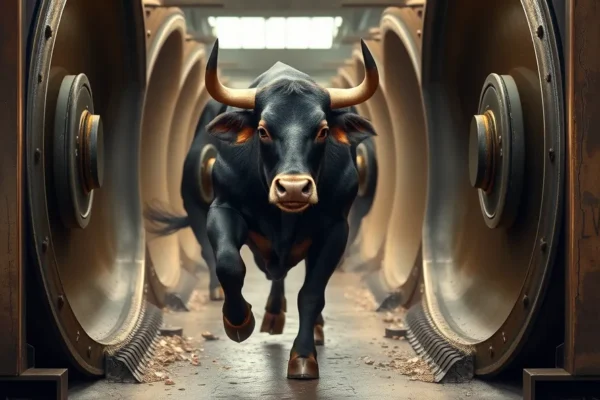
A New Perspective on European Steel
In a notable shift for the industrial metals sector, JPMorgan recently updated its stance on the European steel industry, issuing a stock upgrade for ArcelorMittal (MT). This development comes at a time when ArcelorMittal has experienced a recent pullback in its share price, prompting investors to re-examine the company’s valuation against broader market volatility. According to official equity research reports published in October 2024, the banking giant moved its rating on the Luxembourg-based steelmaker, citing improved expectations for operating margins and a potential recovery in industrial demand.
This market analysis highlights a growing divergence between current stock valuations and the long-term outlook for major commodity players. While the global economic forecast remains tempered by high energy costs and inflationary pressures, the institutional confidence shown by JPMorgan suggests that some analysts see the current price levels as an entry point for those monitoring the recovery of European steel production.
What Triggered the Shift in Sentiment
The primary catalyst for this updated outlook is a combination of inventory re-stocking trends and a stabilization of raw material costs. According to market data from the World Steel Association, European demand has been suppressed for several quarters due to high interest rates impacting construction and automotive sectors. However, JPMorgan’s analysis indicates that the de-stocking cycle—where companies run down existing inventory rather than ordering new steel—is nearing an end.
Furthermore, the recent pullback in ArcelorMittal stock, which saw shares dip significantly from their mid-year highs, has allowed the company to trade at a more attractive earnings multiple. Investment banking firms often adjust their outlooks when such valuation gaps emerge, signaling that the market may have over-corrected during periods of sector-wide pessimism. This upgrade acts as a signal to the financial markets that the fundamental value of the firm may be disconnected from its recent downward price movement.
Financial Context and Sector Fundamentals
To understand why ArcelorMittal remains a focal point in global commodity trading, one must look at its balance sheet and industrial footprint. In its Q2 2024 earnings report, ArcelorMittal disclosed an EBITDA (earnings before interest, taxes, depreciation, and amortization) of approximately $1.9 billion. While this reflects the cooling of metal prices compared to the record-breaking peaks of previous years, the company maintains a robust liquidity position, providing a cushion against potential economic headwinds.
Historically, the steel industry is highly cyclical, meaning it fluctuates alongside the broader economy. Comparing current performance to the post-pandemic recovery era, ArcelorMittal has shifted its focus toward decarbonization and high-value-added steel products. This pivot is crucial, as modern industrial metals consumption is increasingly tied to the green energy transition—specifically in wind turbine infrastructure and electric vehicle components. Despite these efforts, the company remains subject to the volatility inherent in iron ore and coal prices, which remain key inputs for their blast furnace operations.
Analyzing the Market Move
The upgrade from JPMorgan signifies a deeper analytical look at the price-to-book (P/B) ratio and cash flow projections for the coming fiscal year. From a technical perspective, the stock has tested support levels that have historically invited institutional buying. When large firms like JPMorgan upgrade a stock within the European steel sector, it often indicates that they have factored in the risk of sustained high energy costs and found the underlying growth potential to outweigh these factors.
Investors should observe the volume of trading during these phases of volatility. High volume during a downward trend often suggests panic selling, whereas stabilizing volume during a recovery phase—such as the one indicated by this recent upgrade—suggests that “smart money” is beginning to accumulate positions. The market sentiment remains cautious, but the shift from a neutral to a more bullish outlook highlights a technical belief that the European steel market has successfully bottomed out.
Broader Industry Implications
This development does not exist in a vacuum. As ArcelorMittal leads the European steel conversation, other players like Salzgitter AG and ThyssenKrupp are also impacted by the same economic variables. Industry-wide implications include a possible strengthening of prices as manufacturers attempt to pass on their increased cost of compliance with European Union carbon taxation policies.
The competition between domestic European producers and low-cost importers remains a critical theme. If the bullish outlook for ArcelorMittal proves accurate, it likely implies that domestic producers are regaining their competitive edge through supply chain efficiency. Investors tracking industrial metals are also monitoring China’s steel output, as any significant change in their export volume directly influences the pricing power of European firms.
Future Outlook for Steel Investors
Looking ahead, the focus for investors will be the Q4 earnings reports and the guidance provided by management regarding capital expenditure for 2025. Key factors that could shift the current outlook include unexpected changes in European Central Bank interest rate policies, which would directly affect the construction sector’s ability to finance new projects. Furthermore, any changes to trade protection regulations—such as tariffs on non-EU steel—would serve as a major driver for ArcelorMittal’s future profitability.
Market observers should maintain a medium-to-long-term horizon. Steel is not a sector for rapid, short-term speculation; it is an infrastructure-dependent industry that evolves over several quarters. By the first half of 2025, analysts expect to see whether the current sentiment upgrade translates into sustained margin expansion or if macro-economic headwinds continue to weigh on the sector.
Risk Disclaimer
Past performance does not guarantee future results. Financial markets are inherently volatile and subject to global economic shifts, geopolitical risks, and changes in regulatory environments. The information provided here is for educational and analytical purposes only and does not constitute financial or investment advice. Investors should conduct their own research or consult with a qualified financial advisor before making any decisions regarding ArcelorMittal or any other equity investments.
Frequently Asked Questions
Is ArcelorMittal a good buy based on the JPMorgan upgrade?
An upgrade by an investment bank reflects an analytical shift in their outlook, but it is not a direct instruction to buy. According to market reports, JPMorgan shifted its stance based on expected improvements in operating margins and valuation gaps. Investors should assess whether these factors align with their own personal financial goals and risk tolerance before taking action.
What are the primary risks associated with the European steel sector?
The main risks include fluctuating raw material costs, specifically iron ore and coal, and the high cost of energy in Europe. Additionally, the industry is heavily tied to the construction and automotive sectors, both of which are sensitive to interest rate changes. According to corporate finance filings, regulatory compliance costs related to carbon emissions also present a significant ongoing financial burden for European producers.
How does ArcelorMittal compare to its competitors in the European steel market?
ArcelorMittal is one of the world’s largest steel producers, giving it significant economies of scale compared to smaller regional competitors. While peers like ThyssenKrupp and Salzgitter also operate within the same economic climate, ArcelorMittal’s global footprint and diversified production base often allow it to absorb regional demand shocks more effectively than companies focused solely on the European market.
What is the link between the economic forecast and metal prices?
The economic forecast is the strongest driver of metal prices because steel demand is a leading indicator for manufacturing and infrastructure growth. When the economic forecast suggests expansion, the demand for industrial metals typically increases. Conversely, during periods of economic contraction, the industry often faces surplus supply, which puts downward pressure on the commodity prices that ArcelorMittal relies on for revenue.
What should investors look for in upcoming earnings reports?
Investors should look for updates on EBITDA margins and free cash flow generation. The management’s forward-looking guidance regarding capital expenditure for green energy initiatives is also critical, as this will determine the company’s long-term competitive position. Furthermore, commentary on the stability of steel prices in the European region will indicate whether the recent market analysis of a recovery is holding firm.