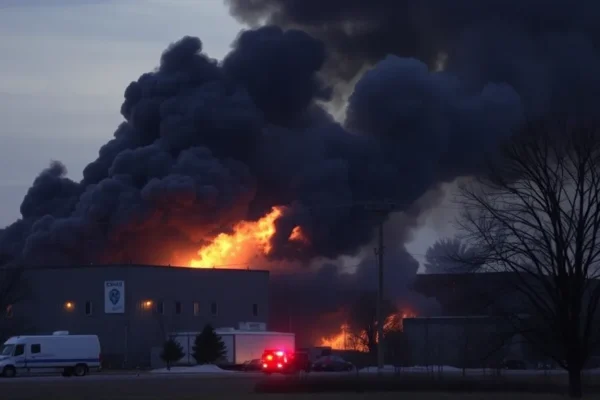
A Moment of Crisis at the Quaker Oats Plant
In late 2023 and early 2024, the Quaker Oats plant in Cedar Rapids, Iowa—a cornerstone facility for PepsiCo—faced a significant operational disruption following an industrial fire and explosion. The incident, which caused visible plumes of smoke over downtown Iowa, triggered an immediate suspension of operations at what is widely considered one of the largest cereal and snack production plants in the world. According to reports from the Cedar Rapids Fire Department and subsequent statements from PepsiCo, the event was contained, but the impact on production lines was immediate and severe.
For a company like PepsiCo, which relies on the Quaker Oats facility as a primary hub for its North American breakfast category, the Quaker Oats plant explosion serves as a stark reminder of the fragility inherent in centralized food production. While emergency services acted quickly to secure the site, the ripple effects of the Cedar Rapids incident extended far beyond the local community, highlighting the vulnerabilities in global supply chain management for massive consumer packaged goods companies.
The Strategic Rationale Behind Centralized Manufacturing
Why do industry giants like PepsiCo concentrate so much production in single facilities like the one in Cedar Rapids? The primary driver is economies of scale. Economies of scale occur when a company reduces its per-unit costs by increasing the volume of production. By centralizing operations, a firm can share fixed costs—such as specialized heavy machinery, massive distribution logistics, and energy infrastructure—across millions of units.
From a strategic perspective, the Cedar Rapids site was chosen for its proximity to grain suppliers and its access to major rail and highway corridors. However, this strategy creates a high concentration risk. Concentration risk is the potential for a significant loss if one specific asset, location, or partner fails. While PepsiCo’s stated strategy involves rigorous safety protocols and maintenance, the incident highlights the trade-off companies make: choosing the efficiency of a massive, singular “mega-plant” over the resilience of a decentralized, multi-site production network.
Competitive Context and Market Positioning
In the competitive cereal and snack market, PepsiCo battles major rivals such as Kellogg’s (now WK Kellogg Co) and General Mills. These competitors also rely on large-scale manufacturing facilities. When a leader like PepsiCo faces an unplanned shutdown, the competitive balance can shift temporarily. Retailers often manage limited shelf space, and if the Quaker Oats brand experiences a supply gap, supermarket buyers may look to stock more units of competing brands to satisfy consumer demand.
This incident forces PepsiCo to engage in a difficult balancing act: maintaining its premium market position without allowing supply chain impact to alienate long-term retail partners. If the Cedar Rapids plant remains offline for extended periods, the firm’s competitive advantage—its ability to deliver consistent volume to every major grocery chain—is temporarily weakened, giving rivals a strategic window to capture increased shelf share.
Industry Implications of Industrial Fire Incidents
The incident in Iowa acts as a bellwether for the broader food production industry. Following the Quaker Oats plant explosion, other food conglomerates are likely re-evaluating their own industrial fire safety protocols and disaster recovery plans. There is a growing trend toward “agile manufacturing,” where firms attempt to balance large-scale production with redundant capabilities. This means having the ability to shift production to smaller, satellite facilities if a major plant goes offline.
Furthermore, this event reflects the increasing scrutiny of food production safety in the United States. Regulators often tighten oversight following high-profile industrial accidents. Companies are now under pressure to demonstrate that their “operational excellence”—a term for managing processes to minimize waste and errors—includes advanced, real-time monitoring of facility hazards, including dust management in grain-heavy environments.
Financial and Operational Impact
The financial impact of such an incident is usually categorized into direct costs and opportunity costs. Direct costs include emergency repairs, equipment replacement, and potential regulatory fines. Opportunity costs, however, are often larger; they represent the lost revenue from products that could not be manufactured or delivered during the downtime.
According to PepsiCo’s quarterly disclosures, the company maintains robust insurance coverage for business interruptions. However, accounting for these losses can be complex. In the short term, shareholders should expect to see increased operating expenses related to logistics shifts, such as paying premiums to move inventory from secondary facilities or accelerating repairs. Over the long term, the financial impact hinges on how quickly the company can restore full production capacity without incurring permanent, structural damage to its distribution network.
Execution Risks and Operational Challenges
Executing a recovery strategy after a factory explosion involves significant operational risk. The biggest challenge is ensuring that safety protocols are upgraded without causing further delays. If the company moves too quickly to restart lines, they risk another incident. If they move too slowly, they risk losing market share.
History shows that companies that communicate transparently during such crises tend to recover brand equity more effectively. However, the operational complexity of a plant as old and massive as the one in Cedar Rapids presents unique hurdles. Upgrading old infrastructure to meet modern, digitized safety standards is a capital-intensive, multi-year process that requires balancing current production needs with future-proofing technology.
Stakeholder Implications
The impact extends well beyond the balance sheet. For the employees in Cedar Rapids, the facility is a primary employer; therefore, the stability of the plant is tied to the economic health of the region. Local and state officials closely watch these developments because they affect tax revenue and regional employment stability.
For investors, the concern is whether this is an isolated incident or a symptom of neglected infrastructure. Meanwhile, customers are generally brand-loyal, but if they find empty shelves repeatedly, brand switching becomes more likely. Effectively managing these diverse stakeholder expectations requires clear, consistent communication from the C-suite, ensuring that both local workers and global shareholders understand the path toward remediation.
Outlook and Next Steps
If the strategy succeeds, PepsiCo will have successfully mitigated the immediate impact of the Cedar Rapids incident, likely emerging with a more modern, safer facility. Key milestones to watch include the full restoration of all production lines and any announcements regarding capital expenditures dedicated to facility modernization in 2024 and 2025.
Investors should monitor the company’s operating margin in the breakfast segment. If margins remain compressed, it suggests the recovery is costing more than anticipated. If the supply of Quaker Oats products returns to pre-incident levels by the next fiscal cycle, it suggests that the company has successfully navigated the operational disruption.
Strategic Q&A Regarding the Cedar Rapids Incident
- Will this affect the availability of Quaker Oats products?
Yes, temporarily. When a large factory like the one in Cedar Rapids faces an industrial fire, it limits the supply of specific SKUs (stock-keeping units). While companies often maintain safety stock, prolonged outages inevitably lead to intermittent shortages at the retail level.
- Why is the Quaker Oats plant explosion a risk to PepsiCo’s stock?
Investors view supply chain disruptions as a risk to revenue and profitability. If the disruption is prolonged, the company incurs costs not only from repairs but also from the lost opportunity to sell goods, which can impact quarterly earnings forecasts.
- How do other companies prevent this type of factory explosion?
Most major food companies use sophisticated dust collection systems, fire suppression technology, and rigorous maintenance schedules. However, as factories age, the risk increases, necessitating constant reinvestment in modern infrastructure to maintain safety.
- Is this event a sign of a larger problem in the food industry?
It highlights a broader trend where massive, centralized facilities are becoming an operational liability. Industry analysts are increasingly discussing the need for decentralized “micro-factories” to improve resilience against local crises.
- What is the most important indicator to watch going forward?
Monitor the company’s “capital expenditure” reports in their quarterly earnings. Increased spending on facility safety and technology indicates that the company is taking proactive steps to avoid a repeat of this incident.
Note: Business outcomes and the timeline for recovery after an industrial incident are subject to significant execution risk. External factors, including regulatory investigations, supply chain volatility, and the speed of structural repairs, mean that projected results are not guaranteed and may vary based on unforeseen developments.