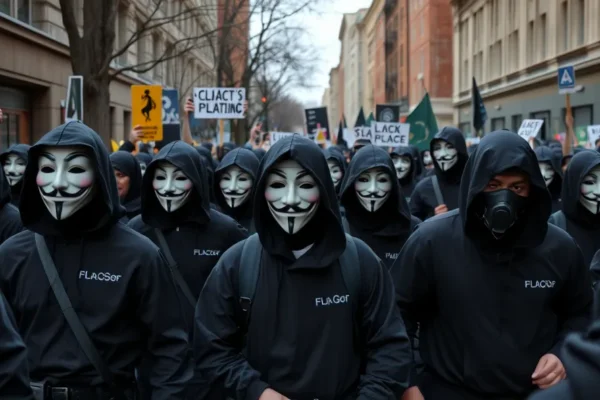
Understanding the Black Bloc in Protests
When we talk about financial education, we often focus on personal budgeting, investing, and saving. But understanding the broader economic and social landscape is also crucial, as events like protests and civil unrest can have ripple effects. Today, we’re going to discuss a specific element sometimes seen at protests: the Black Bloc. This isn’t about direct financial advice, but about understanding forces that can influence economic stability and market sentiment.
The Black Bloc refers to a tactic used by a group of people, often associated with anarchist or anti-authoritarian movements, who dress similarly, typically in black clothing, and often wear masks or face coverings. Their goal isn’t to promote a specific economic policy in the traditional sense, but to disrupt and challenge existing power structures, which can indirectly affect economic conditions.
Why should you care about understanding this? Because social and political instability, often fueled by intense protests, can create uncertainty. This uncertainty can impact investor confidence, leading to market volatility. Businesses might hesitate to invest, and consumers might pull back on spending. By understanding the actors and tactics involved in protests, we can better grasp the potential economic consequences.
How the Black Bloc Tactic Works
The core mechanism of the Black Bloc tactic is anonymity and coordinated action. Participants dress in black to obscure their individual identities, making it harder for law enforcement to identify and arrest them. This anonymity is intended to allow them to engage in more direct and confrontational actions without immediate personal repercussions.
Think of it like a group of friends deciding to play a prank. If they all wear the same disguise, it’s hard to tell who did what. The Black Bloc applies this to protest settings. Their actions often include property destruction, such as smashing windows or vandalizing public or private property, and sometimes engaging in clashes with police. These actions are often described as direct action, meaning they are intended to have an immediate, visible impact rather than relying on traditional political channels like voting or lobbying.
For example, imagine a large demonstration against a new government policy. Within this demonstration, a subgroup of masked individuals, dressed in black, breaks away from the main march. They might then proceed to damage storefronts or throw objects at police lines. This is a classic manifestation of the Black Bloc tactic. The aim is to create chaos and draw attention to their cause through a disruption of the status quo. This is a key part of their anarchist tactics, which often prioritize dismantling existing systems.
Why Understanding the Black Bloc Matters for the Economy
While the Black Bloc itself isn’t an economic entity, their presence and actions at protests can have significant economic implications. When protests turn violent or lead to widespread civil unrest, it can create a climate of instability. This instability can affect various aspects of the economy.
For individuals, economic uncertainty can mean job insecurity if businesses scale back operations or delay expansion plans. It can also affect personal investments. For example, if a city experiences prolonged periods of unrest, businesses located in that area might suffer losses, potentially leading to layoffs. Tourism can also take a hit, impacting the hospitality sector and related jobs.
On a larger scale, sustained civil unrest can deter foreign investment. International companies might view a country or region with a high degree of social instability as too risky for their capital. This can slow economic growth and reduce the creation of new jobs. Stock markets can also react negatively to news of widespread riots or significant political instability, leading to dips in the overall value of investments.
Those who benefit from instability are often not the general public but rather those who seek to profit from disruption or those who believe that destruction is a necessary precursor to change. Conversely, businesses, local communities, and individuals who rely on stability and predictability are negatively affected. The far-left ideologies often associated with the Black Bloc aim to dismantle capitalist structures, and the resulting disruption, whether intended or not, can indeed harm established economic systems.
Historical and Current Context of the Black Bloc
The use of the Black Bloc tactic has roots in 20th-century European protest movements, particularly within anarchist and anti-fascist circles. It gained significant visibility in the late 1990s and early 2000s during large anti-globalization demonstrations, such as the 1999 Seattle WTO protests. These events highlighted how organized groups could use anonymity to engage in confrontational actions within larger protest movements.
Over time, the tactic has evolved and been adopted by various groups expressing dissent. In recent years, the Black Bloc has been observed in numerous anti-government protests and demonstrations across the globe. The use of masks and similar attire is a key element of their anarchist tactics, designed to protect participants and create a sense of collective identity.
Recent interest in the Black Bloc has been heightened by their alleged role in escalating protests into riots. For instance, the French government has, at various times, made claims about the disruptive actions of masked protesters, often described as fitting the Black Bloc profile, in turning otherwise peaceful demonstrations into scenes of vandalism and violence. These claims highlight the ongoing debate about the line between legitimate protest and destructive behavior, and the role of specific groups in pushing those boundaries during anti-government protests.
Practical Implications for Financial Awareness
When you encounter news about protests involving groups that fit the Black Bloc description, it’s important to consider the potential economic implications rather than just the immediate visual impact. This isn’t about judging the protesters’ motives but about understanding the consequences of their actions.
A common misconception is that all protesters are part of a Black Bloc or that all protests will inevitably lead to riots. In reality, protest movements are diverse, and the presence of masked protesters engaging in confrontational tactics is usually a subset of a larger demonstration. Another misconception is that property destruction is always an effective tool for change. While it can draw attention, it often alienates potential allies and can lead to severe economic costs for communities and businesses.
When this topic appears in the news or influences decisions, consider the following:
- Economic Stability: Look for reports on how the unrest is affecting local businesses, employment, and consumer confidence.
- Market Reactions: Observe if financial markets are showing volatility in response to news of protests and potential civil unrest.
- Government Response: Understand that government responses to such activities, including increased security measures or policy changes, can also have economic implications.
An actionable insight is to diversify your personal investments and savings across different asset classes and geographic locations. This can help mitigate risks associated with localized economic disruptions caused by social instability.
Related Concepts in Economics and Finance
Understanding the Black Bloc and their tactics connects to several broader economic and financial concepts. The phenomenon of civil unrest and its impact on markets is a key area of study in political economy. Concepts like risk management become crucial here, as investors and businesses must assess and mitigate risks associated with social and political instability.
The actions of masked protesters and their focus on direct action can also be seen through the lens of supply and demand dynamics. For example, if a protest disrupts supply chains (e.g., by blocking transportation), it can lead to temporary shortages and price increases for certain goods, illustrating concepts like inflation and its drivers. Furthermore, the idea of challenging established systems touches upon broader discussions of economic inequality and alternative economic models.
Understanding the motivations and methods of groups like the Black Bloc can also be linked to the study of market sentiment – the overall attitude of investors toward a particular security or the market as a whole. Negative sentiment driven by perceived instability can lead to sell-offs, even if the underlying economic fundamentals remain strong.
Common Questions About the Black Bloc and Protests
What is the primary goal of the Black Bloc?
The primary goal of the Black Bloc tactic is to create anonymity for participants to engage in confrontational protest actions, often aimed at disrupting authority or societal norms they oppose. They are often associated with far-left or anarchist ideologies seeking systemic change.
How do Black Bloc tactics differ from peaceful protests?
Peaceful protests typically involve non-violent demonstrations, marches, and civil disobedience without property damage or confrontation with authorities. Black Bloc tactics, conversely, often involve property destruction, vandalism, and direct clashes, using anarchist tactics and direct action as their primary methods.
What is the alleged role of Black Bloc members in turning protests into riots?
French government claims, among others, often allege that members of the Black Bloc intentionally escalate peaceful demonstrations into riots through acts of vandalism and confrontation. This can draw police attention and create chaos, sometimes leading to wider disorder and civil unrest.
How does the presence of Black Bloc agitators affect the broader protest movement?
The presence of agitators like the Black Bloc can sometimes overshadow the message of the main protest movement, leading to negative public perception and increased police crackdown. It can also alienate moderate supporters and create internal divisions within the movement.
Can individuals identify Black Bloc members during a protest?
The core strategy of the Black Bloc is to use masks and identical clothing to ensure anonymity. Therefore, it is generally very difficult for individuals, including law enforcement, to reliably identify specific members of the Black Bloc during a protest.
What are the economic consequences of riots fueled by groups like the Black Bloc?
Riots can lead to significant economic consequences, including damage to property, loss of business revenue, increased insurance claims, and a general decrease in consumer and investor confidence, potentially impacting job markets and overall economic growth.
Does the Black Bloc represent the majority of protesters?
No, the Black Bloc typically represents a very small fraction of participants in any given protest movement. The majority of people who attend protests generally engage in peaceful forms of dissent and do not participate in or condone the violent or destructive tactics associated with the Black Bloc.
Disclaimer: This article is for educational purposes only and does not constitute financial advice. Financial situations vary, and it is always recommended to consult with a qualified financial professional for personalized advice. Investing involves risk, including the potential loss of principal.