A New Challenger Enters the Brain-Computer Interface Race: Bridge Neurotech’s Ultrasound Approach
A new neurotech startup, Bridge Neurotech, has emerged with an ambitious goal: to rival established players like Sam Altman’s Merge Labs in the rapidly developing field of brain-computer interfaces (BCIs). Unlike many of its competitors who rely on invasive implants or cumbersome external sensors, Bridge Neurotech is pioneering a less intrusive approach using ultrasound technology. This innovation promises a more accessible and potentially more widespread adoption of brain-computer interfaces, a technology that could fundamentally change how humans interact with machines and even augment human capabilities. The announcement marks a significant development in the ongoing quest to create seamless neural interfaces.
The Promise of Listening to the Brain with Sound Waves
At its core, Bridge Neurotech’s innovation lies in its unique method of “reading” brain activity. A brain-computer interface, or BCI, is a system that allows direct communication pathways between a brain and an external device. Traditionally, these systems have involved either surgically implanted electrodes to pick up the electrical signals from neurons, or external sensors like electroencephalography (EEG) caps that measure electrical activity on the scalp. Both have limitations: implants carry surgical risks and potential for rejection, while scalp-based EEG can be prone to noise and offers lower resolution.
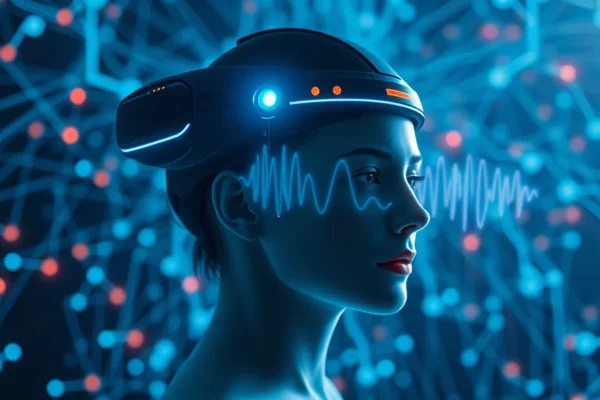
Bridge Neurotech’s approach, however, uses focused ultrasound. Think of it like this: instead of directly tapping into the brain’s electrical wires, they are using a sophisticated form of sonar to “listen” to the brain’s activity. Ultrasound waves, which are sound waves at frequencies higher than humans can hear, are directed towards specific areas of the brain. As these waves pass through brain tissue, they are subtly altered by changes in blood flow and neuronal activity. Bridge Neurotech has developed proprietary technology to detect these minute alterations and translate them back into meaningful brain signals. This ultrasound BCI technology aims to provide a non-invasive, high-fidelity way to monitor neural activity.
Early Demonstrations and Potential Early Adopters
While Bridge Neurotech is a relatively new entrant, their technology is currently in advanced stages of research and development, with early demonstrations indicating promising results. The company has stated that their initial focus is on medical applications, where the need for precise yet non-invasive neural monitoring is paramount. For instance, in intensive care units, continuous monitoring of brain activity can be crucial for patients with severe brain injuries or neurological conditions. An ultrasound BCI could offer a safer, more convenient alternative to current methods.
Beyond critical care, the potential applications extend to neurorehabilitation. After a stroke, for example, patients often need to retrain their brains to regain lost motor functions. A wearable ultrasound BCI could help therapists understand precisely which neural pathways are engaged during therapy, allowing for more personalized and effective treatment plans. The company has indicated plans for clinical trials in the coming years, suggesting a phased rollout starting with these specialized medical fields before potentially expanding into consumer markets.
Navigating a Crowded and Evolving Competitive Landscape
The brain-computer interface space is increasingly competitive, with significant investment and groundbreaking research from various entities. Sam Altman, co-founder of OpenAI, has also ventured into this domain with his company, Merge Labs, reportedly working on advanced neural interface technologies. Other established players and numerous neurotech startups are exploring diverse avenues, from advanced EEG and functional near-infrared spectroscopy (fNIRS) to more sophisticated implantable devices.
Bridge Neurotech’s ultrasound BCI distinguishes itself through its non-invasive nature combined with the potential for higher signal resolution compared to standard EEG. While implantable solutions like those potentially explored by Merge Labs might offer the highest fidelity, they come with significant hurdles. Ultrasound BCI offers a compelling middle ground, potentially providing a performance level close to invasive methods without the associated risks. The key advantage lies in its ability to focus on deeper brain structures more effectively than surface-based EEG, all while remaining external to the body.
Reshaping Interaction and Augmenting Human Potential
The long-term implications of a robust, non-invasive BCI technology like Bridge Neurotech’s are profound and far-reaching. In the medical field, it could revolutionize diagnosis, treatment, and monitoring of neurological disorders, potentially leading to better outcomes for millions. Beyond healthcare, the technology could pave the way for intuitive human-computer interaction. Imagine controlling complex machinery, navigating virtual environments, or communicating with devices purely through thought, without any physical connection.
Economically, this could lead to new industries, job creation in specialized fields like neuro-engineering and AI interpretation of neural data, and a paradigm shift in how we design and interact with technology. Socially, while offering immense benefits in accessibility for individuals with disabilities, it also raises questions about data privacy, security, and the ethical implications of direct brain-machine interaction. The widespread adoption of such a powerful new tech could reshape daily life in ways we are only beginning to imagine.
Overcoming Hurdles on the Path to Widespread Adoption
Despite its promising potential, Bridge Neurotech’s ultrasound BCI faces significant challenges. The fundamental hurdle for any new neurotech startup is demonstrating consistent, reliable performance across diverse individuals and in real-world, noisy environments. Translating subtle ultrasound alterations into accurate brain signals requires sophisticated algorithms and powerful processing.
Technical challenges include refining the focus and penetration depth of the ultrasound to target specific brain regions without causing discomfort or harm. Ensuring the wearability and long-term comfort of the device is crucial for practical adoption. Furthermore, regulatory approval for medical devices, especially those interacting with the brain, is a rigorous and time-consuming process. On the consumer side, cost will be a major factor in accessibility, and public perception and trust in brain-interfacing technology will need to be cultivated.
The Road Ahead: Refining the Technology and Expanding Applications
The future trajectory for Bridge Neurotech hinges on successfully navigating these technical and regulatory hurdles. The company will likely focus on further refining its signal processing capabilities, miniaturizing its hardware, and conducting extensive clinical validation for its initial medical use cases. As the technology matures and becomes more robust, we can anticipate potential expansion into broader applications.
Key developments to watch include the successful completion of clinical trials, partnerships with major healthcare providers, and advancements in the AI models that interpret the ultrasound-generated brain data. Industry observers will be keen to see how Bridge Neurotech’s approach compares to the progress of other leading BCIs, including those from prominent figures like Sam Altman and his Merge Labs. Milestones might include FDA approvals for specific medical devices and early partnerships for consumer applications in the next five to ten years.
Key Questions About Bridge Neurotech’s Ultrasound BCI
What is a brain-computer interface (BCI)?
A brain-computer interface is a system that enables direct communication between the brain and an external device, allowing for control or interaction without physical movement.
How does Bridge Neurotech’s ultrasound BCI differ from other BCIs?
Instead of using electrical signals or implants, Bridge Neurotech uses focused ultrasound waves to detect changes in brain activity related to blood flow and neuronal function, offering a non-invasive approach.
Is this technology currently available to consumers?
No, Bridge Neurotech’s ultrasound BCI technology is still in the research and development phase, with initial applications targeted for medical use and clinical trials planned.
Who are Bridge Neurotech’s main competitors?
Major competitors in the BCI space include companies like Sam Altman’s Merge Labs, along with numerous other neurotech startups and research institutions exploring various forms of neural interface technology.
What are the potential benefits of this new tech?
Potential benefits include revolutionary advancements in treating neurological conditions, enhanced accessibility for individuals with disabilities, and more intuitive human-computer interaction.
What are the biggest challenges facing this technology?
Key challenges include demonstrating consistent accuracy, ensuring user comfort and safety, obtaining regulatory approval, and making the technology affordable and accessible to the public.
It is important to note that the field of brain-computer interfaces is rapidly evolving. While Bridge Neurotech’s ultrasound approach presents exciting possibilities, its long-term efficacy, widespread adoption, and ultimate impact remain subjects of ongoing research and development.