

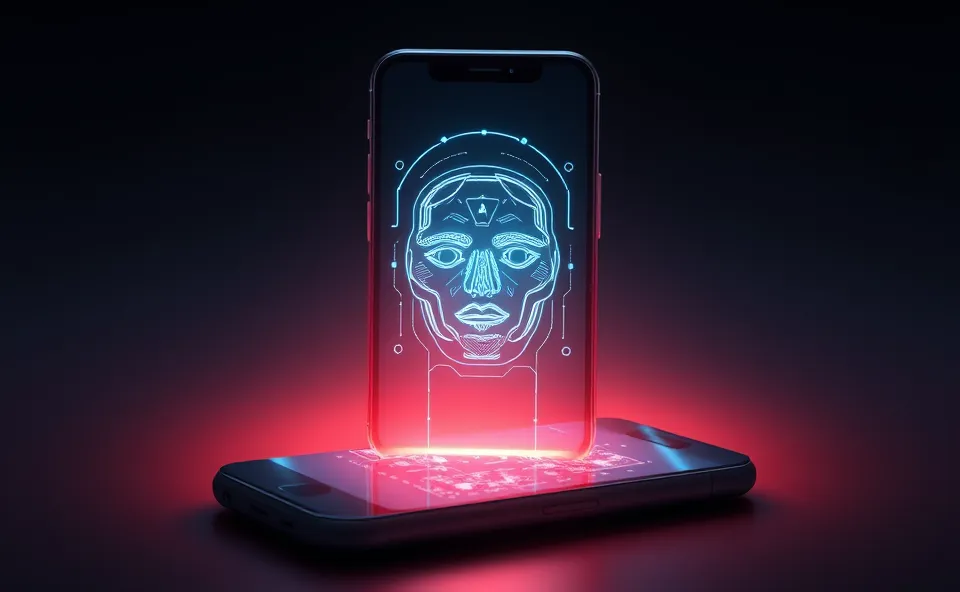
The End of the Notch is Finally Here
For years, we have lived with a compromise on our smartphones. Whether it is a notch, a pill shape, or a tiny hole, there has always been some kind of cutout at the top of the screen. This is mostly because the hardware needed for Face ID is bulky. To get a secure, 3D map of your face, the sensors need a clear, unobstructed view of you. Putting them behind the screen usually makes the image blurry or weakens the security.
Enter Metalenz and their new Polar ID technology. This is a game changer for Invisible Face ID. Instead of using traditional, curved glass lenses that take up a lot of space, Metalenz uses something called metasurfaces. Imagine a lens that is completely flat but can still bend light exactly like a thick piece of glass. This allows the facial recognition sensors to be incredibly thin and sit comfortably underneath the display.
The real magic happens with how it handles light. Polar ID uses the polarization of light to filter out the noise created by the screen pixels. This means the sensor can see your face clearly even though there is a layer of glowing pixels right in front of it. It gives us the best of both worlds: a completely seamless, all-screen display and the high-level security of 3D biometrics.
Why Everyone is Talking About This Now
If you look at the current smartphone market, the hardware has mostly plateaued. We have amazing cameras and fast processors, but the physical design has hit a wall. Users are tired of the notch. Even the most creative solutions, like the Dynamic Island, are still just ways to make a hardware limitation feel like a feature.
People are searching for a way to get a true edge-to-edge experience. We want to watch videos and play games without a black dot or a cutout blocking the view. At the same time, we are not willing to give up smartphone security. Fingerprint scanners are great, but facial recognition is faster and feels more natural.
The buzz around Polar ID is growing because it solves the one problem that has stopped the industry from going fully invisible. It is not just a minor tweak. It is a fundamental shift in how we build optics. The tech world is excited because this moves us away from the era of compromise and into the era of pure design.
The Struggle With Under Display Cameras
To understand why this is a big deal, we have to look at how we got here. Traditional facial recognition depends on projecting thousands of invisible infrared dots onto your face and reading how they bounce back. This requires a very precise lens to focus those dots.
When companies first tried to put cameras and sensors under the display, they ran into a physics problem. A smartphone screen is not actually transparent. It is a grid of pixels, wires, and light-emitting materials. Trying to take a photo through a screen is like trying to look through a screen door during a rainstorm. The image comes out soft, grainy, and lacks detail.
Because of this, early under-display attempts were often relegated to low-end phones or used only for basic selfies. They were never secure enough for authentication. If the sensor cannot see the fine details of your face because the screen is in the way, the security is compromised. This is why the industry stuck with notches. We chose a small ugly hole over a security flaw.
How This Changes the Way We Use Our Devices
The shift to Invisible Face ID does more than just make a phone look prettier. It changes the entire interaction between the user and the device. When the sensors are invisible, the screen becomes a pure canvas. Designers no longer have to build their user interfaces around a notch. Every pixel becomes usable.
From a business perspective, this opens up new possibilities for next-gen tech. We are looking at a future where the hardware disappears, leaving only the software. This impacts several areas:
- User Experience: Full-screen immersion for gaming and media without any visual interruptions.
- Durability: By removing the need for a physical cutout in the glass, the structural integrity of the front panel could potentially improve.
- Design Freedom: Manufacturers can experiment with new screen shapes and sizes without worrying about where to hide the sensor array.
- Security Trust: Because Polar ID maintains the precision of 3D mapping, users do not have to sacrifice safety for aesthetics.
For the average person, this means the phone simply works. You wake up your screen, it recognizes you instantly, and you never have to think about where the camera is. It makes the technology feel less like a tool and more like a natural extension of your life.
What Lies Ahead for Invisible Tech
While the focus is currently on smartphones, the implications of Metalenz technology go far beyond the pocket. Once you can shrink a high-performance lens into a flat metasurface, you can put that technology anywhere.
We can expect to see this move into laptops. Imagine a MacBook or a Dell XPS where the webcam and Face ID are hidden under the bezel or the screen itself. No more thick top bars on laptops just to house a tiny camera. It would allow for thinner frames and more screen real estate on portable computers.
Beyond that, this could revolutionize automotive dashboards. Cars are adding more screens for navigation and entertainment. Having invisible biometrics in the dashboard could allow the car to recognize the driver and automatically adjust the seat, mirrors, and music preferences without needing a visible camera staring at the driver.
We might even see this in augmented reality glasses. AR glasses need to be lightweight and stylish. Bulky lenses make them look like science projects. Flat optics would allow for sleek, normal-looking glasses that can still perform complex visual tasks and security checks.
Common Questions About Invisible Face ID
Is Invisible Face ID as secure as the traditional version?
Yes. Because Polar ID uses advanced metasurfaces and polarization, it can still capture the high-resolution 3D data needed for secure authentication. It does not rely on a simple 2D image, which means it cannot be fooled by a photograph.
Will an under-display camera affect my photo quality?
Traditional under-display cameras often struggle with blurriness. However, the goal of the Metalenz approach is to use flat optics to focus light more efficiently, significantly reducing the quality loss usually associated with sensors hidden behind a screen.
Which devices will get this technology first?
While Metalenz provides the technology, it depends on smartphone manufacturers to integrate it. It is likely to appear first in flagship premium devices where the demand for a notch-less design is highest.
Does this technology replace fingerprint scanners?
It does not necessarily replace them, but it provides a more seamless alternative. Many users prefer Face ID because it is hands-free. Having it be invisible makes it a much more attractive primary security method.
What exactly is a metasurface?
A metasurface is a man-made material with a structure smaller than the wavelength of light. Instead of using a curved shape to bend light, these tiny nanostructures manipulate light waves directly. This allows a lens to be completely flat while performing the same job as a thick glass lens.











