

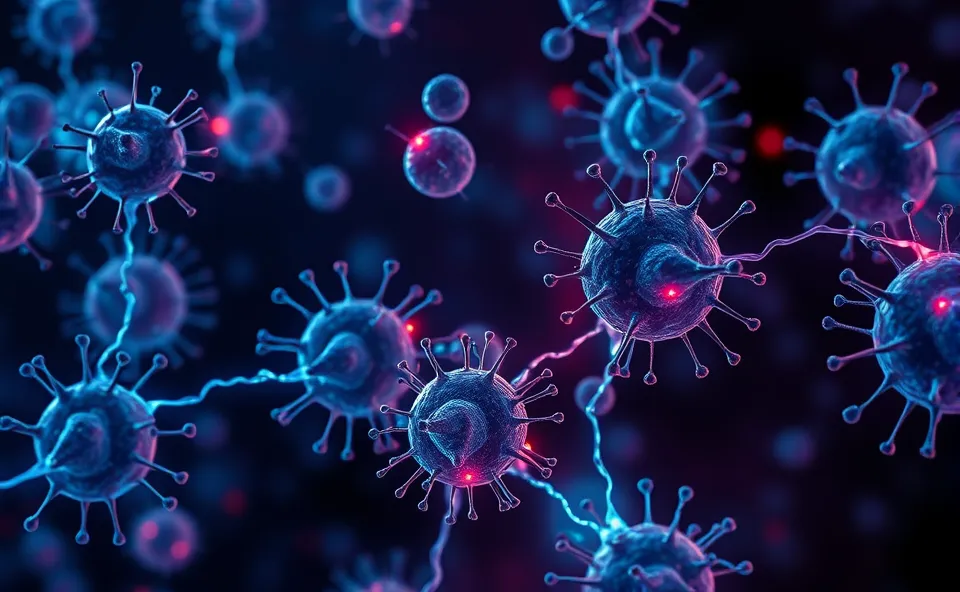
Seeing the Invisible Dance Inside Our Bodies
For a long time, we thought we had a pretty good handle on how the human immune system worked. We knew about white blood cells, antibodies, and the general idea of your body fighting off a cold. But as Daniel Davis from WIRED Health points out, there is a whole other world happening at a scale so small that our old tools simply could not see it. We are talking about the nanoscale, where a single millimeter is a million times larger than the structures we are studying.
Imagine the immune system not as a simple army, but as a complex social network. For cells to communicate, they do not just send signals. They actually touch. They engage in a physical, molecular handshake to decide if a neighboring cell is a friend or a dangerous invader. These interactions happen at the nanoscale, and for decades, these were the nanoscale secrets of our biology. We knew the handshakes were happening, but we could not see the fingers touching.
Now, thanks to new technologies, we are finally getting a front row seat. Scientists are using advanced imaging and molecular mapping to watch these interactions in real time. Instead of guessing based on the results of a chemical reaction, immunologists can now visualize the exact moment two proteins lock together. This is not just a minor upgrade in equipment. It is like moving from a blurry polaroid photo to a high definition 4K movie of the inner workings of our cells.
Why Everyone is Talking About Nanoscale Biology Now
You might wonder why this is suddenly becoming a hot topic in technology and science circles. The truth is that we have hit a tipping point. For years, we had the theories, but we lacked the eyes. The reason this is trending now is that several different fields of scientific discovery have collided at the exact same time.
First, we have seen a massive leap in computing power. Processing the amount of data required to map a single cell at the nanoscale is staggering. We are no longer just taking a picture. We are processing billions of data points to create a 3D model of cellular behavior. When you combine this with AI, the machines can spot patterns in the immune system that a human eye would miss in a thousand years of staring through a lens.
Second, there is a growing urgency to understand how our bodies react to new types of threats. From global pandemics to the rise of autoimmune disorders, the old way of looking at immunology was not enough. We realized that the difference between a healthy immune response and one that attacks the body is often a tiny, nanoscale mistake. People are searching for these answers because the promise of “precision medicine” depends entirely on our ability to see these secrets.
How We Used to Guess the Secrets
To understand how big of a deal this is, we have to look back at how cellular biology functioned for the last century. In the past, if a scientist wanted to know what was happening inside a cell, they basically had to freeze it or stain it with dyes and hope for the best. They would look through a light microscope and see a blob. They knew the blob was a T cell and they knew it was attacking a virus, but the actual mechanism was a mystery.
It was a bit like trying to understand how a smartphone works by looking at it from a mile away with binoculars. You can see that the screen lights up and that people are using it, but you have no idea how the transistors or the circuitry actually function. You can infer the process, but you cannot prove it.
Immunologists relied on “indirect evidence.” They would add a chemical to a dish, see the cells move, and assume a certain protein was responsible. This worked for the basics, but it failed when things got complicated. The human immune system is the most complex system in the known universe, and trying to decode it with basic microscopes was like trying to read a book in the dark by feeling the edges of the pages.
What This Means for the Future of Health and Tech
The ability to uncover nanoscale secrets is not just a win for textbooks. It has massive implications for how we build technology and treat disease. When we can see the exact molecular bridge that a virus uses to enter a cell, we can build a “bridge blocker” with absolute precision. This is where advanced imaging turns into a tool for engineering.
For businesses and the biotech market, this shifts the entire strategy of drug development. In the past, pharmaceutical companies often used a shotgun approach. They would create a drug that affected a wide range of cells and hope the benefits outweighed the side effects. With nanoscale insights, we can move toward a sniper approach.
- Reduced Side Effects: By targeting only the specific molecular handshake that causes inflammation, we can stop the disease without harming healthy cells.
- Better Vaccines: We can design vaccines that mimic the nanoscale structure of a pathogen more accurately, teaching the immune system to recognize the enemy faster.
- Autoimmune Breakthroughs: We can finally see why the body accidentally attacks itself and find the specific “glitch” in the cellular conversation to switch it off.
This is also driving a new era of hardware. The demand for these insights is pushing the development of sensors and lenses that can operate at the atomic level. The technology being developed for immunology will likely bleed over into other fields, such as materials science and nanotechnology, creating a ripple effect of innovation across the entire tech sector.
Where Do We Go From Here
Looking ahead, the goal is to move from seeing a few cells in a lab to seeing the entire human immune system in action inside a living body. Right now, most of this happens in controlled environments. The next logical step is the development of non invasive imaging that can watch these nanoscale interactions in real time while a patient is still walking and talking.
We can expect to see a rise in personalized immunology. Instead of a one size fits all treatment, a doctor might analyze the specific nanoscale secrets of your own immune cells. They might find that your body’s “handshake” mechanism is slightly different from the average person’s, allowing them to customize a medication specifically for your molecular architecture.
We are also likely to see a deeper integration of AI and cellular biology. As we feed more nanoscale images into machine learning models, the AI will start predicting how a new virus will interact with our cells before the virus even evolves. We will stop reacting to diseases and start anticipating them by understanding the fundamental rules of the nanoscale world.
Common Questions About the Immune System and Nanotechnology
What are nanoscale secrets in the immune system?
These are the tiny, molecular interactions that happen between cells. They include the specific ways proteins lock together to send signals, which occur at a scale too small for traditional microscopes to see.
How do new technologies help immunologists?
New technologies like super resolution microscopy and AI driven data analysis allow scientists to see the actual physical connections between cells, moving from theoretical guesses to visual proof.
Why is advanced imaging important for the human immune system?
Advanced imaging allows us to see the “handshakes” between immune cells and pathogens. This helps scientists understand exactly how a disease enters the body and how to block it more effectively.
What is the connection between immunology and cellular biology?
Immunology is the study of the immune system, while cellular biology is the study of the cell itself. By combining them, we can understand how the structural parts of a cell enable the complex defense mechanisms of the body.
Can these scientific discoveries lead to better medicine?
Yes. By understanding the nanoscale secrets of how cells communicate, researchers can create targeted therapies that treat diseases with higher precision and fewer side effects than traditional medicine.











