

The Billion Dollar Bet on Artificial Intelligence
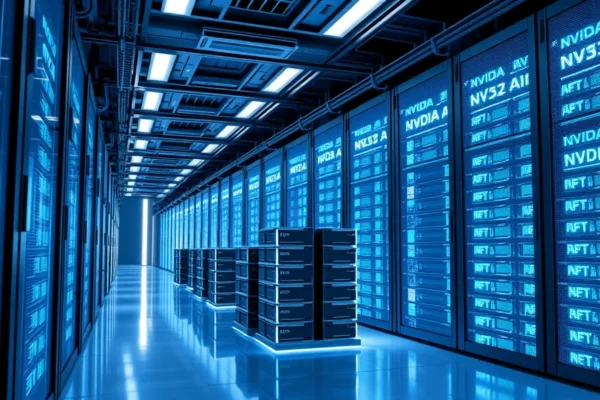
The race to build more powerful artificial intelligence is no longer just about clever software code. It has become a massive, physical challenge of infrastructure. Recently, Neocloud Lambda, a company specializing in high-performance cloud infrastructure, announced it has secured $1 billion in debt financing. The purpose of this significant capital infusion is singular: to purchase a vast fleet of high-end Nvidia AI chips. These processors will then be leased to major technology partners, including Microsoft, to fuel the next wave of AI development. This move highlights a sobering reality of the modern technology landscape. While AI is often discussed in abstract, digital terms, the actual work requires a staggering amount of expensive hardware.
How Specialized Chips Power the AI Engine
To understand why Neocloud Lambda needs such an immense amount of capital, one must understand what these AI chips actually do. Standard computer processors, like the ones in a laptop, are designed to handle a wide variety of general tasks, from running a web browser to word processing. However, training an AI model requires performing billions of small mathematical calculations simultaneously.
Think of a standard computer processor like a highly skilled professor who can solve complex problems one at a time. An AI chip, by contrast, is more like a massive room full of thousands of primary school students performing basic addition at the exact same time. While neither is smarter than the other, the room full of students finishes the massive pile of simple math much faster. This architecture is essential for artificial intelligence, which relies on processing massive datasets to learn patterns. Without these specialized chips, modern AI systems would take years, rather than weeks, to complete their training.
Current Use Cases and the Demand for Cloud Computing
Today, these high-powered systems are the backbone of modern cloud computing. Companies like Microsoft offer access to these massive “supercomputers” through their cloud platforms, allowing businesses to rent the processing power they need without buying the hardware themselves. This model, often called Infrastructure as a Service, is currently seeing unprecedented demand.
From healthcare researchers training models to identify diseases in medical scans, to financial institutions building complex risk-assessment tools, the use cases are expanding rapidly. Currently, this technology is in a phase of rapid adoption by large enterprises. Most organizations do not have the expertise or the capital to build their own custom data centers, making services provided by companies like Neocloud Lambda essential. These resources are available now, but demand currently far outstrips the global supply of advanced semiconductor hardware.
The Competitive Landscape of Infrastructure Providers
Neocloud Lambda is not alone in this race. The market for AI-ready infrastructure is highly competitive, featuring both established tech giants and emerging players. Companies like CoreWeave are pursuing similar venture debt strategies to secure hardware, while major cloud providers like Amazon and Google are attempting to design their own proprietary chips to lessen their reliance on external suppliers.
The advantage for Neocloud Lambda lies in its agility and specialized focus on the AI ecosystem. While large cloud incumbents must support legacy systems and millions of non-AI customers, firms like Neocloud are built specifically to handle the unique thermal and electrical requirements of intensive AI workloads. However, the reliance on a single primary manufacturer for these chips remains a shared vulnerability across the entire industry.
The Economic and Social Implications of the AI Boom
The sheer scale of this $1 billion investment underscores the massive economic stakes of the current AI boom. As companies rush to secure the “digital gold” of processing power, the business model for software development is shifting. We are seeing a move toward capital-intensive computing, where the barrier to entry is no longer just a good idea, but the ability to finance millions of dollars in hardware.
In the short term, this will likely lead to rapid advancements in AI capabilities as more computing power becomes available. However, there are long-term concerns regarding market concentration. If only the wealthiest companies can afford to lease these chips, smaller innovators may be pushed to the sidelines. Furthermore, the immense energy consumption required to run these server farms has become a significant topic of public discussion regarding environmental sustainability.
Bottlenecks and Challenges in Hardware Deployment
Despite the influx of capital, the industry faces significant hurdles. The primary challenge is the supply chain for semiconductors. These chips are incredibly complex to manufacture, requiring specialized facilities that take years to build. Even if Neocloud Lambda has the money to buy them, they are subject to global supply limitations and long lead times.
Beyond availability, there is the issue of technical maturity. Many AI models are still being optimized, and the “cooling” required to keep these chips from overheating in massive data centers is a constant engineering challenge. Additionally, the regulatory environment is beginning to tighten. Governments are increasingly looking at how these chip-intensive technologies are used, particularly regarding safety and potential misuse, which could create future barriers for those leasing the infrastructure.
The Road Ahead for AI Infrastructure
Looking forward, the trajectory of this technology points toward greater specialization. We are likely to see the emergence of “purpose-built” hardware that is even more efficient for specific tasks, such as generating video or analyzing genomic data. Industry experts suggest that the next few years will be defined by an attempt to increase the “compute efficiency” of models, meaning developers will look for ways to achieve the same results with less hardware.
While the current era is defined by a “bigger is better” approach, the future will likely prioritize software optimization alongside physical hardware expansion. We should expect to see these companies transition from simply providing raw power to offering more managed services that help users get the most out of their expensive computing time.
Frequently Asked Questions
Is the current model of debt financing for AI chips sustainable?
While venture debt allows companies like Neocloud Lambda to grow quickly, it relies on the assumption that demand for AI chips will continue to rise exponentially. If the market for AI services hits a plateau, companies with high debt loads could face significant financial pressure.
Who ultimately benefits from this $1 billion investment?
The direct beneficiaries are the cloud providers and their customers, such as Microsoft, who gain access to the hardware necessary for advanced software development. Ultimately, users of AI-powered applications may benefit from faster, more capable services as these models become easier to train.
How long will it take for this hardware to become mainstream?
The hardware is already being deployed in data centers today, but widespread, low-cost access for smaller developers remains a future goal. We are currently in an early adoption phase where the most powerful tools are concentrated in the hands of well-capitalized tech firms.
What are the main risks associated with this reliance on AI chips?
The primary risks include supply chain bottlenecks, massive electricity consumption, and the high financial cost of maintaining this equipment. If a manufacturer faces production delays, the entire AI development pipeline can effectively grind to a halt.
Is there a limit to how much power these chips can provide?
Technically, we are hitting physical limits in how small and dense we can make these transistors. The future of the industry will rely less on just making chips “bigger” and more on improving how efficiently they communicate and process data.
Note: This article is based on recent financial reports and public announcements regarding infrastructure investments in the semiconductor sector. As the field of artificial intelligence is rapidly evolving, information regarding hardware availability and industry benchmarks should be treated as dynamic and subject to change based on market conditions and supply chain developments.











