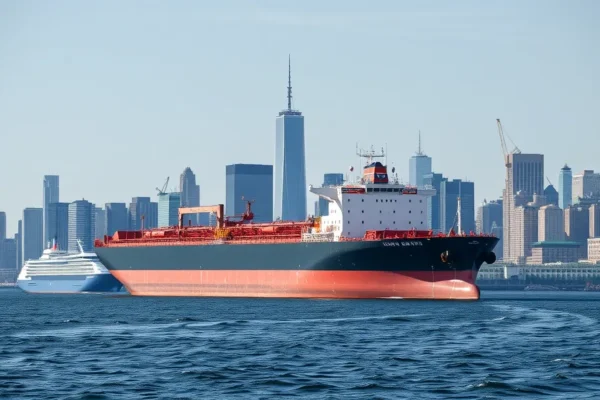
First Russian Diesel Tanker Arrives in New York
The arrival of a Russian diesel tanker, the ‘Nonya,’ at a New York harbor in early 2024 marked a significant, albeit often overlooked, development in global energy markets. Carrying an estimated 300,000 barrels of diesel fuel, the vessel’s presence underscored a shift in how the United States sources its fuel supply. This event, while seemingly a simple commodity transaction, is deeply intertwined with broader geopolitical dynamics and international trade agreements, specifically touching upon discussions surrounding a potential “Trump-Putin deal” aimed at influencing fuel prices.
The ‘Nonya,’ operated by Sovcomflot, a Russian state-owned shipping company, delivered its cargo to a terminal in New York, according to reports from Reuters and industry tracking services like Vortexa. The exact destination and buyer were not publicly disclosed, which is common in the opaque world of commodity trading. However, the sheer fact of a Russian-flagged vessel delivering a substantial volume of diesel fuel to a major U.S. consumption hub generated considerable attention, prompting analysis of its strategic implications.
Why This Russian Diesel Delivery Matters
The strategic rationale behind this Russian diesel tanker’s arrival in New York is multifaceted, extending beyond immediate supply and demand. For Russia, it represents an opportunity to maintain and even expand its market share in key Western economies, despite ongoing geopolitical tensions and sanctions. By securing buyers for its diesel, Russia can generate vital export revenues, bolstering its economy. For the U.S. market, the influx of diesel from Russia, if it becomes a sustained trend, could serve to increase competition among suppliers, potentially leading to lower prices for consumers and businesses reliant on diesel, such as trucking companies and agricultural operations. This aligns with a broader U.S. energy policy objective of ensuring stable and affordable fuel supplies.
The broader context for this move involves the global commodity markets’ inherent search for arbitrage opportunities. When the price of a product like diesel in one region is significantly higher than in another, adjusted for shipping costs, traders and suppliers are incentivized to move that product. Reports suggesting a potential “Trump-Putin deal” to lower global fuel prices, as alluded to by then-candidate Donald Trump during his 2024 campaign, add another layer of complexity. While the specifics of such a hypothetical deal remain speculative, the underlying aim would likely be to leverage geopolitical influence to stabilize or reduce energy costs, particularly ahead of elections or during periods of economic concern. This event, therefore, can be viewed as a practical manifestation of market forces responding to potential shifts in international relations and energy policy.
Competitive Dynamics in the Diesel Market
The arrival of the Russian diesel tanker directly impacts the competitive landscape for diesel suppliers in the U.S. and globally. Traditionally, North American refiners and suppliers, including major integrated oil companies and independent refiners, dominate the U.S. diesel market. However, global supply chains mean that imports always play a role, especially when domestic production cannot meet demand or when international prices are more attractive. This Russian delivery introduces a new source of competition, potentially putting pressure on domestic refiners and their profit margins. If more Russian diesel enters the U.S. market, it could force domestic producers to compete more aggressively on price.
Companies that stand to gain from increased diesel supply and potentially lower prices include end-users such as logistics firms, trucking companies, and agricultural businesses that depend heavily on diesel fuel. Their operating costs could decrease, improving their profitability and potentially allowing them to pass savings onto consumers. Conversely, U.S. oil refiners might face increased competition, potentially impacting their revenue and market positioning if they cannot match the landed cost of Russian diesel. The competitive advantage shifts towards buyers who can secure the most cost-effective fuel. This also has implications for global energy giants like ExxonMobil, Chevron, and Shell, whose trading arms constantly monitor and exploit these price differentials to optimize their own supply chains and trading profits.
Broader Industry Implications and Trends
This event signals that despite political rhetoric and sanctions, the global energy trade remains deeply interconnected. It highlights the persistent influence of commodity markets on international relations and the practicalities of energy policy. The industry trend towards optimizing global supply chains to meet demand wherever it is most profitable continues, even amidst geopolitical friction. For peers in the energy sector, the implication is clear: market forces will continue to seek the most efficient pathways for resource distribution, and companies that can navigate these complex dynamics will thrive.
Industry peers are likely to monitor the volume and consistency of such imports. If Russian diesel becomes a reliable and cost-effective supply source for the U.S., other importers may also seek similar opportunities. This could lead to a recalibration of traditional supply routes and potentially a reduction in the premium U.S. diesel has commanded in recent times. The long-term impact depends on whether this is a one-off event or the beginning of a sustained flow. The competitive landscape in North America could see increased pressure on refining margins, potentially influencing investment decisions in refining capacity and feedstock sourcing. Furthermore, it underscores the ongoing importance of international trade agreements and sanctions enforcement in shaping market access and competitive dynamics.
Financial and Operational Impacts
The financial and operational impacts of this Russian diesel tanker’s arrival are primarily related to pricing and supply chain optimization. For buyers of diesel in the New York region, securing a cargo at a potentially lower price than available from domestic sources can lead to immediate cost savings. This translates directly into improved profitability for businesses that are significant diesel consumers. Over the long term, a sustained increase in the availability of competitively priced diesel could lead to more stable fuel prices, reducing cost volatility for industries that rely on it.
Operationally, this might mean that U.S. refineries need to adjust their product slates or feedstock procurement strategies if they face increased competition. It could also influence the strategic decisions of oil trading companies, prompting them to dedicate more resources to sourcing and distributing Russian diesel to the U.S. market. The financial implications for Russian energy companies like Sovcomflot are clear: it provides an important export market and revenue stream. For U.S. refiners, it could mean a squeeze on their gross refining margins, particularly if they are forced to lower prices to compete with imports. While specific financial figures for this single shipment are not publicly available, the aggregated impact of such imports over time can be substantial, influencing quarterly earnings reports for refiners and trading houses.
Execution Risks and Challenges
While the arrival of the Russian diesel tanker presents potential benefits, significant execution risks and challenges exist. The primary risk is the unpredictable nature of geopolitical relations. Any escalation of sanctions, political tensions, or shifts in international policy could abruptly halt such trade flows. For example, if the “Trump-Putin deal” narrative gains traction and leads to renewed sanctions or trade restrictions, the flow of Russian oil products to the U.S. could be severely curtailed. Historical precedents show that energy markets are highly susceptible to political decisions and international agreements, often leading to volatility.
Furthermore, the operational challenges are not insignificant. The logistics of international shipping, including tanker availability, port congestion, and compliance with maritime regulations, can introduce delays and additional costs. There’s also the risk of market backlash or scrutiny if the volume of Russian imports becomes too substantial, potentially leading to public or political pressure to restrict such trade, especially if it is perceived as undermining domestic energy security or supporting an adversary. The U.S. Energy Information Administration (EIA) data, for instance, tracks import volumes closely, and significant shifts can trigger policy discussions. The success of this strategy hinges on sustained market access and favorable pricing, both of which are vulnerable to external shocks.
Stakeholder Implications
The arrival of Russian diesel impacts various stakeholders in different ways. For end-users, such as trucking companies and farmers, the potential for lower fuel prices offers significant relief, directly improving their financial health and operational efficiency. Customers of these businesses may eventually see the benefit in lower prices for goods and services. For investors in U.S. refining companies, this development could be viewed negatively, potentially leading to downward pressure on stock prices if profit margins are squeezed. Conversely, investors in energy trading firms might see opportunities. Employees in the U.S. refining sector could face uncertainty regarding job security if increased competition leads to reduced production.
For the broader U.S. energy policy landscape, this event raises questions about energy independence and the reliance on imports from countries with complex geopolitical relationships. It could spur debate among policymakers regarding the trade-offs between affordability and energy security. The market sentiment, particularly around energy prices, could shift if these imports stabilize or lower fuel costs, potentially influencing consumer confidence and economic indicators. The strategic decision by traders and buyers to procure Russian diesel reflects a pragmatic approach to market conditions, prioritizing cost-effectiveness in the immediate term.
Outlook and Next Steps
The outlook for sustained Russian diesel imports into the U.S. hinges on several factors. If this trend continues, we could see a more consistent presence of Russian fuel in the U.S. market, potentially leading to more predictable fuel prices for consumers and businesses. Key milestones to watch include the frequency of future Russian diesel tanker arrivals in U.S. ports, the volume of diesel imported, and any official statements or policy shifts from governments regarding these trade flows. The U.S. EIA will likely continue to be a critical source for tracking these import volumes.
Indicators to monitor for success or failure would include shifts in U.S. diesel price benchmarks, changes in the market share of domestic versus imported diesel, and any official U.S. government responses. Measurable outcomes could include a sustained decrease in average diesel prices over a six-to-twelve-month period. However, the geopolitical climate and the potential for any “Trump-Putin deal” to materialize or be abandoned add a significant layer of uncertainty to this outlook. The long-term success of this strategy is not guaranteed and depends heavily on factors beyond pure market economics.
Key Questions and Answers
Will this Russian diesel tanker’s arrival lead to lower fuel prices for U.S. consumers?
Potentially, yes. Increased diesel supply from sources like this Russian diesel tanker can boost competition in commodity markets, which often drives prices down. However, the extent of the price reduction depends on the volume imported, the sustained nature of these imports, and global market conditions. The goal of a “Trump-Putin deal” would likely be to influence global fuel prices.
Why did the U.S. allow a Russian diesel tanker given current geopolitical relations?
The U.S. energy policy generally prioritizes market mechanisms for pricing and supply, and the market dictates where commodities flow based on price differentials. Unless specific sanctions are in place that prohibit such imports, the U.S. market will naturally absorb competitively priced goods, including Russian oil and diesel supply, to meet its U.S. energy demand.
What are the risks of relying on Russian diesel imports?
The primary risks involve geopolitical instability, potential for renewed sanctions, and the unpredictable nature of international relations. A sudden shift in policy or escalation of tensions could halt these fuel imports, leading to price volatility and supply disruptions. These are significant execution risks for any strategy involving Russian energy trade.
How does this compare to typical U.S. energy policy and fuel imports?
Historically, the U.S. has aimed for energy independence but still relies on global energy markets and fuel imports. This event highlights that while domestic production is key, international trade remains vital for meeting U.S. energy demand. The U.S. energy policy allows for imports when they are economically advantageous, but the origin country can become a political factor.
What is the “Trump-Putin deal” mentioned in relation to fuel prices?
The “Trump-Putin deal” refers to a hypothetical or discussed agreement between the former U.S. President and the Russian President aimed at stabilizing or lowering global energy prices. While specifics are unclear and it remains largely speculative, the arrival of Russian diesel in New York could be seen by some as a practical outcome of such potential future understandings influencing commodity markets.
What are the long-term implications for the U.S. diesel supply chain?
If Russian diesel imports become a regular feature, it could lead to a more diversified diesel supply chain in the U.S. This might increase competition for domestic refiners, potentially leading to adjustments in their operations and investment strategies. It also underscores the intricate nature of international trade and the constant search for optimal sourcing by businesses.
Business outcomes are subject to execution risk and market volatility.