The Recycling Robot Revolution: Danu Robotics’ Journey
The sheer volume of waste generated globally presents one of our most pressing environmental challenges. Traditional recycling methods, often relying on manual sorting, are inefficient, hazardous, and struggle to keep pace with the complex mix of materials we discard. This is where innovative environmental technology like that pioneered by Danu Robotics comes in. Over the past six years, under the leadership of founder Amy Ma, Danu Robotics has been dedicated to developing advanced recycling robots designed to tackle this problem head-on. Their work aims to enhance waste sorting efficiency, increase recycling rates, and contribute to a more robust circular economy through cutting-edge robotics in recycling. This initiative represents a significant push towards leveraging automation in waste management to achieve greater sustainability.
Sources: Information on Danu Robotics’ mission and journey is publicly available through their company statements and interviews with Amy Ma.
How Danu Robotics’ Machines Sort Your Trash
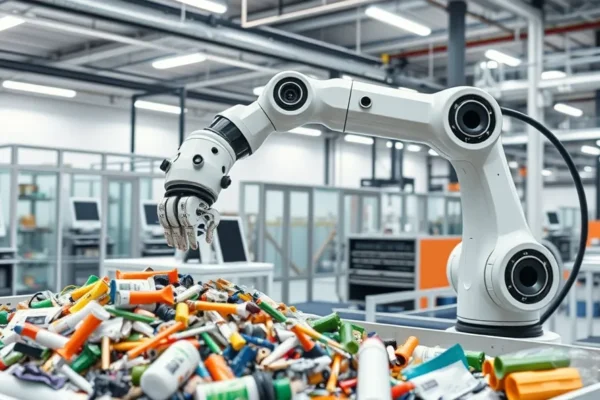
At its heart, a recycling robot from Danu Robotics is an intelligent system designed to identify and separate different types of recyclable materials with remarkable speed and accuracy. Think of it like a highly specialized robotic arm in a factory, but instead of assembling cars, it’s picking out plastic bottles from a stream of mixed waste. The core technology often involves a combination of advanced sensors and artificial intelligence (AI).
These robots use sophisticated cameras that can see beyond what the human eye can detect. They might employ near-infrared spectroscopy, a technique that uses light to identify the chemical composition of materials. For example, one type of plastic might reflect infrared light differently than another, allowing the AI to distinguish between them. This is crucial because different plastics need to be recycled separately.
Once a material is identified, the robot’s AI, trained on vast datasets of waste images, directs a robotic arm to pick it up. This arm is equipped with a gripper that can carefully grasp objects without damaging them. The “brains” behind this operation are the AI algorithms. These algorithms learn from every item they process, becoming progressively better at recognizing new or unusual items. The entire process is about automating the meticulous task of waste sorting, making it faster and more precise than human capabilities alone.
Recycling Robots in Action Today
Danu Robotics is currently in the advanced stages of developing and piloting its robotic sorting solutions. While widespread commercial deployment is still emerging, their technology is making its way into pilot programs and partnerships within the waste management industry. These early deployments are crucial for refining the technology and demonstrating its effectiveness in real-world conditions.
The focus is on integrating these recycling robots into existing Material Recovery Facilities (MRFs), the places where recyclables are processed. By adding these automated systems, MRFs can significantly increase their throughput – the amount of material they can handle. Companies looking to improve their sustainability metrics and operational efficiency are prime candidates for adopting these robotic sorting solutions. The technology is moving from research labs to real-world testing grounds, indicating a shift towards early adoption.
Sources: Details on pilot programs and partnerships are typically announced by Danu Robotics or their industry collaborators.
The Competitive Field of Robotic Waste Sorting
The pursuit of automated waste sorting is a global race, with several companies and research institutions developing similar technologies. Competitors like AMP Robotics, for instance, have already established a strong presence in the market with their AI-powered sorting robots. These rivals often use comparable sensor technologies and AI algorithms to achieve waste separation.
What distinguishes Danu Robotics’ approach, according to their own statements, is their focus on specific material types or a particular operational efficiency in their robotic sorting solutions. Amy Ma’s vision emphasizes creating adaptable systems that can be tailored to different recycling facility needs and material streams. While many companies are developing general-purpose sorting robots, Danu might be targeting niche challenges or aiming for a higher degree of accuracy on specific materials. The advantage often lies in the sophistication of the AI, the speed and dexterity of the robotic arms, and the overall cost-effectiveness of the solution. The competition is driving innovation across the board in the field of robotics in recycling.
Reshaping Waste Management and Driving Sustainability
The widespread adoption of recycling robots like those from Danu Robotics has the potential to fundamentally reshape the waste management industry and significantly boost our progress towards a circular economy. By automating waste sorting, these robots can dramatically increase the purity and volume of recycled materials. This means more resources can be effectively recovered and reintegrated into manufacturing, reducing the need for virgin materials.
Economically, this could lead to new job roles focused on managing and maintaining these advanced systems, while potentially reducing the demand for manual sorting labor. It can also make recycling more profitable for businesses, as cleaner material streams fetch higher prices. Socially, the benefits include a cleaner environment, reduced landfill burden, and a more sustainable consumption model. The environmental technology offered by such innovations directly supports global sustainability goals. In the short term, we can expect to see increased efficiency in existing recycling facilities. In the long term, this could enable entirely new recycling processes and a far more closed-loop system for materials.
The Hurdles on the Path to Automation
Despite the promising advancements, deploying recycling robots at scale is not without its challenges. One significant hurdle is the sheer diversity and variability of waste streams. Unlike a controlled factory environment, a recycling facility deals with an unpredictable mix of items, some of which can be heavily contaminated or unusual in shape and form. This requires highly robust AI that can adapt to novel situations, a capability that is still under continuous development.
Cost is another major barrier. The initial investment in advanced robotic systems, including the robots themselves, sensors, and AI software, can be substantial. This makes it difficult for smaller recycling facilities or those in developing economies to adopt the technology. Furthermore, integrating these robots into existing infrastructure can be complex and require significant modifications to current operational workflows. The reliability and maintenance of these complex machines in dusty, demanding environments also pose ongoing technical challenges.
The Future of Smart Waste Sorting
The trajectory for Danu Robotics and the broader field of recycling robots points towards increasingly sophisticated and integrated solutions. We can anticipate robots becoming more adept at identifying a wider range of materials, including complex composites and electronics that are currently difficult to recycle. The AI will likely evolve to predict material composition more accurately and to learn from less data, becoming more efficient and adaptable.
Future developments may also see these robots working more collaboratively, forming networks within a facility to achieve highly specialized sorting tasks. The integration of robotics in recycling with broader AI in waste management systems could lead to real-time data analytics on waste streams, informing better policy and production decisions. While specific timelines are hard to predict, the trend is towards greater automation, increased efficiency, and a more seamless integration of recycled materials back into the supply chain. The ongoing research and development suggest that breakthroughs in robotic sorting solutions are likely to continue.
Frequently Asked Questions about Recycling Robots
What exactly is a recycling robot?
A recycling robot is an automated machine that uses sensors and artificial intelligence to identify and sort different types of recyclable materials from a mixed waste stream. This technology aims to improve the efficiency and accuracy of waste sorting processes.
How does the AI in recycling robots work?
The AI learns to recognize materials by being trained on vast amounts of data, essentially thousands of images of different recyclable items. When a robot encounters an object, its AI analyzes sensor data (like visual or spectral information) to identify the material and then guides the robot to sort it accordingly.
Is this technology available now or is it still in development?
Recycling robot technology, including that from Danu Robotics, is currently in advanced stages of development and early adoption. It is being piloted and implemented in some recycling facilities, but widespread mainstream availability is still a few years away as the technology matures and costs decrease.
What are the main benefits of using recycling robots?
The primary benefits include increased recycling rates, higher purity of recycled materials, improved operational efficiency, reduced reliance on manual labor for hazardous tasks, and a significant contribution to sustainability and the circular economy.
Who are the main competitors to Danu Robotics?
Key players in the recycling robot market include companies like AMP Robotics, as well as various other startups and established automation firms developing robotic sorting solutions for the waste management industry.
What are the biggest limitations of current recycling robots?
Current limitations include challenges in identifying extremely diverse or heavily contaminated waste, the high initial cost of implementation, and the need for complex integration with existing recycling infrastructure.
This article provides an overview of the current capabilities and potential of recycling robots, drawing on public information and general industry trends. The specific performance and availability of Danu Robotics’ technology may vary and is subject to ongoing development and commercialization efforts.