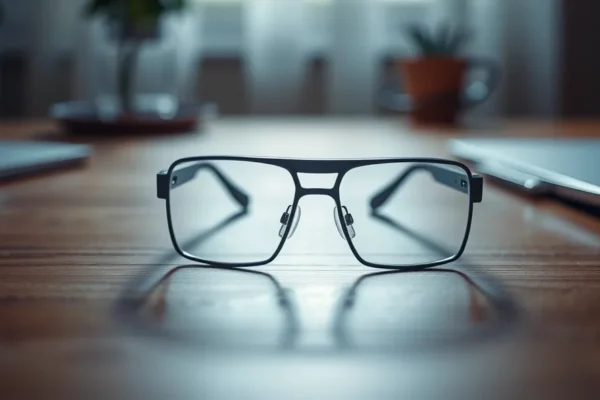
The world of smart glasses is getting interesting again, and HTC is throwing its hat in the ring with the Vive Eagle. Unlike some other tech wearables that want to plaster your social life all over your face, the Vive Eagle is taking a decidedly different path, focusing heavily on privacy. This might sound a bit niche, but if you’ve ever felt a pang of unease about smart devices collecting too much data, this could be a game-changer for you. Let’s dive into what these new HTC smart glasses offer and why their privacy-first approach is worth paying attention to.
What’s This New Gadget All About?
Imagine a pair of glasses that can do more than just help you see clearly. That’s essentially what the HTC Vive Eagle smart glasses aim to be. They’re designed to offer subtle augmented reality (AR) experiences without being intrusive. Think of it like having a helpful, private assistant layered onto your view of the real world. Instead of a big, flashy screen in your face, it’s about providing information and tools that blend seamlessly into your day. This is particularly interesting for anyone who’s felt overwhelmed by the “always-on” nature of some other tech wearables.
The core idea is to enhance your daily life with useful digital overlays, like navigation prompts appearing gently in your line of sight or important notifications popping up discreetly. It’s for the person who wants the convenience of smart technology without feeling like they’re constantly broadcasting their presence or being tracked by a social media giant. If you value your personal space and data, the Vive Eagle’s philosophy is designed with you in mind.
How Would You Actually Use These Things?
Okay, so what does this privacy-focused smart eyewear actually do in the real world? It’s not about scrolling through TikTok on your face. Instead, it’s about making everyday tasks smoother and more private.
- For the Busy Commuter: Imagine walking to your train station. Instead of pulling out your phone, a subtle arrow might appear, guiding you to the right platform. When your train is approaching, a discreet notification could pop up, telling you its arrival time. All of this happens without anyone else seeing your personal commute details.
- For the Home Chef: While following a recipe, the Vive Eagle could display the next step or ingredients list right in your line of sight, allowing you to keep your hands free and your phone clean. It’s like having a digital sous-chef who doesn’t judge your chopping skills.
- For the Traveler: Navigating a new city becomes less stressful. Turn-by-turn directions can be overlaid onto your view, making it easy to find your way without constantly staring down at a screen. It can also translate signs in real-time, displayed directly on the lens, which is incredibly handy when exploring foreign places.
The key is that these features are designed to be helpful and unobtrusive. The augmented reality aspects are subtle, aiming to enhance, not dominate, your perception of the world.
Who Should Be Checking Out the HTC Vive Eagle?
This is where the Vive Eagle really shines for a specific group of people.
- Best for: Privacy-Conscious Individuals. If the idea of your data being scooped up by social media companies for targeted ads makes you uneasy, the Vive Eagle’s commitment to privacy is its biggest selling point. You get smart features without feeling like you’re signing away your digital life.
- Good for: Tech Enthusiasts Who Value Discretion. For those who want to experiment with augmented reality and smart glasses but prefer a less intrusive experience than what some competitors offer.
- Skip if: You’re Looking for a Fully Immersive VR Experience or Social Integration. The Vive Eagle isn’t designed for gaming or deep dives into virtual worlds. It’s also not about sharing your experiences live on social media, unlike some other wearables.
Essentially, if you want smart glasses that feel more like a personal tool and less like a public billboard for data collection, this is worth a serious look.
How Does This Stack Up Against the Competition?
The biggest elephant in the room when talking about smart glasses is often Meta’s Ray-Ban smart glasses. The core difference is their fundamental approach. Meta’s glasses are built with social media and content creation in mind – think taking photos and videos to share instantly. They are deeply integrated into the Meta ecosystem. The HTC Vive Eagle, on the other hand, is taking a privacy-first stance. It’s less about creating shareable content and more about enhancing your personal experience discreetly.
While Meta’s glasses might appeal to those who love sharing their lives online, the Vive Eagle is for those who want utility without that constant connection or data sharing. In terms of augmented reality capabilities, the Vive Eagle is aiming for more practical, subtle overlays, whereas some other advanced AR glasses (often far more expensive and less consumer-friendly) offer more complex visual integrations. For the average consumer looking for useful everyday tech, the Vive Eagle’s privacy focus is a significant differentiator. Price wise, HTC’s VR offerings can sometimes be on the premium side, and it’s likely the Vive Eagle will reflect that, positioning itself as a more sophisticated, privacy-focused option compared to potentially more affordable, but less privacy-oriented, alternatives. (Specific pricing for the Vive Eagle was not yet confirmed at time of writing, but general HTC VR trends suggest a mid-to-high range investment).
Getting Started: Setup and Ease of Use
One of the biggest hurdles for any new gadget is the setup process. For the HTC Vive Eagle, the aim is likely to make it as straightforward as possible, especially given its focus on everyday users. We anticipate a process similar to setting up other modern tech wearables: connecting to your smartphone via a dedicated app. This app would likely be where you manage settings, customize notifications, and potentially download any specialized AR applications.
For most users, this should feel familiar and not overly technical. If you’ve ever paired a smartwatch or wireless earbuds, you’re probably already equipped with the necessary skills. The learning curve for basic functions like viewing notifications or getting directions should be minimal. More advanced AR features might require a bit of exploration within the app, but the core experience is designed to be intuitive. HTC’s VR heritage means they have experience building user-friendly interfaces, so we expect the Vive Eagle to follow suit, minimizing frustration and getting you to use its features quickly. (Official setup guides and user feedback will be crucial here once the product is widely available).
Real-World Pros You’ll Actually Notice
Let’s talk about the good stuff you’ll experience day-to-day with the HTC Vive Eagle.
- Genuine Privacy Protection: This is the headline feature. Unlike some competitors, the Vive Eagle is built from the ground up with data privacy as a core principle. You can feel more secure knowing your personal information isn’t being fed into a social media giant’s algorithm.
- Subtle and Non-Intrusive AR: The augmented reality overlays are designed to be helpful without being distracting. Think of it as an enhancement, not a replacement for your vision. This makes them practical for everyday use, whether you’re walking, working, or cooking.
- Sleek and Discreet Design: From what we’ve seen, the Vive Eagle aims to look more like a fashionable pair of glasses than a bulky piece of tech. This is crucial for adoption, as nobody wants to look like they’re wearing a science experiment.
- Enhanced Productivity: Imagine getting navigation cues, calendar reminders, or quick message alerts without having to constantly pull out your phone. This hands-free approach can genuinely save time and keep you more focused on the task at hand.
- Focus on Utility: The HTC Vive Eagle seems to prioritize practical applications over novelty. This means the features are designed to solve real problems and make your life easier, rather than just being cool tech demos.
Real-World Cons and Limitations to Consider
No gadget is perfect, and the HTC Vive Eagle is no exception. Here are some potential drawbacks to keep in mind.
- Limited Social/Content Creation Features: If your primary interest in smart glasses is capturing and sharing photos or videos instantly to social media, the Vive Eagle isn’t built for that. Its privacy focus means it steers clear of those highly shareable, often data-intensive, features.
- Potential for a Niche Market: While privacy is important, not everyone is acutely aware of or concerned about data collection in their wearables. This could mean a smaller initial market compared to more broadly appealing gadgets.
- Dependence on Companion App: Like most smart tech, the Vive Eagle will likely rely heavily on a smartphone app for management and updates. If you’re not someone who regularly uses companion apps, there might be a slight adjustment period.
- Augmented Reality is Still Developing: While the AR here is subtle, the technology is still evolving. Complex AR experiences might be limited, and performance can vary in different lighting conditions or environments. It’s not going to be a fully immersive holographic experience.
- Battery Life Expectations: While official figures are pending, wearable tech with always-on displays and processing can be power-hungry. Expect daily charging to be a necessity, especially with heavy use.
Price, Value, and Affordability
HTC has a reputation for quality, especially in the VR space, which often translates to a premium price point. While specific pricing for the HTC Vive Eagle smart glasses wasn’t finalized at the time of this review, it’s reasonable to expect them to be positioned as a premium product in the smart eyewear market. This means they’ll likely be more expensive than basic smart glasses that might just offer audio playback.
The value proposition here is heavily tied to its privacy-first approach. If protecting your data and having discreet smart features is a top priority, the potential cost might be justified. For those looking for the absolute cheapest entry into smart glasses, this probably won’t be it. Hidden costs could include optional prescription lens inserts if needed, or potential future software subscriptions for advanced features, though this is speculative. Compared to Meta’s Ray-Ban glasses, the Vive Eagle could be priced similarly or slightly higher, depending on its feature set and build quality. If the price is a major concern, it might be worth exploring older generations of smart glasses or simpler audio-focused eyewear. However, for its target audience, the long-term value lies in its privacy commitment and discreet utility.
The Verdict: Should You Buy the HTC Vive Eagle?
The HTC Vive Eagle smart glasses are an intriguing proposition, especially for those who are wary of how much data other tech wearables collect. If your main concern is keeping your personal information private while still enjoying the convenience of augmented reality overlays for everyday tasks, then this device is absolutely worth considering.
You should buy the HTC Vive Eagle if: You prioritize data privacy above all else, want discreet and useful AR for navigation, reminders, and information, and are willing to invest in a premium tech wearable that respects your digital footprint. It’s for the discerning user who sees technology as a tool, not a social platform.
You should wait or look elsewhere if: You’re primarily interested in capturing and sharing photos/videos to social media, you want a fully immersive VR gaming experience, or you’re on a tight budget and looking for the most affordable smart eyewear option available. If you don’t have strong privacy concerns about your current wearables, you might find other options better suited to your needs.
Ultimately, the Vive Eagle carves out a valuable niche by offering smart functionality with a conscience. Its best use case is empowering individuals with useful technology without compromising their privacy.
Common Questions About the HTC Vive Eagle
Is the HTC Vive Eagle worth the price?
For individuals who highly value their data privacy and want practical, discreet augmented reality features, the Vive Eagle is likely to offer good value. If these aspects aren’t your top priorities, other smart glasses might be a better fit for your budget.
How long does the battery on the HTC Vive Eagle last?
Specific battery life details will depend on HTC’s official specifications, but generally, smart glasses with active displays and AR processing require daily charging. Expect to charge them overnight after a typical day of use.
Can I use my own prescription lenses with the Vive Eagle?
This will depend on the final design of the Vive Eagle. Many smart glasses offer options for prescription lens inserts, but this is something that needs to be confirmed with HTC’s official product details or accessories.
How does the privacy-focused approach of the Vive Eagle differ from Meta’s smart glasses?
The Vive Eagle prioritizes keeping your data private and uses AR for personal utility, not for social media sharing. Meta’s Ray-Ban glasses are more geared towards content creation and sharing, with deeper integration into social platforms.
Where can I buy the HTC Vive Eagle smart glasses?
Availability will likely be through HTC’s official website and select major electronics retailers, both online and in-store, depending on your region. Check HTC’s official channels for the most up-to-date purchase information.
Do I need a specific smartphone to use the HTC Vive Eagle?
Most modern smart glasses require a compatible smartphone for setup and operation, typically running iOS or Android. You’ll likely need to check HTC’s compatibility list for specific OS versions and device requirements.
Product prices and availability vary by region. Verify current pricing before purchase.