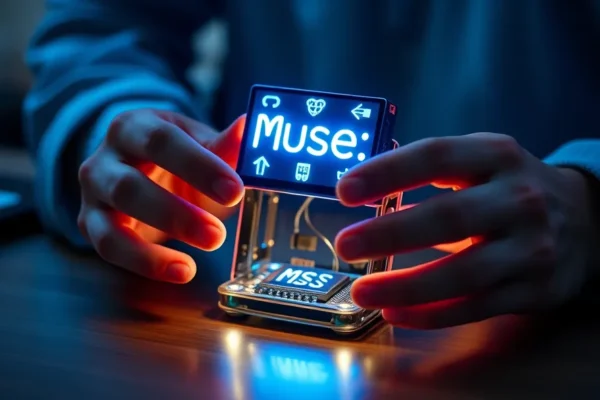
Unlocking a New Era of DIY AI Gadgets with Meta’s Open Source Muse AI
Meta has recently opened a door for creators and developers worldwide by open-sourcing key components of its Muse AI project. This move allows enthusiasts to build their own custom AI gadgets, blurring the lines between sophisticated artificial intelligence and accessible, do-it-yourself electronics. The goal is to democratize AI development, enabling individuals to experiment with and deploy AI agents in novel ways. This initiative signifies a growing trend towards making advanced AI tools more readily available, fostering a community of innovation and personalized technology.
How Meta’s Muse AI Works for Your Gadgets
At its heart, Muse AI is a framework that helps AI agents understand and interact with their environment. Think of it like giving a digital assistant a set of senses and a brain that can process what it sees, hears, and learns. The open-sourced code provides the building blocks for these agents, allowing them to perform complex tasks, from recognizing objects in an image to generating coherent text responses.
For DIY electronics, this means developers can integrate these AI capabilities into devices powered by common microcontrollers like the ESP32 or more powerful single-board computers such as the Raspberry Pi. These devices, often equipped with peripherals like cameras, microphones, or specialized displays like E Ink screens, can then become intelligent agents. For instance, an AI agent could be programmed to monitor a plant’s health by analyzing images from a camera and then display a simple alert on an E Ink display. Another application could involve creating a smart home assistant that responds to voice commands processed by the AI. The HDMI stick format also suggests potential for easy integration with existing displays, turning any monitor into an AI-powered interface. The touchscreen device aspect points towards interactive AI experiences, allowing users to directly engage with the AI’s capabilities.
Real-World Experiments and Early Access
While Muse AI is an emerging technology, the open-sourcing of its components is making it available for experimentation right now. Developers and hobbyists are already beginning to integrate these AI models into their projects. Early applications are focused on creating personalized AI companions, smart monitoring systems, and interactive educational tools. Imagine a small robot that can learn to navigate a room and report obstacles, or a wearable device that provides context-aware information based on the user’s surroundings. The availability of the code means that anyone with a passion for technology can start building, moving beyond theoretical concepts to tangible AI gadgets.
The Growing Open Source AI Landscape
Meta’s contribution places Muse AI within a broader ecosystem of open-source AI initiatives. Companies and research institutions are increasingly releasing their AI models and frameworks to the public. Competitors in this space include Google’s TensorFlow and PyTorch, which provide foundational tools for building and training AI models. However, Muse AI distinguishes itself by focusing on creating adaptable AI agents designed for real-time interaction and deployment on resource-constrained devices. This emphasis on agentic behavior and hardware compatibility sets it apart from more general-purpose AI development platforms. The advantage of Meta’s approach lies in its potential to simplify the creation of intelligent, responsive devices for a wider audience.
Transforming Our Relationship with Technology
The ability to build custom AI gadgets has profound implications. It could lead to a surge in personalized technology, where devices are tailored to individual needs and preferences. Industries such as education, healthcare, and entertainment could see innovative applications emerge, from AI tutors that adapt to a student’s learning style to smart diagnostic tools that assist medical professionals. Economically, this could spur a new wave of hardware startups and empower independent developers. Socially, it promises greater user control over technology and the potential for AI to augment human capabilities in more meaningful ways. In the short term, we will likely see a rise in creative DIY projects and niche applications. In the long term, this could reshape how we interact with our environment, making technology more integrated and intuitive.
Navigating the Current Hurdles
Despite the exciting potential, there are limitations. Developing sophisticated AI requires significant computational power and specialized knowledge. While Muse AI simplifies aspects of AI agent creation, integrating it effectively into hardware still demands expertise in electronics and programming. The performance of AI models on smaller devices like the ESP32 can be constrained, leading to slower response times or less complex capabilities compared to cloud-based AI. Furthermore, ethical considerations surrounding AI, such as data privacy and algorithmic bias, remain critical challenges that need to be addressed as these custom gadgets become more prevalent. The current state is largely one of experimentation and early adoption, with mainstream consumer products still some way off.
The Path Forward for DIY AI
The future trajectory of Muse AI and similar open-source initiatives points towards more accessible AI development. We can expect to see advancements in optimizing AI models for lower-power devices, making them even more suitable for embedded systems and wearables. Further development of user-friendly interfaces and tools will likely lower the barrier to entry for non-experts. Research into more efficient AI learning algorithms will also play a crucial role. The timeline for widespread adoption of complex DIY AI gadgets is still uncertain, but the foundational work being done now suggests a gradual but steady increase in sophisticated, personalized AI devices over the next few years.
Your Questions About Muse AI Gadgets Answered
What exactly are Muse AI gadgets?
Muse AI gadgets are custom-built electronic devices that incorporate artificial intelligence capabilities, powered by Meta’s open-sourced Muse AI framework. They are designed for creators and hobbyists to build their own intelligent devices.
How can I start building with Muse AI?
To start, you would typically need some basic electronics knowledge, a development board like an ESP32 or Raspberry Pi, and access to the Muse AI open-source code. Many online communities and tutorials are emerging to guide you through the process.
Is this technology ready for everyday consumers?
Currently, Muse AI gadgets are more for enthusiasts and early adopters. While the code is available, creating functional and robust AI gadgets requires technical skill and ongoing development. Mainstream consumer readiness is a future milestone.
What are the advantages of using Meta’s open source code?
Using Meta’s open source code for Muse AI allows for greater customization, lower development costs, and fosters a collaborative environment for innovation. It democratizes access to advanced AI technologies.
What are the biggest challenges in creating DIY Muse AI gadgets?
Key challenges include balancing AI processing power with the capabilities of small, embedded hardware, optimizing for energy efficiency, and ensuring the AI performs reliably and ethically in real-world scenarios.
When can we expect to see more advanced Muse AI gadgets in the market?
While many innovative DIY projects are possible now, widespread commercial availability of advanced Muse AI gadgets is likely several years away. The pace of development in both AI and hardware will dictate this timeline.
This article is based on publicly available information regarding Meta’s Muse AI project and general trends in open-source AI development. Specific capabilities and timelines are subject to ongoing research and development.